
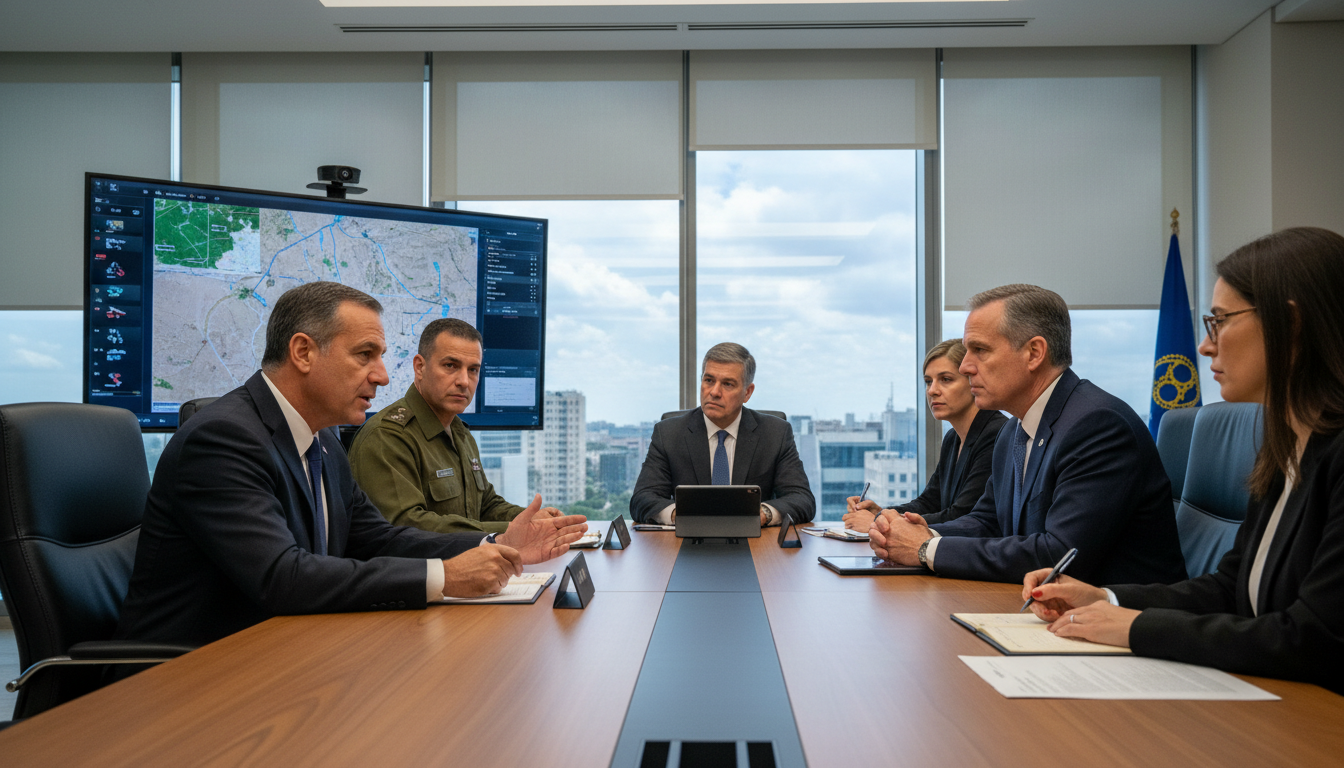
Israel Ready to Return to War on Iran, Official Says Pending U.S. Approval
Senior Israeli official tells Kan Israel is ready to return to war on Iran with US approval as nuclear talks stall and U.S. and Israeli statements diverge.
A senior Israeli official told the Israeli Broadcasting Corporation (Kan) that Israel is prepared to return to war on Iran, but only with the explicit approval of the United States. The statement, relayed by Kan, said no final agreement has been reached between Washington and Tehran on the nuclear file and that Israeli authorities are awaiting further developments. The official framed Israel’s stance as conditional on U.S. consent, underscoring deep sensitivity to American diplomatic and military posture.
Kan report and official wording
Kan attributed the comments to a “senior” Israeli figure who did not identify themselves by name.
The official was quoted as saying Israel would be ready to resume military action against Iran “with the approval of the Americans,” framing the decision as a coordinated, allied choice rather than a unilateral move.
Kan’s reporting emphasized both the conditional nature of the threat and the absence, according to that source, of a settled diplomatic resolution between Washington and Tehran.
Contradictory U.S. statements earlier the same day
The Kan report contrasted with a statement attributed to U.S. President Donald Trump earlier the same day, in which he said an agreement with Iran would be signed in Pakistan.
That comment, as cited in the source material, appeared to signal confidence in an imminent diplomatic breakthrough that the Israeli official said had not materialized.
The disparity between the two messages highlights a gap in public signals from allied capitals regarding the status of nuclear negotiations.
Status of U.S.-Iran nuclear talks, per the Israeli source
According to the Kan-sourced account, the senior Israeli official insisted that, to date, there has been no comprehensive agreement on the nuclear dossier.
The official said parties “are not close” to reaching a deal, and that Israel and others are effectively waiting on further moves by Washington.
The remarks implied that, in Israel’s view, unresolved elements of the negotiations keep the region on edge and leave military options on the table as a contingency.
Regional security implications of a renewed Israeli offensive
If Israel were to seek U.S. approval and ultimately resume hostilities against Iran, the security consequences would extend across the Middle East.
Military action targeting Iran could prompt direct responses from Iranian forces or allied militias in Lebanon, Syria, Iraq and Yemen, raising the prospect of wider escalation.
Analysts say any exchange of strikes would also complicate regional energy flows and heighten diplomatic pressure on neighbouring Gulf states, including those in the UAE, to navigate competing security and economic interests.
U.S. role and international diplomatic considerations
The Israeli official’s insistence on U.S. approval underscores Washington’s central role in any decision to use force against Iran.
Securing American consent would likely require briefings to Congress, consultations with NATO partners and assessment of the legal and strategic ramifications of renewed military action.
International actors, from European capitals to Gulf governments, would be closely watching for signs of coordination or divergence among Israel and its allies.
Military posture and potential operational choices
The phrase “return to war” used in the Kan reporting suggests a broad range of potential military options rather than an immediate, single course of action.
Those options could include targeted strikes on Iranian nuclear facilities, strikes against proxy forces, cyber operations or an intensification of aerial and naval deployments in the region.
Military planners would face complex trade-offs between degrading perceived threats and avoiding uncontrolled escalation that could draw multiple states into conflict.
The account reported by Kan and cited in this item presents a snapshot of heightened uncertainty: an Israeli official signalling conditional readiness for military action, U.S. comments suggesting progress, and no clear on-the-record confirmation of a comprehensive deal with Iran. As diplomatic efforts continue and public statements diverge, governments and observers in the UAE and across the region will be monitoring official channels closely for any shift in alignment or authorization that could alter the security landscape.
