
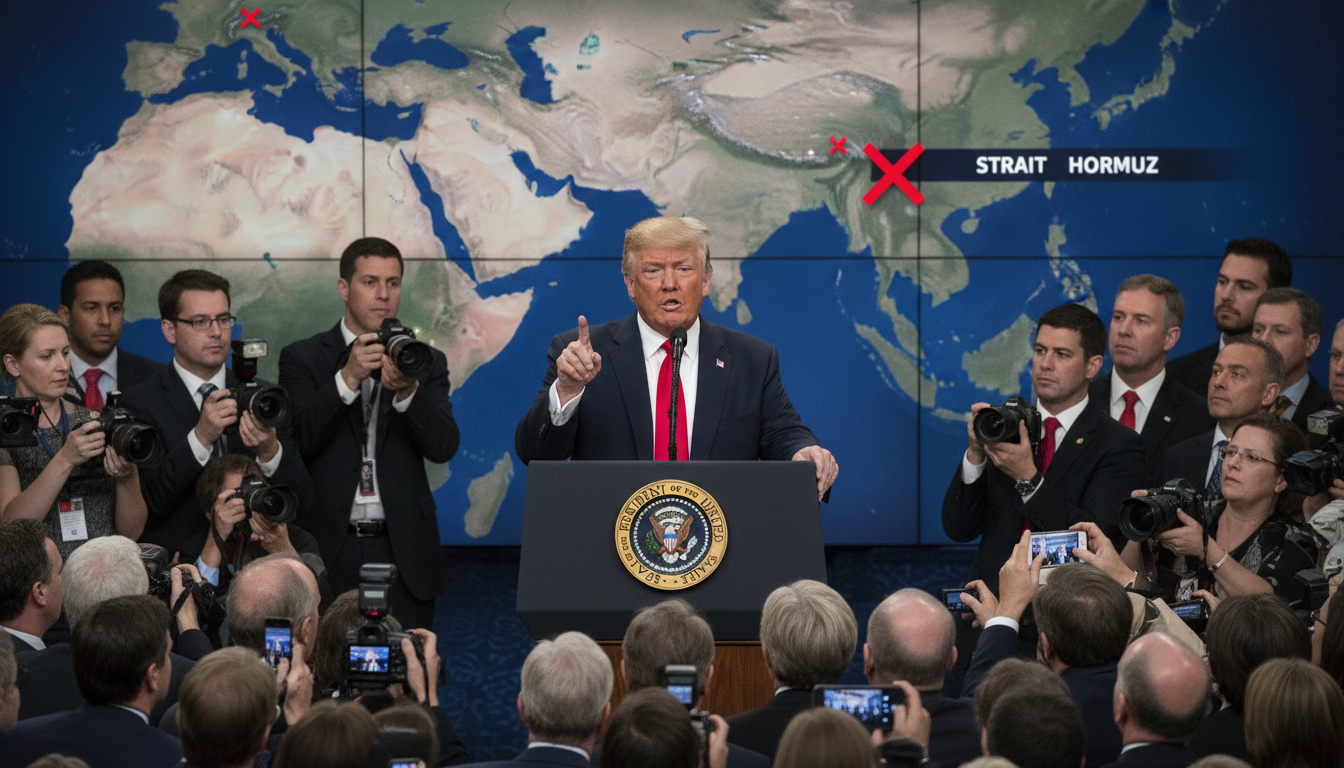
Trump Says Iran’s Nuclear Labs Destroyed as He Claims Strait of Hormuz ‘Under Control’
Trump claimed Iran’s nuclear labs and naval forces were destroyed and the Strait of Hormuz sealed, while a ceasefire is extended pending an Iranian proposal.
Trump’s Statement on Iran’s Nuclear Facilities
President Donald Trump posted on Truth Social that Iran’s nuclear laboratories and storage facilities have been “completely destroyed.”
He framed the strikes as decisive and comprehensive, saying Tehran’s capacity to sustain or hide nuclear materials had been eliminated.
The post also asserted that Iranian naval and air capabilities had been neutralized in parallel operations.
Allegations Regarding Iranian Naval and Air Forces
Mr. Trump wrote that Iran’s entire naval fleet was “sunk in the sea” and that its air force had collapsed.
He added that Iranian air defenses and radar installations were destroyed, describing a broad degradation of Tehran’s military posture.
These characterizations were presented as part of a single, coordinated campaign affecting multiple military domains.
Control of the Strait of Hormuz and Maritime Restrictions
The president claimed the Strait of Hormuz was “completely blockaded and under our control,” with orders that no vessel would be permitted to reach Iranian ports.
He framed the maritime posture as a secure perimeter intended to prevent resupply or escape by sanctioned Iranian units and materiel.
Such assertions, if accurate, would represent a major shift in the security dynamics of a waterway critical to global energy shipments.
Ceasefire Extension and Demand for an Iranian Proposal
Mr. Trump announced an extension of a ceasefire until Iran delivers a formal proposal and negotiations conclude.
He described the pause as conditional, saying the extension was granted to allow Iranian leaders to present a unified offer for ending hostilities.
According to his post, the pause will remain in effect only while talks continue and a satisfactory Iranian proposal is under consideration.
Pakistan’s Role in Requesting a Delay
In his post, Mr. Trump said the decision to delay further attacks followed a request from Pakistan, which sought time for its leaders and Iranian representatives to reach consensus.
He suggested the Pakistani intervention was instrumental in securing the temporary halt and framed it as a diplomatic opening.
The president did not provide details on Pakistan’s specific proposals or the nature of its mediation efforts.
U.S. Military Orders and State of Readiness
The president indicated he had ordered U.S. forces to maintain the maritime blockade and remain on high alert and ready to move.
He emphasized that troops and assets would sustain their posture until political developments determined a different course.
The public message stressed continued operational readiness as a deterrent while negotiations were underway.
Verification and Regional Implications
There has been no independent verification presented alongside the president’s claims regarding the destruction of sites, ships, or air defenses.
Analysts note that claims of such scale typically require corroboration from satellite imagery, on-the-ground reports, or statements from other governments to confirm their accuracy.
If substantiated, the actions described would have significant implications for regional security, trade through the Gulf, and diplomatic relations involving Gulf states.
The president’s posts combined military assertions with diplomatic timelines, making the next 48 to 72 hours critical for clarifying whether Iran will submit the proposal Mr. Trump outlined.
Regional capitals and international shipping operators will be watching developments closely for signs of escalation or de-escalation affecting commercial traffic through the Gulf.
For now, the situation rests on official statements from the U.S. and any response from Tehran and intermediary actors such as Pakistan, which Mr. Trump said had asked for a pause.
The claims remain subject to verification and the international community awaits further details that could confirm or contradict the president’s account.
