
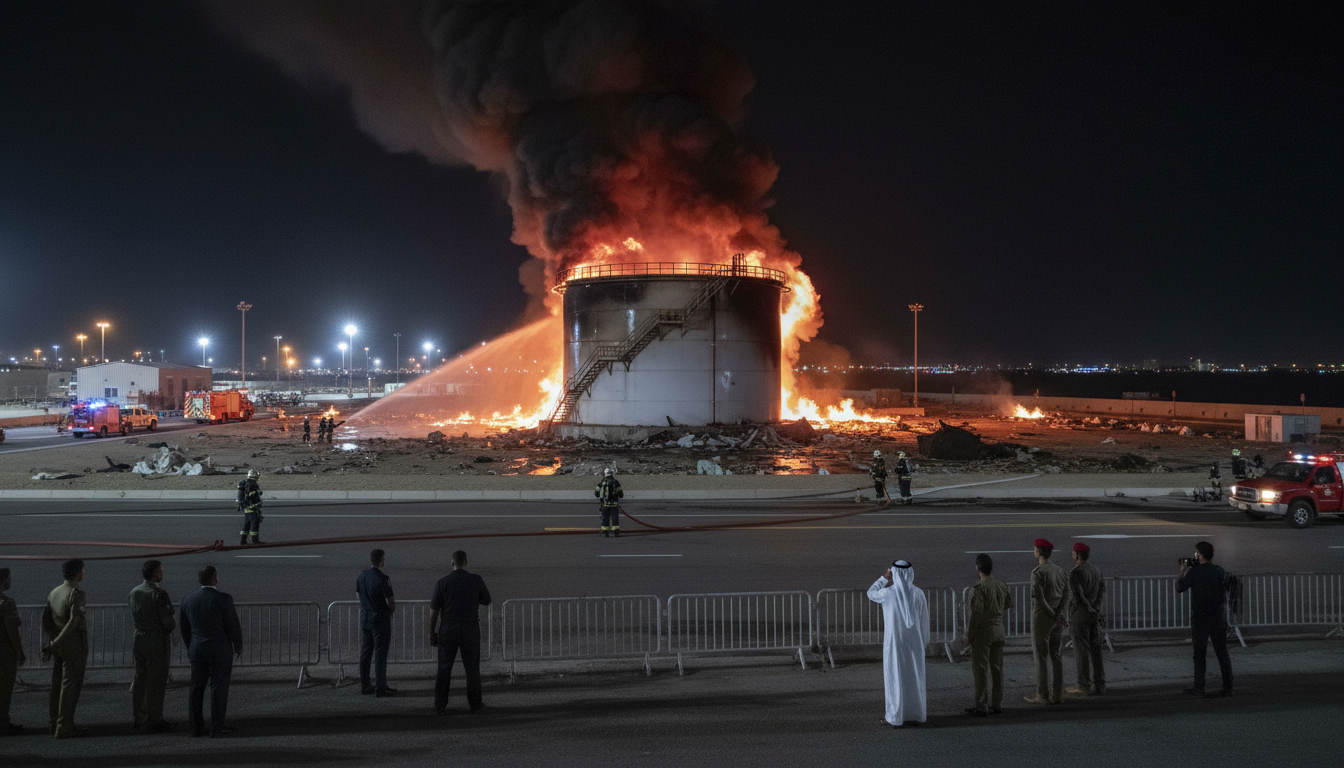
Iran Strikes Fujairah Petroleum Site Days After UAE Announces OPEC Exit
Iran struck a petroleum site in Fujairah on May 5, 2026, days after the United Arab Emirates announced plans to leave OPEC, raising fresh concerns over energy security in the Gulf. The Fujairah petroleum site attack has sent oil prices higher and deepened fears about the safety of shipping and facilities near the Strait of Hormuz.
Attack in Fujairah Hits Petroleum Infrastructure
The strike targeted a commercial petroleum facility in Fujairah, authorities reported, causing damage to storage and handling infrastructure but no immediate confirmation of major casualties. Local emergency teams moved quickly to contain fires and secure the site while investigators assessed the extent of material losses.
Regional officials described the assault as a deliberate blow to energy infrastructure, noting that Fujairah hosts significant bunkering and storage capacity outside the Strait of Hormuz. The timing and target have prompted international attention given the port’s role in global oil logistics.
Timing Follows UAE Exit from OPEC
The incident occurred days after the UAE declared its intention to leave OPEC, a move that has already reshaped diplomatic and market calculations across the Gulf. Observers say the proximity of the attack to that political shift has elevated concerns about deliberate strategic signaling amid shifting alliances.
UAE authorities have not publicly linked the departures from OPEC to the attack, but analysts point to the broader geopolitical reverberations of a major Gulf producer repositioning itself. The overlap of political realignment and security incidents underscores an increasingly complex regional environment for energy producers.
Strait of Hormuz Security Concerns Rise
Security experts warn the attack could exacerbate tensions around the Strait of Hormuz, a critical chokepoint through which a large share of the world’s seaborne oil passes. Any perception of vulnerability along nearby ports or shipping lanes risks disrupting tanker traffic and increasing insurance and shipping costs.
Regional navies and international partners have stepped up surveillance and convoy planning in recent weeks, driven by a string of incidents that analysts say are testing deterrence measures. For commercial operators, the calculus now increasingly factors in route risk and the potential for spillover disruptions.
Market Reaction and Rising Oil Prices
Global oil benchmarks responded promptly, with traders pricing in greater risk premiums after news of the Fujairah strike. Markets moved higher as participants weighed the potential for supply interruptions against existing spare capacity and inventories.
Refiners and trading houses are monitoring shipping alternatives and storage logistics, while sovereign and private holders assess the need for short-term adjustments. Economists caution that sustained volatility could push longer-term inflationary pressure onto fuel and transport sectors if attacks persist.
Regional Responses and UAE Measures
UAE federal and local authorities announced heightened security measures around petroleum facilities and ports, mobilizing civil defense and security assets to protect critical infrastructure. Officials said contingency plans include rerouting shipments, accelerating inspections, and coordinating with international partners to secure maritime approaches.
Diplomatic channels are reported to be active as regional governments seek clarity and potential de-escalation. In recent days, defence and foreign ministry officials have exchanged calls with counterparts in neighbouring states and with trading partners to coordinate responses and share intelligence.
Expert Analysis: Energy Transition or Greater Volatility?
Energy analysts differ on whether incidents like the Fujairah petroleum site attack will accelerate the shift to renewables or strengthen investments in fossil-fuel resilience. Jim Krane, co-director of the Middle East Energy Roundtable at Rice University’s Baker Institute, noted that security-driven price spikes can both prompt government support for diversification and justify near-term investment in protective measures around hydrocarbon assets.
Some policy-makers may use the episode to argue for faster deployment of domestic solar, storage and grid upgrades, while others focus on shoring up supply chains and strategic reserves. The immediate policy choices will shape whether the region tilts toward faster clean-energy adoption or toward strengthened conventional energy security.
The incident also raises questions about insurance, financing and private-sector risk appetites in the Gulf energy sector. Lenders and investors are recalibrating risk models to account for geopolitical disruptions, which could affect project timelines and the cost of capital for both fossil and renewable projects.
Looking ahead, the Fujairah attack is likely to remain a pivotal point in debates over Gulf energy strategy, maritime security and the pace of the global transition away from oil.
The coming weeks will test the resilience of Gulf supply networks and the effectiveness of regional coordination in preventing further attacks, and will influence whether this episode becomes a short-lived shock or a catalyst for longer-term policy shifts in energy and security planning.
