
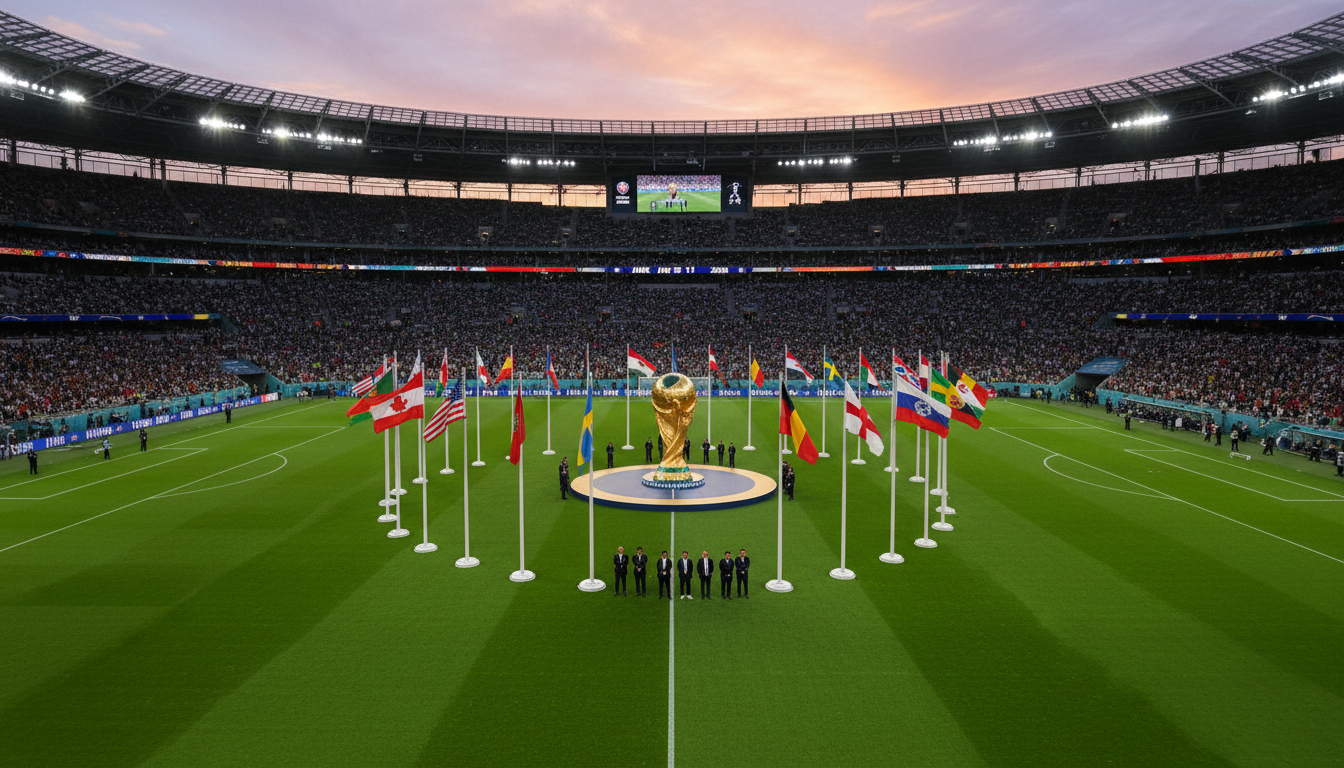
FIFA World Cup 2026: Full groups, schedule, debut nations and stadium renames for the 48‑team tournament
Guide to FIFA World Cup 2026 – groups, debut nations, full schedule, stadium renames and key dates for the 48-team tournament across USA, Canada, Mexico.
48 teams, 16 venues and a 39-day schedule
The FIFA World Cup 2026 will be the largest in the competition’s history, featuring 48 national teams competing across 16 venues in Canada, Mexico and the United States over 39 days. The expanded tournament comprises 104 matches beginning on June 11 and concluding with the final on July 19. Organisers describe the event as a continental staging, with Mexico hosting the opening match and New Jersey hosting the final under the tournament-era name New York New Jersey Stadium.
The event returns to North America after 32 years and introduces a new knockout structure that expands opportunities for more nations to advance. The schedule is tightly packed, with the group phase running from June 11 to June 27 followed immediately by a round of 32 that ushers in the expanded knockout rounds. Fans should expect multiple double‑header days and a wide geographic spread that will test travel plans for supporters and teams alike.
Groups revealed with notable matchups and four debutants
The tournament draw produced 12 groups of four teams, setting up headline fixtures and regional interest across the three hosts. Traditional powers appear in challenging pools, including Brazil with Morocco, Haiti and Scotland, and Argentina facing Algeria, Austria and debutant Jordan in Group J. The United States open in Group D alongside Paraguay, Australia and Turkiye.
Four countries will make their World Cup debuts in 2026: Cape Verde, Curacao, Jordan and Uzbekistan. Their presence increases representation from regions that have long sought World Cup inclusion and adds fresh storylines to the group-stage narrative. Several groups contain high-profile rematches from recent tournaments, guaranteeing attention from global broadcasters and local supporters.
Opening match in Mexico City and final at New York New Jersey Stadium
The tournament will kick off on June 11 at Mexico City Stadium with Mexico taking the field at 3pm local time, marking the start of a transnational tournament calendar. The final is scheduled for July 19 at the venue known during the event as the New York New Jersey Stadium, with kickoff set at 3pm local time. Organisers have mapped a progression of stages so that climactic matches are staged in major metropolitan centres across the United States.
Between the opening and the final, 16 host cities will stage group and knockout matches, including Toronto, Vancouver, Guadalajara, Dallas, Los Angeles, Houston, Miami, Philadelphia, Atlanta, Boston, Seattle, Kansas City and others. That distribution was designed to maximise stadium readiness and fan access while balancing the commercial and logistical demands of a three‑country event.
New knockout structure begins with a round of 32
For the first time at the men’s World Cup, the knockout phase will begin with a round of 32 rather than a round of 16, reflecting the tournament’s enlargement to 48 teams. The schedule places the round of 32 from June 28 to July 3, followed by the round of 16 from July 4 to July 7, and quarterfinals across July 9 to July 11. Semifinals are set for July 14 and 15, with a bronze medal match on July 18 and the final on July 19.
This structure is intended to deliver more knockout football and greater commercial value, but it also compresses team recovery windows and travel demands. National associations and coaching staffs will need to manage rotation carefully, and broadcasters will have a heavier slate of live knockout content to programme over a 22‑day knockout span.
Key match dates and schedule highlights fans should note
The group stage features several high‑profile fixtures in the opening weeks, including Brazil versus Morocco, France versus Senegal, Spain versus Saudi Arabia and Argentina’s group matches which are likely to attract global audiences. Group play concludes on June 27, with the first knockout matches taking place the following day. Notable date markers include the quarterfinal window on July 9–11 and the semifinals on July 14–15.
Match timings vary by host city and local time, with a number of evening kickoffs arranged for North American prime time and some fixtures scheduled to accommodate international viewership. Supporters planning travel should consult official match tickets and team itineraries for changes, and expect logistics updates from national federations as the tournament approaches.
Stadium rebranding implemented to prevent ambush marketing
FIFA has implemented temporary name changes at several venues to curtail ambush marketing and align with tournament sponsorship arrangements. Under that policy, commercial stadium names have been replaced with neutral host‑city descriptors for the duration of the World Cup, with MetLife Stadium referred to as New York New Jersey Stadium and SoFi Stadium cited as Los Angeles Stadium in official materials. The move is designed to protect authorised partners and maintain a consistent commercial environment across all match sites.
The rebranding affects signage, broadcast references and promotional material during the event, though local and historical naming conventions will remain familiar to fans and residents. Host cities and stadium operators have cooperated with FIFA to implement the temporary changes while preserving the fan experience and operational readiness for every match.
Tickets, broadcasting plans and travel logistics will continue to evolve as team confirmations are finalised and operational details are refined. Supporters are advised to follow announcements from their national associations and official tournament channels for the most up‑to‑date information on match access and stadium protocols.
The FIFA World Cup 2026 promises a busy summer of football with expanded participation, new markets and an altered competition structure that together create a distinct chapter in the tournament’s history.
