
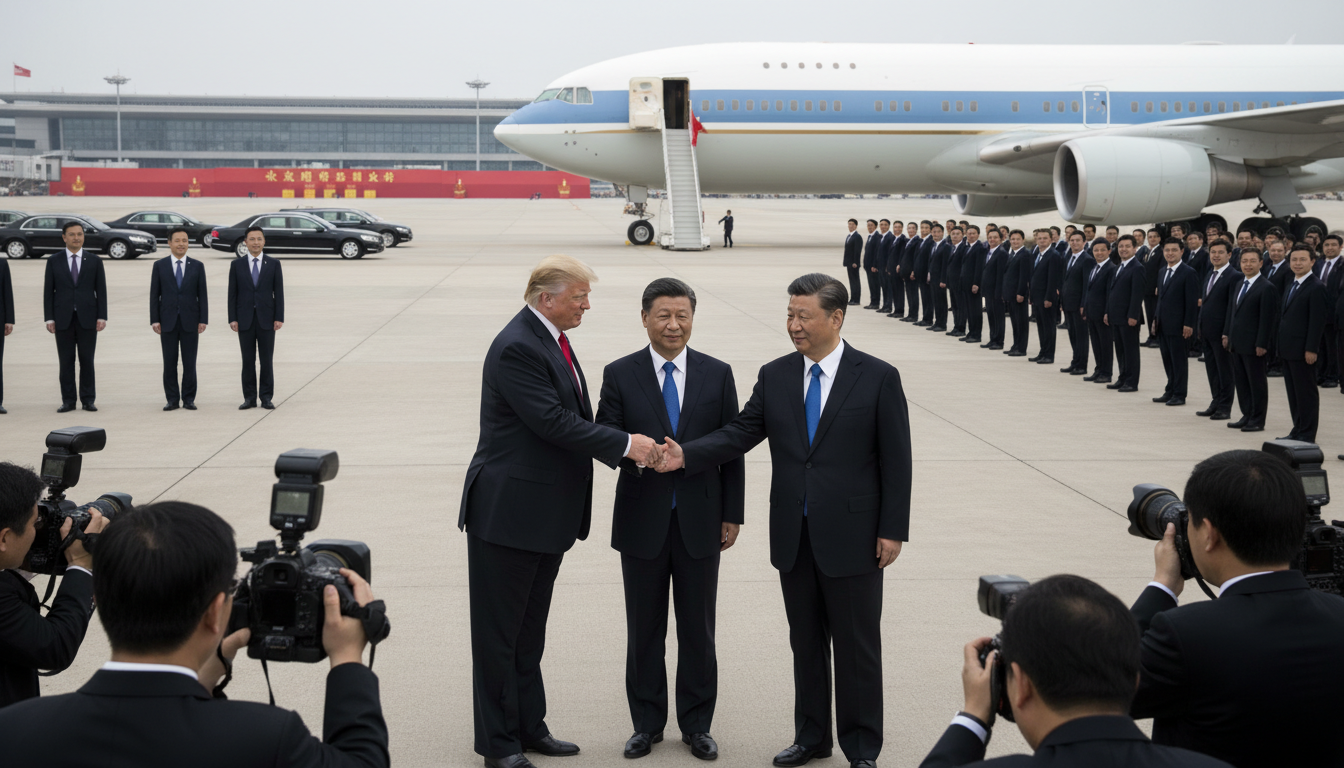
Trump visit to Beijing begins with talks on Iran and trade
President Donald Trump arrived in Beijing to meet Xi Jinping, joined by US business leaders to discuss Iran, trade ties and expanded economic cooperation.
President Donald Trump landed in Beijing on an official visit to hold “lengthy talks” with Chinese President Xi Jinping, kicking off diplomacy focused on the war with Iran and bilateral trade. The Trump visit to Beijing began in the evening when the presidential aircraft touched down around 19:50 local time (11:50 GMT). Chinese officials publicly welcomed the delegation and signalled readiness to expand cooperation while managing disagreements.
Arrival and official welcome
The presidential plane arrived amid formal preparations and media attention, marking what reports described as the first visit by a U.S. president to China since November 2017. Beijing’s foreign ministry conveyed a public welcome, with a spokesperson saying China is prepared to work with the United States to widen cooperation and address contentious issues. The visit is scheduled to include high-level meetings Thursday and Friday and a state banquet in the Great Hall of the People.
Security and ceremonial teams coordinated arrival procedures at the airport and on routes to the capital, with local authorities deploying additional checkpoints. Officials said the reception will feature customary protocol and public-facing events meant to underscore the bilateral dialogue.
Talks to focus on Iran and security
U.S. and Chinese leaders are expected to prioritise discussions over the ongoing conflict involving Iran, according to comments made by President Trump before departure. Trump told reporters he would press Xi on Tehran’s actions and Iran’s oil exports, which remain a key lever in international pressure strategies. He indicated he would seek assurances that China would not provide new support that could undermine U.S. sanctions or escalate the maritime confrontation centred on the Strait of Hormuz.
Analysts say the Iran agenda will test the two countries’ ability to reconcile strategic competition with crisis management. Observers expect detailed exchanges on regional stability, sanctions enforcement and measures to prevent miscalculation amid heightened tensions.
Trade, investment and corporate presence
The Trump visit to Beijing has drawn an unusually large U.S. business delegation, underlining the economic dimension of the trip. Senior executives travelling with the president include NVIDIA chief Jensen Huang and Tesla and SpaceX CEO Elon Musk, with Apple’s Tim Cook also among those accompanying the delegation. Their presence signals an emphasis on trade, technology cooperation and opportunities for American companies in the Chinese market.
Officials and business leaders are expected to combine private meetings with public messaging aimed at creating space for commercial engagement. Washington has framed parts of the visit as an effort to “open” markets and encourage regulatory access that would allow U.S. firms to expand operations and innovation activities in China.
Presidential messaging and objectives
Before departure, President Trump posted on social media urging President Xi to “open” China to allow talented individuals and companies to contribute to growth in the People’s Republic. He framed the visit as constructive and said he and Xi have a personal rapport that should yield productive outcomes. Trump also stressed that he does not expect China to provide assistance to Iran, reiterating his administration’s position on sanctions and maritime security.
Chinese officials have responded with diplomacy-focused statements highlighting mutual interests and the need to manage differences. The bilateral talks will therefore balance public-facing trade and investment commitments with sensitive security negotiations.
State programme and official events
The official programme includes a formal dinner in the Great Hall of the People and a series of bilateral meetings designed to cover both high-stakes security topics and economic cooperation. State-level ceremonies are intended to project respect for protocol while enabling substantive negotiation in private sessions. The itinerary spans two days and aims to produce at least a framework for follow-up on specific trade and security issues.
Planned events will also provide opportunities for U.S. business leaders to meet Chinese counterparts and for both governments to announce cooperative initiatives or joint statements. Organisers say the mix of protocol and working sessions reflects a diplomatic effort to stabilise ties while advancing national priorities.
Security measures and city preparations
Beijing visibly tightened security ahead of the summit, with checkpoints placed at major intersections and identity checks reported at some metro stations, according to journalists on the ground. The heightened policing and movement monitoring aim to ensure the safety of visiting delegations and maintain public order during high-profile events. City authorities have also managed traffic plans and restricted access along key ceremonial routes.
Local media coverage and correspondent reports noted a significant security footprint in central districts where official functions will take place. Officials described the measures as routine for a visit of this scale and reassured the public that disruptions would be limited.
The coming days will test whether the mix of diplomatic theatre, commercial engagement and crisis-driven security talks can produce concrete outcomes on Iran and trade. Observers will watch for any joint statements or agreements from the meetings, and for signals about how both capitals intend to manage competition while preserving channels for cooperation.
