
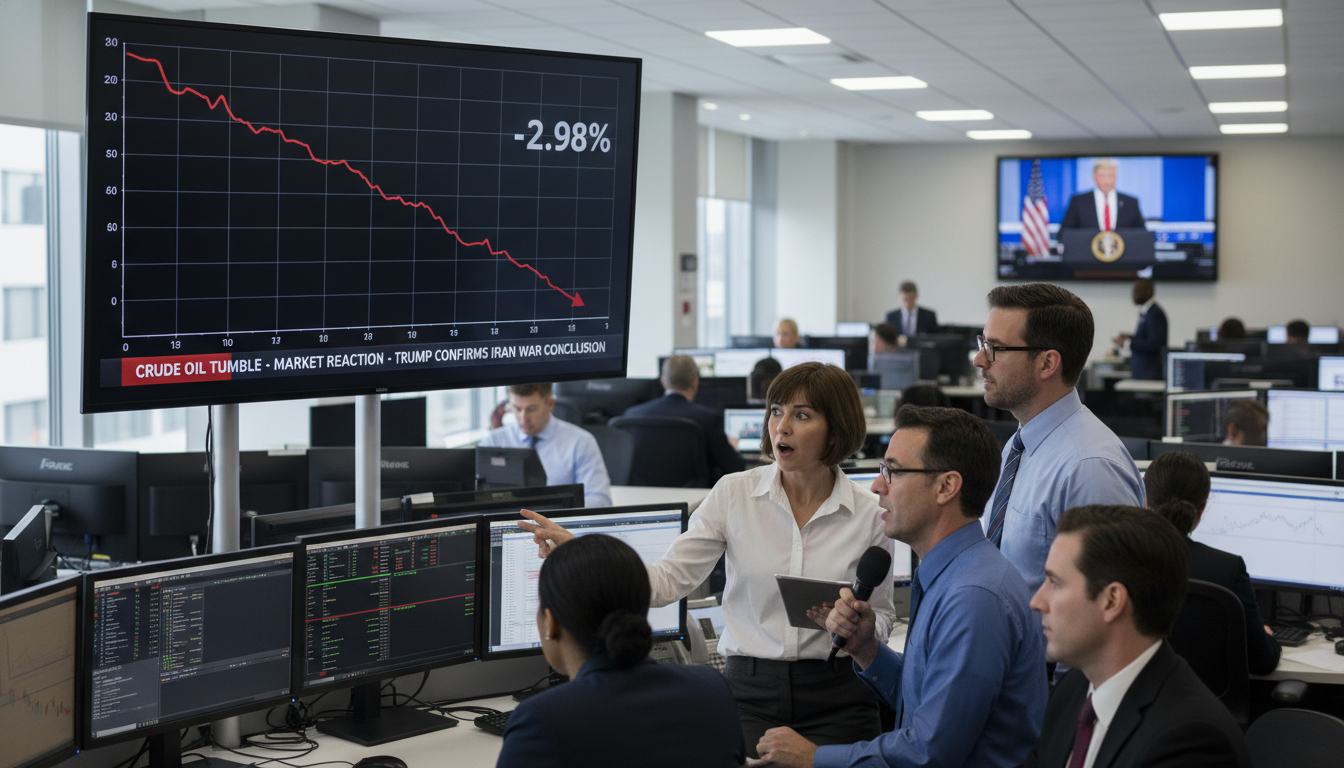
Oil prices tumble nearly 3% after US president’s Iran remarks amid persistent supply concerns
Oil prices fell about 3% after US President Donald Trump said a war with Iran would end “very quickly”, as Brent dropped to $108.31 and WTI to $101.46 while markets weighed supply risks.
Markets React to Presidential Remarks
The oil market moved sharply after President Trump reiterated that any conflict with Iran would be short-lived, a comment that eased some immediate geopolitical fears. Traders took the remarks as a signal that large-scale, sustained military disruption might be unlikely, prompting a wave of selling across energy contracts. Despite the pullback, market participants remained cautious because physical supply routes in the Middle East are still disrupted.
Brent and WTI Price Moves
Brent futures fell $2.97, or about 2.7 percent, to $108.31 a barrel at 10:59 GMT, while US West Texas Intermediate lost $2.69, or roughly 2.6 percent, to $101.46 a barrel. Both benchmarks registered their sharpest single-day percentage and absolute declines in roughly two weeks as sellers seized on the de-risking signal. The sudden drop trimmed paper-market premiums but did not remove concerns about actual crude flows.
Short-Term Volatility and Trading Patterns
The rapid decline reflected a classic short-term volatility response to shifting geopolitical headlines, with traders rebalancing positions after comments from Washington. Volatility remains elevated, and the speed of the move underscores how sensitive oil prices are to statements from senior US officials. Market liquidity has been uneven, amplifying price swings when large orders hit the books.
Analysts Warn of Lingering Supply Pressure
Analysts cautioned that any downward move may be temporary because physical supply is unlikely to return to pre-crisis levels immediately. A London Stock Exchange Group analyst noted that even if an agreement or de-escalation is reached, logistical and production lags mean the market retains upside risk. Citigroup strategists have suggested Brent could rise back toward $120 a barrel in the near term, while consultancy Wood Mackenzie warned prices might approach $200 a barrel if the Strait of Hormuz remains largely closed through year-end.
Geopolitical Developments and Diplomatic Signals
The price action followed reports that US political figures indicated progress in talks with Iran, while President Trump also said the United States might have to strike again and described a narrowly averted strike he considered issuing. Such mixed signals — a mixture of conciliatory and warning rhetoric — have kept traders divided over the path of future supply disruptions. Until there is a clear, verifiable improvement in regional shipping and production, geopolitical risk will continue to cast a long shadow over the market.
Structure of the Forward Curve and Risk Premiums
Market structure showed a marked narrowing in the Brent calendar spread, with the gap between next-month delivery and contracts six months out around $20 a barrel, down from more than $35 at its recent peak. That tightening suggests some easing of immediate forward premium, but the level still reflects significant near-term risk compared with historical norms. Oil desks said the market is moving from acute panic-driven premiums toward a more measured risk allocation, though the contango remains markedly steeper than in normal cycles.
Markets will watch shipping lanes, OPEC+ signals and US policy moves closely in the coming days and weeks. The interplay between headline-driven short-term moves and underlying supply constraints means oil prices could swing sharply again if fresh intelligence or diplomatic breakthroughs emerge.
Oil prices may have retreated on the latest comments, but traders and analysts agree that structural factors — interrupted exports, refinery adjustments and geopolitical uncertainty in the Gulf — continue to support elevated price levels until flows and inventories visibly normalize.
