
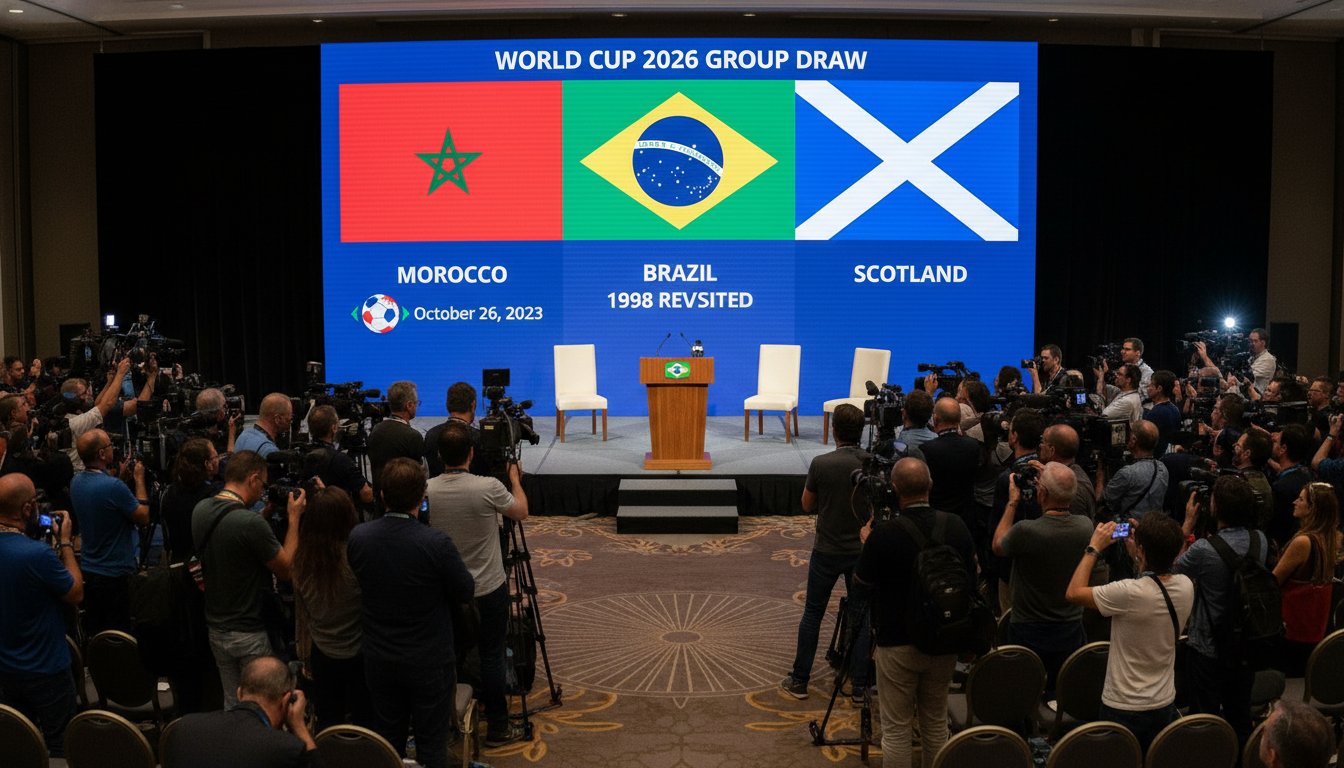
Morocco, Brazil and Scotland Drawn Together in World Cup 2026 Group, Echoing 1998
Morocco, Brazil and Scotland drawn in the World Cup 2026 group echoing 1998 — rising Morocco, Brazil’s reclamation bid and Scotland’s long-awaited return.
The World Cup 2026 group that pairs Morocco, Brazil and Scotland has reignited memories of the 1998 draw while presenting a markedly different competitive landscape. The match-up brings together teams at distinct moments in their football histories, setting up a group where precedent matters less than present form. Expectations will be recalibrated on the pitch as each nation arrives with different ambitions and resources.
Draw rekindles a three-way narrative from 1998
The grouping immediately recalled the 1998 tournament when the same three nations found themselves in the same pool, a coincidence that fuels headlines and fan interest. That year ended with dramatic twists and late goals that shaped fortunes, but 2026 introduces new contexts and new stakes. Fans and pundits are keen to see whether history will offer a repeat or whether modern dynamics will produce an entirely different script.
Morocco’s ascent reshapes the group dynamic
Morocco enters the World Cup 2026 group with the confidence of a nation that has recently redefined itself on the global stage. The team’s deep run at the 2022 tournament transformed perceptions, moving Morocco from a respected underdog to a serious contender with tactical discipline and depth. That evolution means opponents can no longer treat Morocco as a mere obstacle to be circled on the calendar.
Brazil faces pressure to reclaim past glory
Brazil remains football’s most storied nation and brings vast history into the World Cup 2026 group, but recent decades have been mixed by the standard of its own legacy. The Selecao’s supporters expect a return to dominance after the last world title eluded them since 2002, placing extra emphasis on identity and results. With a blend of emerging talent and established figures, Brazil will be judged on whether it can translate pedigree into tournament control.
Scotland returns with experience and renewed purpose
Scotland’s presence in the World Cup 2026 group marks a long-awaited return after nearly three decades away from the global finals. That absence has given way to a squad combining experience, cohesion and a determination to make an impression on the world stage. For Scotland, the draw represents both a challenge and an opportunity to establish itself beyond the role of historical participant.
Tactical contrasts promise an open and unpredictable group
On paper, the trio offers contrasting styles: Morocco’s organized defense and quick transitions, Brazil’s technical creativity and fluid attack, and Scotland’s resilience and set-piece strengths. Those contrasts create tactical puzzles for coaches and scouting teams, and they make match outcomes difficult to predict before the first whistle. The lack of a clear favorite increases the likelihood of surprise results and a tightly contested group table.
Commercial, sporting and national significance of the draw
Beyond the immediate sporting implications, the grouping carries commercial and symbolic weight for each federation and fanbase. High-profile matches will attract global audiences and commercial interest, while national expectations will influence squad selection and preparation. The draw also underscores football’s cyclical nature, where echoes of past tournaments surface but rarely dictate present outcomes.
The World Cup 2026 group featuring Morocco, Brazil and Scotland combines history with contemporary shifts in quality and ambition, ensuring intense scrutiny and genuine uncertainty. Each team brings a distinct narrative: Morocco the evolved contender, Brazil the storied claimant seeking restoration, and Scotland the returning challenger intent on making a mark. In that mix, past echoes provide color but not certainty, and the group is set to be decided by performance rather than reminiscence.
