
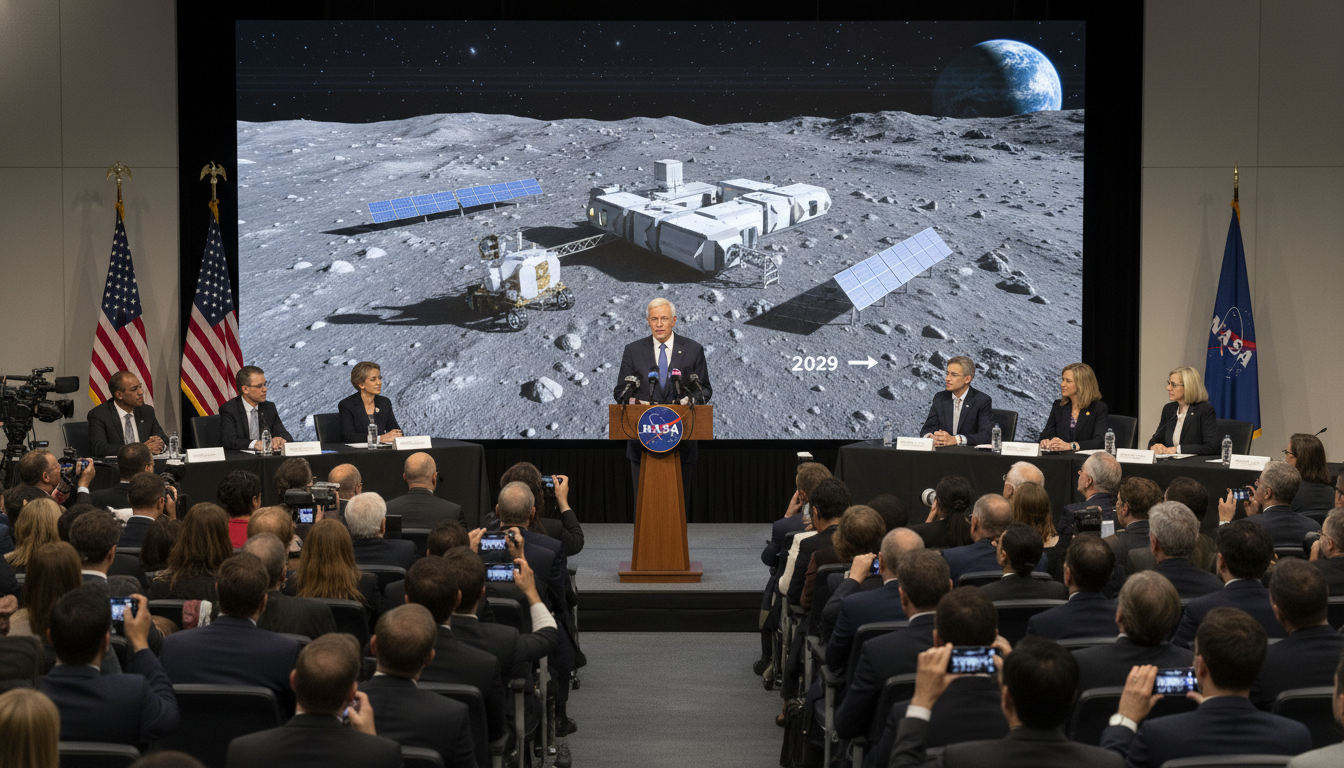
NASA lunar base planned at Moon’s south pole within six years
NASA plans to build its first lunar base at the Moon’s south pole within six years, phased across hundreds of square kilometres to support science and Mars missions.
The United States space agency has unveiled plans for a NASA lunar base on the Moon’s south pole that it says could host humans and sustained operations within six years, according to reporting by PA Media.
The proposed facility would be developed in stages and could extend across hundreds of square kilometres, with each phase designed to incrementally boost capability and habitation.
NASA frames the initiative as a platform for new scientific discovery and the development of technologies required for deeper space exploration, including future missions to Mars.
Site Selection Focused on Lunar South Pole
The agency has identified the lunar south pole as the preferred location for its first long-duration surface base, citing strategic advantages tied to long-term operations and research value.
Although precise coordinates and final parceling remain under study, reports indicate the base could include multiple surface sites spanning a wide area to take advantage of varied terrain and resources.
NASA officials emphasize that a dispersed, modular layout will allow incremental expansion while enabling parallel science and engineering activities across the polar region.
Staged Construction to Span Hundreds of Square Kilometres
NASA’s plan foresees construction carried out in consecutive phases, beginning with robotic infrastructure and followed by crewed modules and permanent systems.
The phased approach is intended to reduce risk, allow lessons learned from early deployments to guide later work, and enable capabilities to grow in line with mission needs rather than in a single large build-out.
By spreading initial sites across a broad footprint, engineers hope to create redundancy, access diverse research sites and scale logistics as power, communications and life‑support elements are validated on the surface.
Research Priorities and Technology Demonstrations
A central purpose of the NASA lunar base will be scientific discovery across disciplines including planetary geology, space weather and potentially in-situ resource utilization research that supports long-duration human activity.
The project is also explicitly framed as a technology testbed to mature systems — such as habitats, power generation, thermal control and surface mobility — that will be essential for sustained operations on the Moon and for missions farther afield, including Mars.
NASA has stated that the lessons and hardware developed at the lunar base will inform mission architectures, crew training and logistics planning for future crewed missions into deep space.
Artemis 2 Flyby as a Pivotal Step
NASA’s announcement follows the agency’s recent crewed lunar flyby under the Artemis programme, which PA Media reported took place in April and provided critical operational experience.
That mission’s flight tests and crew procedures have been cited by officials as an important validation of systems and human factors that will underpin subsequent surface attempts and infrastructure emplacement.
Operational learnings from Artemis 2 are expected to shape timelines, safety protocols and mission design for both the initial surface deliveries and later phases of the lunar base project.
Timeline, Partnerships and Operational Challenges
The six‑year goal for establishing a functioning base imposes an ambitious schedule that will require tight coordination across mission planning, payload development and launch campaigns.
NASA has indicated the base will be built in cooperation with a mix of robotic precursors, commercial partners and international collaborators, though specifics of partnerships and procurement remain to be finalized.
Key operational challenges identified include logistics for transporting large payloads, establishing reliable surface power and communications, and ensuring crew health and safety during extended stays in the lunar environment.
The proposed NASA lunar base marks a major strategic pivot from short-duration landings to sustained presence on the Moon, and it will test new models for how national agencies, commercial firms and global partners can work together in deep space.
As detailed plans are refined and contracts awarded, the next milestones to watch will include robotic site surveys, technology demonstrations and mission manifests that translate the six‑year objective into launchable campaigns.
If timelines hold, the coming years will see a rapid sequence of deployments that move humanity closer to a permanent foothold beyond Earth and lay groundwork for missions to Mars and beyond.
