
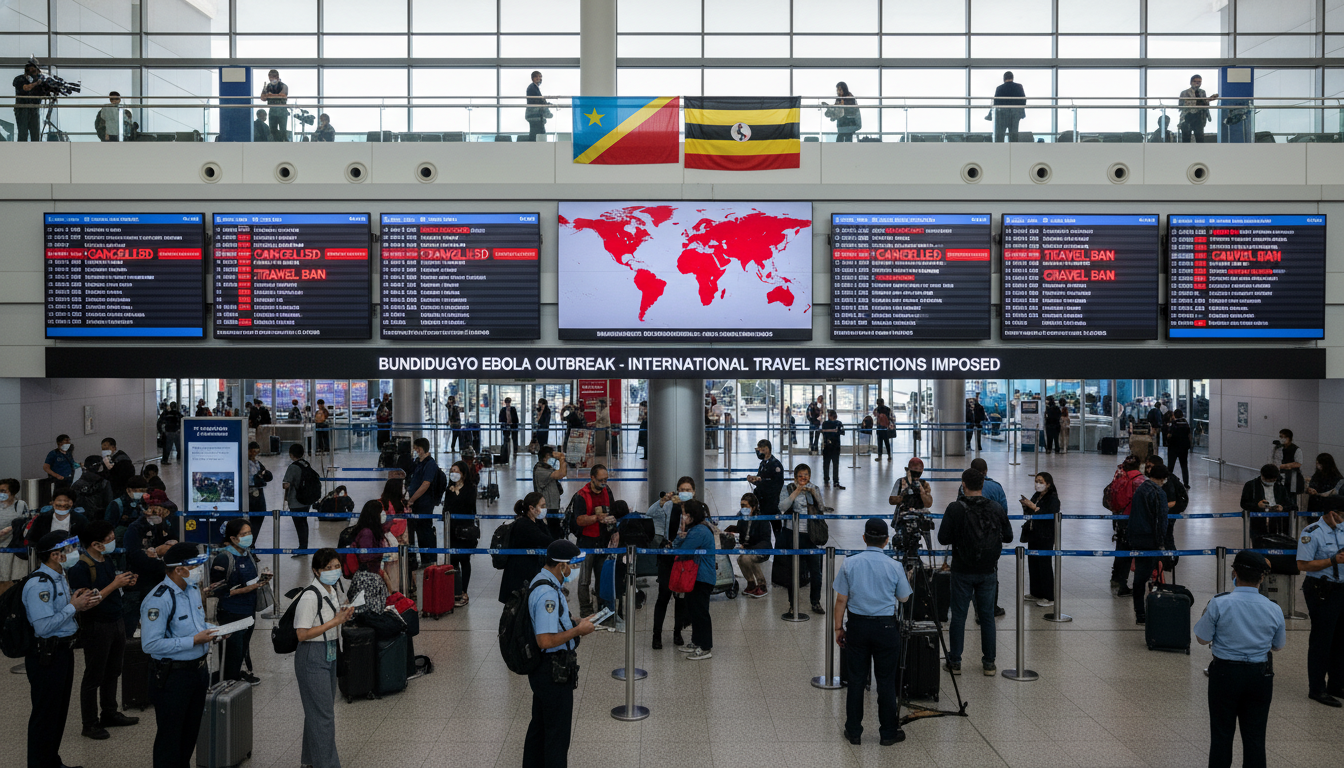
DR Congo and Uganda Face Rapid Bundibugyo Ebola Outbreak as Countries Impose Travel Restrictions
Global health agencies report rising Bundibugyo Ebola outbreak cases in DRC and Uganda, prompting flight suspensions, border curbs and targeted screening measures. (who.int)
WHO raises national risk assessment in DRC
The World Health Organization has upgraded its risk assessment for the Democratic Republic of the Congo from high to very high at the national level after the outbreak was confirmed in mid-May. The agency has recorded hundreds of suspected cases and dozens of suspected deaths linked to the rare Bundibugyo strain. (who.int)
WHO has declared the situation a Public Health Emergency of International Concern and activated emergency response operations across affected provinces. The organisation and partner agencies are urging rapid case detection, isolation and robust contact tracing to prevent further spread. (who.int)
DRC suspends flights to Bunia as outbreak expands
Congolese authorities moved this week to suspend commercial flights to and from Bunia in Ituri province, citing the need to limit movement from an area identified as an epicentre. The Bunia health zone is among multiple health zones affected in eastern DRC, and exceptions for humanitarian and medical flights may be permitted under strict approval. (uaejournal.com)
Local officials say the flight suspension is one of several measures intended to reduce contact between affected communities and other parts of the country while response teams scale up treatment and surveillance. Health authorities have also restricted certain communal activities that can accelerate transmission. (uaejournal.com)
Uganda closes border crossings and reports local cases
Uganda has introduced stringent border controls with the DRC, including suspension of direct flights and temporary halts to bus and boat crossings for several weeks to limit cross-border transmission. Kampala has reported confirmed local infections linked to cross-border exposure and has paused weekly border markets in affected districts. (apnews.com)
The Ugandan Ministry of Health has activated national emergency coordination centres and is conducting contact tracing, community engagement and isolation of suspected cases to break chains of transmission. Essential freight and food supplies have been allowed to continue under monitored conditions. (health.go.ug)
Canada, the Bahamas and the United States tighten entry rules
Several countries outside the immediate outbreak zone announced temporary entry and quarantine rules this week. Canada said it would pause final immigration decisions for nationals of affected countries and require quarantine for travellers who were in the DRC, Uganda or South Sudan within the previous 21 days, a measure effective from May 30. (canada.ca)
The Bahamas is enforcing an immediate, 30-day ban on entry for travellers from the three African countries, subject to review by its health ministry. Both countries stressed the precautions are temporary and will be reviewed as the epidemiological picture evolves. (tribune242.com)
The United States implemented an initial restriction on non-citizen entries and has since expanded orders to include lawful permanent residents who were recently in the affected countries. U.S. authorities also designated a small number of airports for enhanced public-health screening of arrivals from the region. (cdc.gov)
U.S. designated airports and screening procedures
U.S. officials directed that travellers who have been in the DRC, Uganda or South Sudan in the previous 21 days arrive at designated airports for enhanced screening and public-health processing. Washington-Dulles, Hartsfield-Jackson Atlanta and George Bush Intercontinental in Houston were named as primary reception points and later additions have been reported for other ports of entry. (evaair.com)
The Centers for Disease Control and Prevention has framed the entry restrictions as a layered prevention approach, aimed at identifying and managing potentially exposed travellers before they disperse widely within the United States. U.S. agencies emphasize the temporary nature of the measures while risk assessments continue. (cdc.gov)
On-the-ground response: treatment centres, contact tracing and altered funerary practices
National and regional emergency operations in DRC and Uganda are focused on rapid case isolation, setting up treatment centres and strengthening infection prevention and control in health facilities. Teams are also carrying out contact tracing and community outreach to encourage safe care-seeking and reporting. (afro.who.int)
Authorities in the DRC have curtailed traditional funeral practices in some areas because deceased bodies can be highly infectious, and response teams warn that delayed detection has allowed the virus to spread before containment measures began. International partners are supporting laboratory testing and logistics for supplies and patient care. (apnews.com)
ICAO and aviation bodies urge measured, coordinated screening
The International Civil Aviation Organization has urged states, airlines and airports to follow WHO guidance and COVID-era health protocols, stressing that international air services remain safe when proper measures are implemented. ICAO recommended prioritising exit screening at departure points in affected countries rather than blanket border closures. (icao.int)
ICAO and UN agencies emphasised digital tools such as electronic health declarations and contactless border processes to support targeted detection, while warning against broad restrictions that could disrupt supplies of humanitarian and medical aid into outbreak zones. The agency reiterated coordination with WHO and national authorities to limit unnecessary travel disruption. (icao.int)
International health authorities say rapid scaling of surveillance and treatment can stop transmission, but they also caution that the current Bundibugyo outbreak has moved quickly and requires urgent escalation of operations. Global partners continue to monitor the situation closely as DRC and Uganda expand their response. (ungeneva.org)
The WHO leadership has reiterated confidence in established public-health measures and called for international cooperation to support affected countries while avoiding measures that would impede emergency response efforts. The coming days will be critical for contact tracing, treatment capacity and preventing cross-border spread. (ungeneva.org)
