
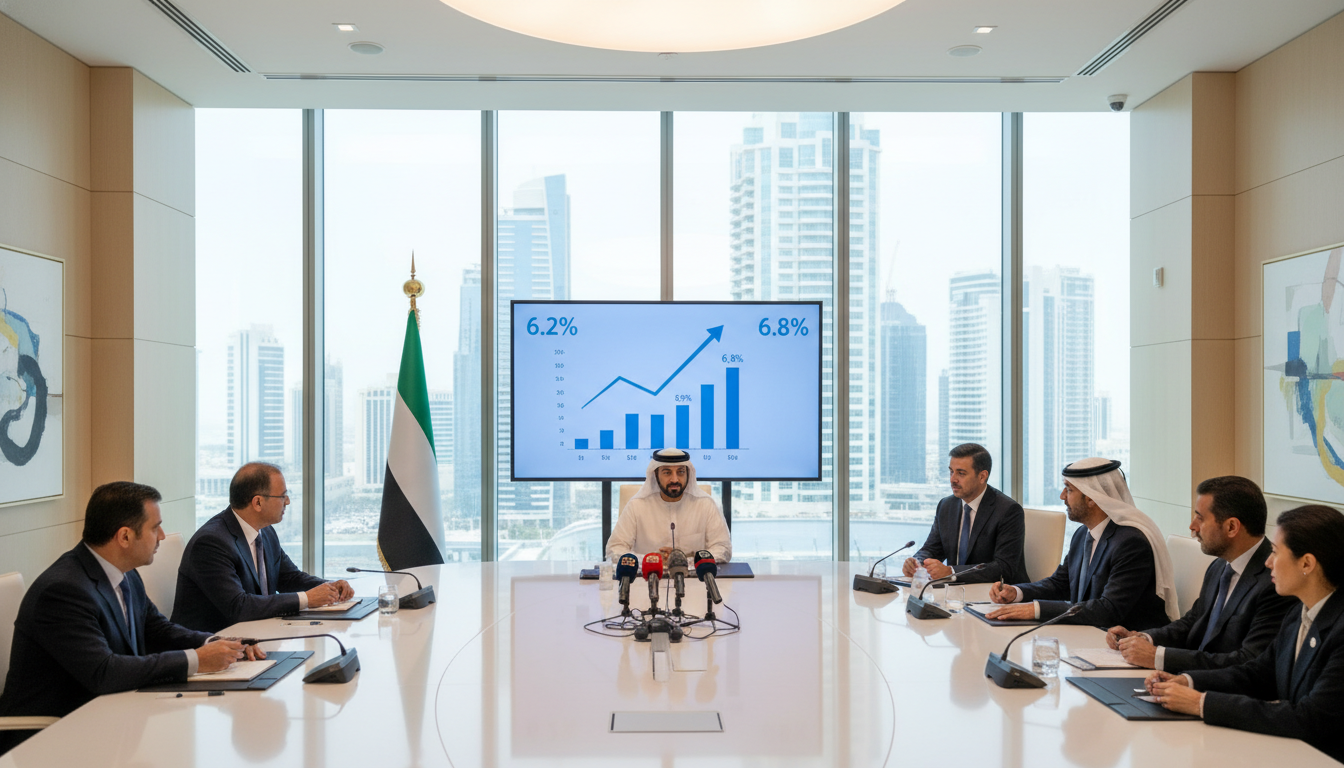
UAE GDP 2025: Real Economy Grows 6.2% to AED 1.9 Trillion, Non‑Oil GDP Up 6.8%
UAE GDP 2025: Real GDP rose 6.2% to AED 1.9 trillion, while non‑oil GDP expanded 6.8% to AED 1.5 trillion, driven by construction, finance and trade, official data.
The United Arab Emirates recorded robust growth in 2025, with UAE GDP 2025 real output up 6.2% year‑on‑year to AED 1.9 trillion, the Federal Competitiveness and Statistics Center reported. Non‑oil GDP rose 6.8% to AED 1.5 trillion, underscoring sustained momentum outside the hydrocarbon sector. Government officials highlighted the results as evidence of successful economic diversification and resilient policymaking amid global uncertainties.
Official GDP figures and headline growth
The Federal Competitiveness and Statistics Center released aggregated national accounts showing overall real gross domestic product expanding by 6.2% in 2025 compared with 2024. The total value of the UAE economy reached AED 1.9 trillion on a real basis, marking one of the stronger annual performances in recent years. Authorities attributed the outcome to a broad upswing across multiple sectors and a continued shift toward higher‑value, non‑oil activity.
The data also showed non‑oil activity accounting for a significant portion of aggregate expansion, reflecting policy priorities to reduce reliance on hydrocarbons. Analysts said the combination of public investment, private sector dynamism and favourable business conditions supported spending and investment across the economy.
Non‑oil GDP growth and sectoral contributions
Non‑oil GDP climbed 6.8% year‑on‑year to reach AED 1.5 trillion in 2025, according to the statistical release. Trade remained the largest contributor to non‑oil output, followed by finance and insurance, construction and manufacturing, which together sustained the expansion. The composition of non‑oil GDP points to diversification across services, real estate and industry rather than concentrated growth in a single area.
Officials highlighted that the rising share of non‑oil sectors strengthened the economy’s resilience to external shocks. The shift reflects targeted measures to foster economic breadth, including incentives for investment, streamlined regulations and strategic infrastructure projects.
Top performing sectors: construction and finance lead
Sectoral breakdowns for 2025 indicate construction led growth with an 11.1% expansion, the fastest among major industries. The finance and insurance sector grew by 10.4%, while real estate advanced 7.9% and transport and storage increased 7.8%. These gains reflect both ongoing public capital programmes and heightened private investment in property, logistics and financial services.
Market observers noted that construction’s strong performance was supported by large‑scale projects and urban development across the Emirates. Meanwhile, growth in finance and insurance signalled deeper activity in capital markets, corporate finance and cross‑border transactions that underpin the UAE’s role as a regional financial hub.
Government strategy and economic diversification drive results
Ministry of Economy and Tourism leadership framed the results as validation of the UAE’s long‑term economic strategy, which emphasizes diversification, competitiveness and high‑value activity. Ministers said flexible policy responses and forward‑looking economic planning helped accelerate the transition to a more diversified growth model. The government pointed to the country’s Vision 2031 objectives as guiding the move toward sustainable, knowledge‑intensive industries.
Policy measures cited by officials include targeted support for non‑oil sectors, regulatory reforms to enhance the business environment, and sustained public and private investment in technology and infrastructure. These actions are aimed at increasing the contribution of sectors that deliver higher value‑added and stronger employment outcomes.
Statistical capacity and data quality underpin policy decisions
The Federal Competitiveness and Statistics Center emphasised that the 2025 results also reflect improvements in the national statistical system and the quality of economic data. Authorities said ongoing efforts to modernise statistical methods and expand data coverage have enhanced the accuracy and timeliness of national accounts. Enhanced data collection and integration are intended to provide policymakers with clearer signals for macroeconomic management and strategic planning.
Officials stressed that reliable statistics are essential to monitor progress against national targets, evaluate policy effectiveness and attract investment. Continued investment in data infrastructure and analytics was presented as a priority to ensure the economy remains responsive to emerging trends and opportunities.
Looking ahead, the UAE’s economic outlook for the near term will depend on the global environment, commodity price movements and the pace of domestic reforms. The 2025 GDP results signal a strengthening non‑oil base and demonstrate the impact of diversification policies. With construction, finance and trade driving momentum, policymakers will likely focus on sustaining investment, supporting innovation and maintaining a competitive regulatory framework to keep UAE GDP 2025 growth on a steady path.
