
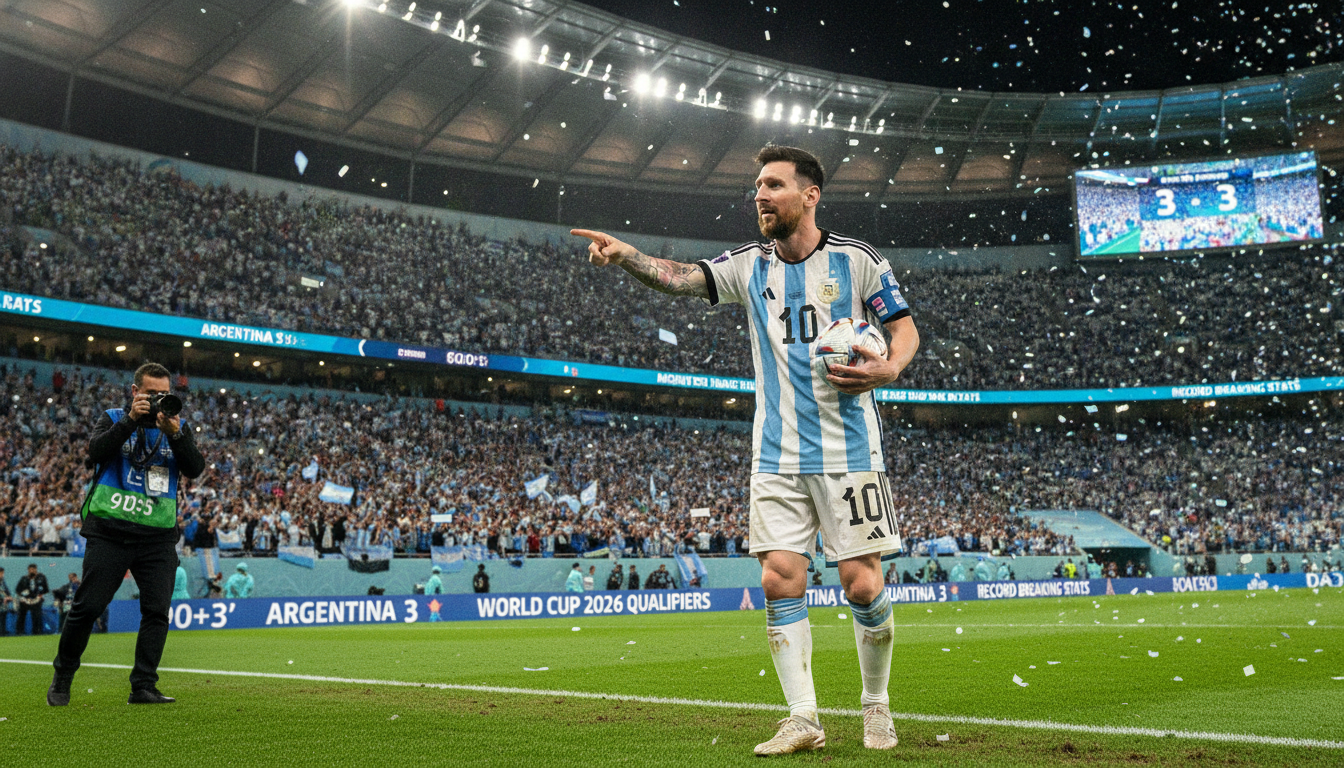
2026 World Cup: Messi Hat‑trick, Ronaldo’s Limited Touches and Arab Sides Winless After Group Round One
The 2026 World Cup group stage opened with a string of striking individual and team statistics, highlighted by Lionel Messi’s hat‑trick and a sharp dip in Cristiano Ronaldo’s influence. Tournament data from round one show Messi moved level with the all‑time World Cup scoring mark at 16 goals, while Portugal’s captain registered just 25 touches in a single match. Several national teams from the Arab world failed to record a win, and a handful of unusual records and clean disciplinary trends also emerged.
Messi equals Klose with 16 World Cup goals
Lionel Messi delivered a three‑goal performance against Algeria that pushed him to 16 career World Cup goals, tying the long‑standing mark set by Miroslav Klose. The goals not only topped the scoring charts for the tournament’s opening round but also reinforced Argentina’s attacking threat as the competition progresses. Messi’s display combined clinical finishing with sustained involvement in build‑up play, underscoring his central role for his national side.
Ronaldo posts lowest touches of major tournament match
Cristiano Ronaldo’s influence was strikingly muted in Portugal’s draw with the Democratic Republic of Congo, with official counts showing just 25 touches of the ball. That tally represents his fewest touches in a full match at a major international tournament, prompting debate over his on‑field role and Portugal’s tactical approach. Coaches and analysts will be watching whether Portugal adapts in the coming fixtures to increase his involvement.
Arab teams fail to secure a win in opening round
Eight Arab national teams concluded the first group round without a victory, with Qatar, Morocco, Egypt and Saudi Arabia taking draws while Tunisia, Iraq, Algeria and Jordan suffered defeats. Despite the collective lack of wins, individual performances stood out, such as Saudi goalkeeper Mohammed Al‑Owais who compiled nine saves against Uruguay. Tournament observers noted the contrast between encouraging individual contributions and the broader struggle to convert those into positive results for several sides.
Individual and team records surface in early games
The opening round produced a series of notable statistical firsts, including Mexico‑born Julian Quiñones becoming the first player active in the Saudi league to score an opening‑goal at this level of the World Cup. U.S. defender Chris Richards posted a perfect passing record, completing 83 passes at a 100 percent success rate — a figure unmatched in available passing records dating back to the mid‑20th century. These milestones reflect both evolving tactical emphasis on possession and the rising profile of players from diverse club backgrounds.
Substitute impact and possession markers draw attention
Sweden’s Mattias Svanberg made an immediate impact by scoring just 18 seconds after entering as a substitute, registering the second‑fastest goal by a replacement in World Cup history. Morocco impressed defensively and in progression play against Brazil, completing 123 successful passes in the attacking third — the highest such tally in the nation’s World Cup matches to date. Coaches have highlighted the growing importance of impact substitutions and high‑accuracy short passing as determinants in tight group fixtures.
Germany’s attacking statement and tournament discipline trends
Germany closed the first group round as the most potent attacking side on paper after a resounding 7‑1 victory over Curaçao, sending a clear message about their front‑line depth and finishing efficiency. Across the tournament’s initial fixtures, referees issued fewer dismissals than in previous editions, with no red cards reported since the opening match, suggesting a comparatively restrained disciplinary environment. Both the offensive outburst by high‑scoring teams and the calmer cards trend may shape refereeing and tactical planning in the rounds ahead.
The early phase of the 2026 World Cup has combined individual brilliance with unexpected statistical patterns, producing talking points that extend beyond match results. From Messi’s landmark scoring to records for passing accuracy and substitute impact, round one has set a data‑rich stage for the tournament’s next phase. As teams regroup and strategies adjust, attention will turn to whether underperforming sides can convert strong individual displays into collective success and whether the statistical themes of the opening round persist or shift in the coming fixtures.
