
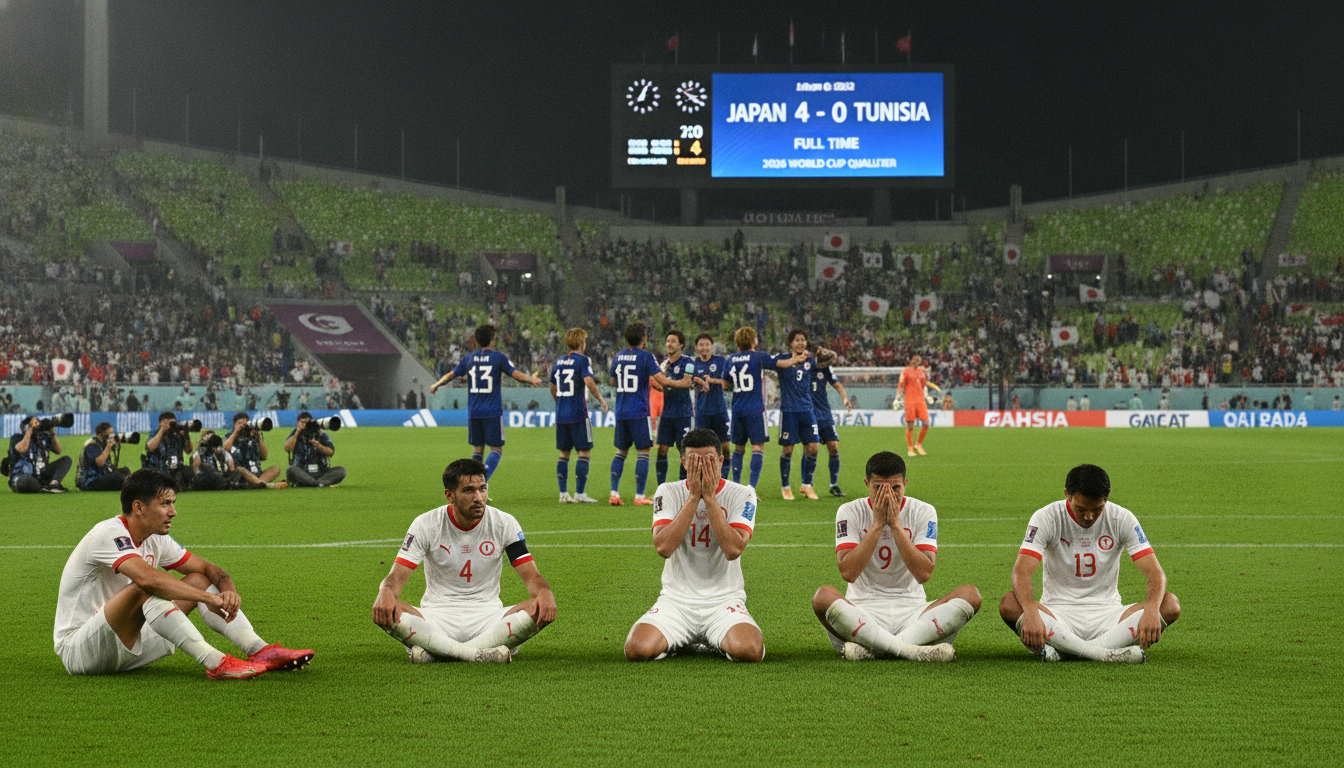
Tunisia exit World Cup 2026 after 4-0 defeat to Japan in tournament’s 1,000th match
Tunisia eliminated from World Cup 2026 after 4-0 loss to Japan in the tournament’s 1,000th match, becoming the first Arab side officially knocked out in Group B.
Tunisia’s World Cup 2026 campaign ended abruptly as the North African side fell 4-0 to Japan, leaving the team mathematically eliminated after two matches. The defeat came in the 1,000th match in the history of World Cup finals and made Tunisia the first Arab country to exit the tournament at this stage. The loss deepened concerns over the team’s defensive frailties and raised questions about recent coaching changes.
Match events and decisive moments
Japan took control of the match from the outset and opened the scoring within four minutes through Daichi Kamada. The early goal unsettled Tunisia and allowed Japan to dictate tempo and territory for much of the first half.
Ayase Ueda added a second goal in the 31st minute to give the visitors a clear interval advantage. In the second half Japan extended their lead with Junya Ito’s strike in the 69th minute and Ueda completed his brace late in the game to make it 4-0, leaving Tunisia with no meaningful attacking threat.
Defensive breakdown under the microscope
The defeat exposed major defensive shortcomings for Tunisia, whose backline conceded nine goals across the opening two group matches. Individual errors and poor positioning were evident, and the national side struggled to contain Japan’s movement and combination play.
The lack of cohesive defending compounded Tunisia’s inability to press effectively, allowing Japan to build attacks without sustained resistance. The statistical and visual evidence suggested systemic problems rather than isolated lapses.
Late coaching change fails to halt decline
The Tunisian Football Federation replaced Sabri Lamouchi with Hervé Renard shortly before the tournament in an effort to arrest the team’s slide. Renard, a coach with extensive international experience, had limited time to implement tactical adjustments or to reshape the squad’s mentality.
Despite the managerial change, patterns from the opening defeat persisted: defensive disorganization, low pressing intensity and scant attacking penetration. The hurried transition left Renard with few practical options to reverse momentum in time.
Historic context and tournament milestones
The match against Japan carried extra historical weight as the 1,000th fixture in World Cup finals history, a milestone that contrasted starkly with Tunisia’s struggling performance. The team’s start — nine goals conceded in two games — stands among the poorest openings for Tunisia at the World Cup.
Being the first Arab nation to be officially eliminated from this edition adds an unwelcome footnote to the country’s tournament record. Tunisia had aimed to reach the knockout stage for a seventh time, but the current run ends their hopes prematurely.
Group standings and the final round implications
With elimination confirmed, Tunisia’s final group match against the Netherlands will be played with pride and image restoration as primary objectives. The encounter now becomes a chance to salvage credibility ahead of the squad’s return home and to provide younger players with experience on the world stage.
For Japan, the victory consolidates a strong position in Group B and advances their prospects of reaching the knockout rounds. The contrasting trajectories of the two teams underline how quickly fortunes can shift in short, high-stakes tournaments.
Tunisia’s early exit will prompt immediate evaluation by the federation, players and coaching staff, with attention focused on defensive structure, player selection and preparation methods. The team now faces a period of introspection and planning ahead of future qualifiers and international fixtures.
