
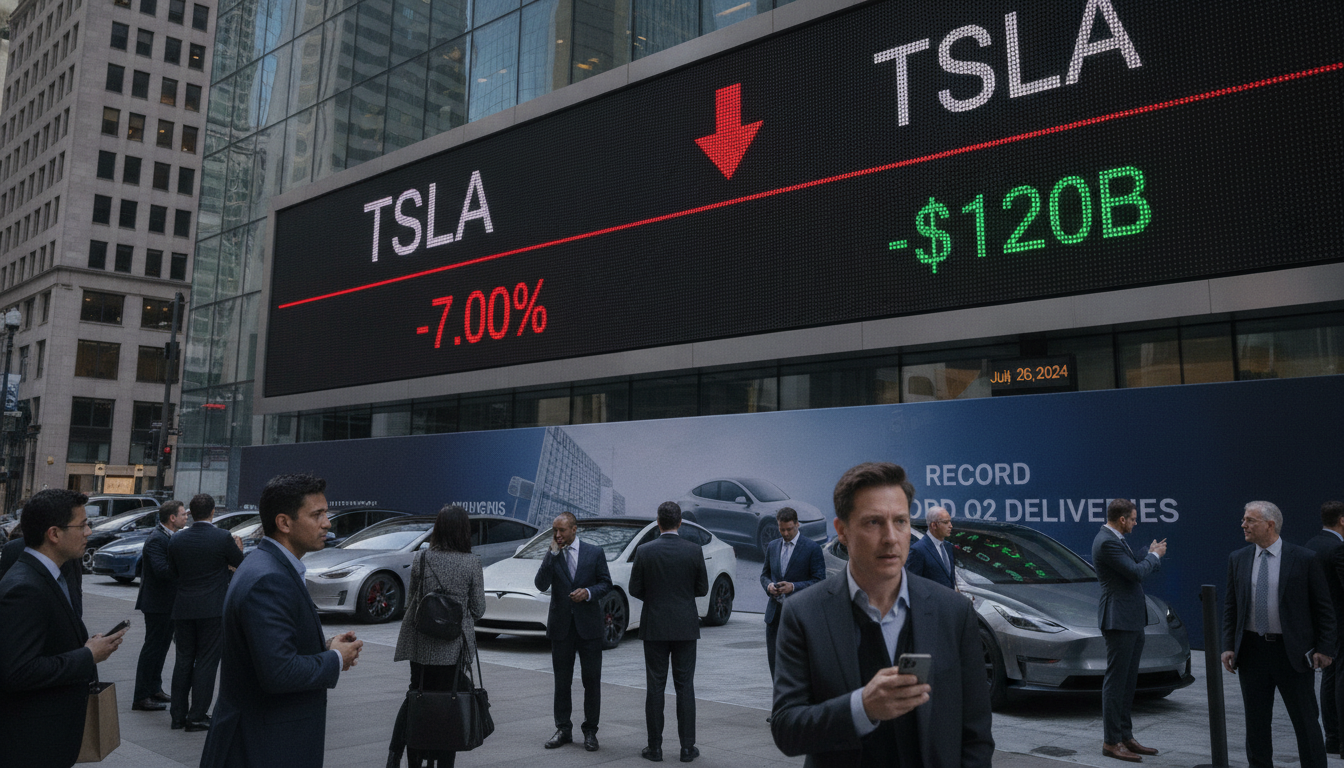
Tesla stock tumbles 7% as Q2 deliveries top estimates but markets react nervously
Tesla stock fell 7% in a single trading session after the company reported stronger-than-expected second-quarter deliveries, wiping roughly $120 billion from its market value despite record sales. The stock reaction came even as Tesla announced 480,126 vehicle deliveries from April through June, well above analyst forecasts and marking a near 25% year-on-year increase. Investors appeared to focus on valuation and sentiment risks rather than the company’s sales momentum, sending shares to their largest daily drop in about a year. The mixed signals highlight the tug-of-war between operational progress and broader market concerns facing electric vehicle manufacturers.
Shares Slide Despite Record Q2 Deliveries
In the trading session on Thursday, Tesla shares fell about 7%, representing the steepest single-day percentage decline in roughly twelve months. The sell-off erased around $120 billion from Tesla’s market capitalization in just one day, underscoring the sensitivity of equity markets to short-term investor sentiment.
The share movement came despite the company’s report that it delivered 480,126 vehicles in the second quarter, a quarterly record that easily surpassed the consensus estimate of approximately 402,776. Market participants reacted to a mix of valuation worries and external factors rather than the headline delivery figures alone.
Delivery Numbers and Analyst Expectations
Tesla’s reported 480,126 deliveries equal a roughly 25% increase compared with the same period last year, indicating sustained demand for its electric vehicles. The company’s results significantly exceeded the average analyst estimate, pointing to stronger operational execution and regional improvements.
Analysts had expected a softer outcome given seasonal patterns and macro uncertainty, but Tesla’s production and logistics teams managed to push deliveries to a new quarterly high. Still, some market watchers cautioned that deliveries are only one metric and that profitability, margins and future guidance will be central to investor judgment.
European Market Fuels Sales Momentum
A notable driver behind the stronger deliveries was a rebound in Europe, where Tesla saw rising demand across multiple markets. The company benefited from a combination of higher gasoline prices, expanded government incentives for electric vehicles and an acceleration in corporate fleet electrification.
Those forces helped offset weaker demand in other regions and contributed materially to the quarter’s delivery total. Observers noted that the European recovery underscores the importance of regional policy and fuel economics in shaping EV adoption rates.
Investor Sentiment and CEO Controversies
Market reaction also reflected lingering investor sensitivity to non-operational risks, including reputational issues tied to chief executive Elon Musk. Consumer response to Mr. Musk’s controversial public positions last year became less uniformly negative, but the episode left a residual risk premium for some shareholders.
Investors appear to be weighing whether renewed sales momentum can fully neutralize concerns about governance, brand perception and potential regulatory scrutiny. The combination of strong operational results and elevated sentiment risk can produce volatile price action, as the recent drop illustrated.
Valuation Pressures and Broader Market Context
Tesla remains one of the most closely watched companies on global exchanges, and its valuation has long been a focal point for investors assessing growth vs. risk. The sudden $120 billion market-value reduction in a single session reflects how quickly sentiment can drive market capitalization swings for high-profile names.
Macroeconomic conditions, interest-rate expectations and shifting investor appetite for growth stocks all contribute to the price moves. For Tesla specifically, questions about margin sustainability, pricing strategies and competition in key segments continue to influence investor assessments.
Outlook: What Investors Will Watch Next
Looking ahead, market participants will likely focus on Tesla’s upcoming reporting for profitability, gross margins and any forward guidance the company offers. Production updates from key factories, supply-chain developments and regional policy shifts—especially in Europe—will be monitored closely.
Analysts will also track whether the delivery beat presages continued volume growth or represents a near-term peak supported by temporary tailwinds such as higher fuel costs. Corporate fleet conversions and incentive programs could sustain momentum, but execution risks remain.
The wider takeaway for the market is that strong deliveries do not always produce an immediate share-price rally if investors remain concerned about valuation or non-operational risks. The recent session shows how Tesla stock can swing sharply on a complex mix of fundamentals, sentiment and external events.
