
Portugal wildfire near Viseu scorches 12,000 hectares as Spain and Italy send reinforcements; toxic smoke blankets parts of Thessaloniki
Portugal wildfire near Viseu has burned 12,000 hectares; over 1,200 firefighters, EU reinforcements and airborne assets tackle the blaze while Greece warns residents about toxic smoke.
Hundreds of firefighters remain engaged in large-scale wildfire operations in Portugal and Greece after flames that began days ago have consumed extensive woodland and threatened populated areas. The Portugal wildfire near Viseu has emerged as the most damaging, prompting a multinational response under the European Civil Protection mechanism. In northern Greece, authorities urged residents of Thessaloniki neighborhoods to shelter indoors as toxic smoke from a recycling plant and nearby blazes spread over parts of the city.
Fire spreads across central Portugal, officials report
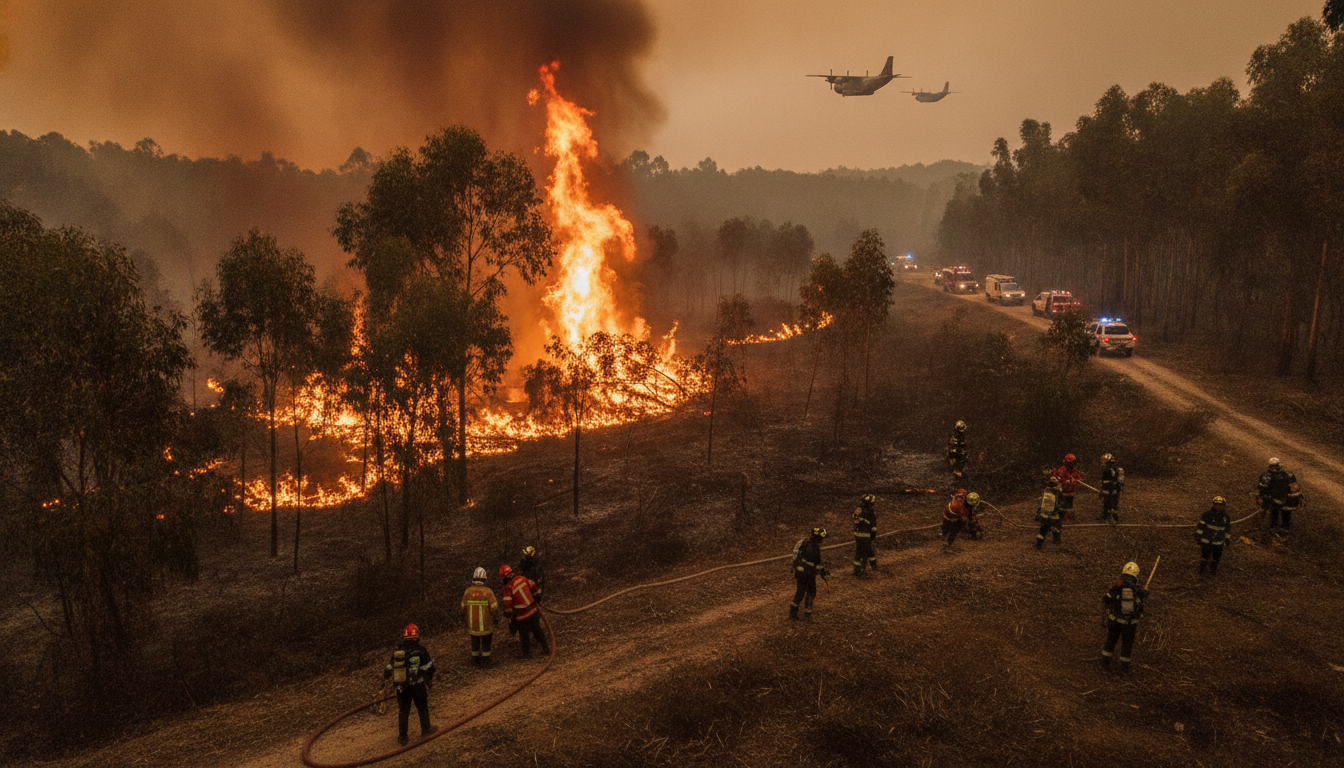
More than 1,200 firefighters are working to contain the blaze in the Viseu area, supported by roughly 400 ground vehicles and 15 aircraft deployed for fire suppression. Portuguese civil protection authorities estimate the fire has consumed about 12,000 hectares of forest and scrub, creating a fast-moving front in difficult terrain.
Local commanders said steep slopes, dry vegetation and shifting winds have complicated containment efforts, forcing crews to adjust tactics and prioritize protection of villages and critical infrastructure. Evacuations have been carried out where necessary and road closures implemented to keep civilians clear of affected zones.
Scale of the firefighting operation and resource deployment
Portuguese firefighting coordinators have organized rotating crews to maintain sustained operations through daylight and night hours, using coordinated aerial water drops to support ground teams. Incident commanders emphasized the importance of aircraft for slowing the fire’s advance in remote sectors that are difficult for vehicles to access.
Ground teams have focused on establishing control lines, protecting homes and extinguishing spot fires that flare up ahead of the main front. Emergency services continue to monitor weather forecasts closely, since any increase in temperature or wind speed could broaden the fire’s reach.
EU civil protection activates international support to Portugal
The European Civil Protection and Humanitarian Aid department confirmed that Spain dispatched 120 firefighters and 45 vehicles to assist Portugal, while additional aerial assets were provided by Spain and Italy. Three firefighting aircraft from partner countries joined the Portuguese aerial effort to deliver sustained water and retardant drops over the most active sectors.
Officials said the international reinforcements were coordinated through established EU mechanisms to ensure rapid deployment and effective integration with Portuguese command structures. Authorities underlined that cross-border support remains essential when national resources are stretched by simultaneous incidents.
Thessaloniki residents ordered to shelter as toxic smoke spreads
In Greece, authorities issued warnings for inhabitants of certain Thessaloniki districts to remain indoors and seal windows after smoke from a recycling plant fire, fed by nearby wildfires, caused hazardous air conditions. Municipal and public health officials cautioned that the smoke contained potentially toxic compounds, particularly from burning industrial materials.
Emergency services in northern Greece concentrated on preventing the industrial blaze from spreading to residential zones and on reducing further air pollution. Local hospitals and health centers were put on alert to treat patients with respiratory problems and to advise vulnerable groups on protective measures.
Air quality monitoring and public safety measures in both countries
Portuguese and Greek authorities have activated air quality monitoring and public information systems to keep residents informed about evolving conditions. In affected municipalities, officials recommended that people limit outdoor activities, particularly those with respiratory conditions, children and the elderly.
Public safety messaging emphasized the importance of following evacuation orders, avoiding non-essential travel near active fire zones and adhering to guidance from civil protection agencies. Authorities also urged the public to report new ignitions promptly to support rapid suppression and limit further spread.
Portuguese firefighting commanders and EU partners said they are continuing concerted efforts to stabilize the situation and protect communities while crews work to extinguish remaining hotspots. In Greece, municipal emergency services maintained a round-the-clock presence around the recycling plant and its perimeter to prevent rekindling and reduce the health impact of lingering smoke.
