
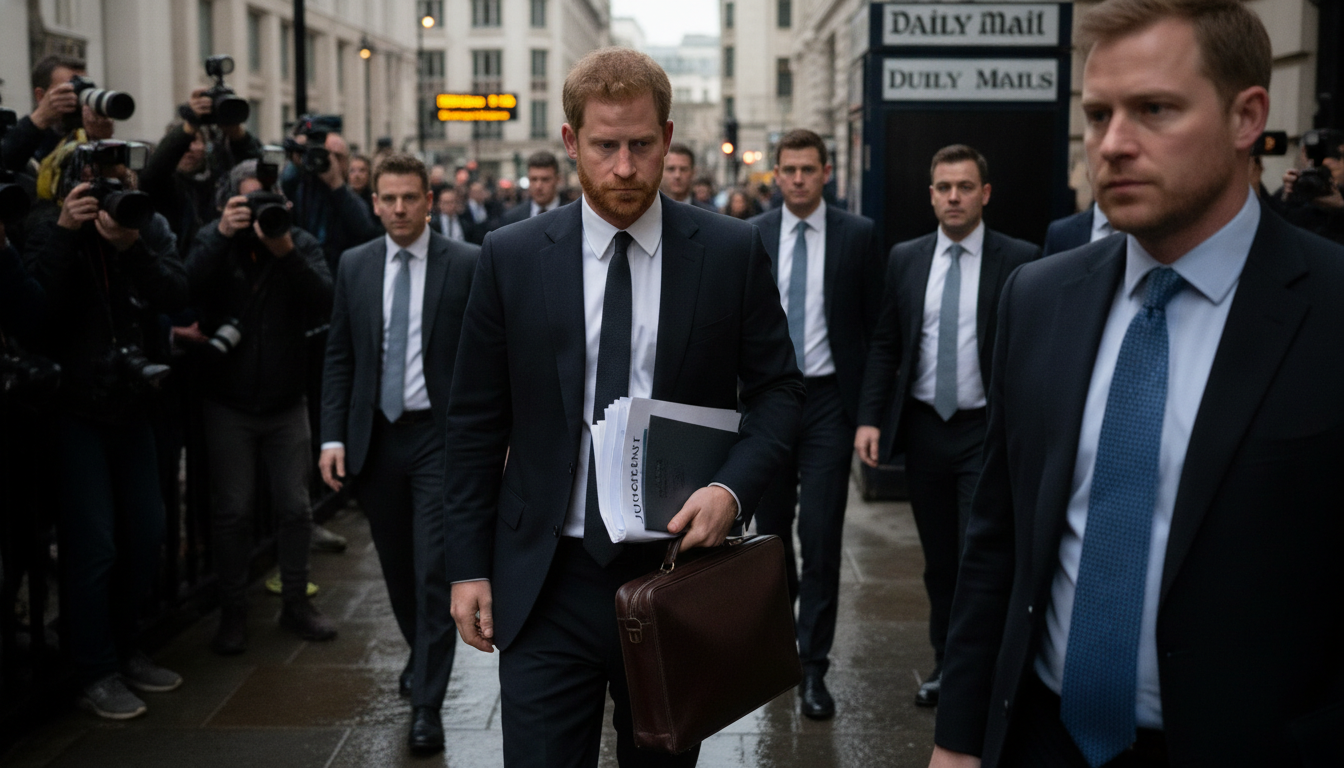
Prince Harry loses High Court privacy case against Daily Mail publisher
Prince Harry privacy case ends in defeat as London High Court dismisses claims against Associated Newspapers, marking a major setback in his long-running legal battle with the British press.
Prince Harry’s privacy case against the publisher of the Daily Mail and Mail on Sunday was dismissed by the High Court in London on Tuesday, with a judge ruling that the claimants had not proved unlawful information gathering by journalists. The ruling, issued while the duke was in the UK, concludes a high-profile legal fight brought by Harry and six other public figures against Associated Newspapers Limited. (apnews.com)
High Court dismisses claims
The judgment, handed down by Justice Matthew Nicklin, found that the evidence presented did not meet the threshold required to show that the publisher had used illegal methods such as phone hacking or systematic voicemail interception. The judge rejected allegations spanning articles published over many years, saying the claimants had not established unlawful information-gathering on the balance of probabilities. The decision terminates this particular claim against Associated Newspapers, which operates the Daily Mail and MailOnline. (aljazeera.com)
Details of the legal complaint
The litigation, filed in 2022, targeted a series of stories from roughly 2001 to 2013 that the claimants said were produced with the help of unlawful reporting techniques. Alongside Prince Harry, the group of claimants included high-profile figures who alleged intrusive newsgathering on personal and sensitive matters. The case examined decades of reporting practices and sought to hold the publisher accountable for any alleged breaches of privacy and data protection standards. (aljazeera.com)
Co-claimants and allegations
Co-claimants named in the action included Elton John and his husband David Furnish, actresses Elizabeth Hurley and Sadie Frost, campaigner Baroness Doreen Lawrence and former politician Simon Hughes. The claimants presented a range of allegations, from phone interception to impersonation and other methods to obtain private information. Each claimant put forward individual examples which the court examined during an extended trial earlier this year. (townandcountrymag.com)
Judge’s assessment of the evidence
In his written judgment the judge said suspicions about unlawful information gathering were not matched by the available evidence and that key assertions could not be proven to the required civil standard. The ruling emphasised the distinction between belief or suspicion and legally admissible proof of wrongdoing by journalists or the publisher. Counsel for the claimants had urged the court to infer unlawful methods from circumstantial material, but the judge found those inferences unpersuasive. (apnews.com)
Publisher response and industry reaction
Associated Newspapers described the ruling as a “magnificent vindication” of its journalism and said it welcomed the judgment as an endorsement of lawful reporting practices. The publisher’s statement framed the decision as a win for press freedom and the integrity of its reporters’ work. Media industry voices pointed to the judgment as a significant moment for editorial defence against accusations of historic malpractice. (itv.com)
Context within Harry’s wider legal campaign
The defeat marks a contrast with earlier outcomes in the duke’s legal campaign against sections of the British press, where he secured a judgment against Mirror Group Newspapers and reached a settlement with other publishers in previous years. Those earlier actions produced awards and apologies over specific unlawful activities and intrusions. Legal commentators say the mixed record demonstrates the varying evidential challenges claimants face when pursuing historic privacy complaints in UK courts. (news.sky.com)
Timing and public attention
The judgment arrived while Prince Harry was in London for a visit that has drawn intense media scrutiny, including speculation about his relationship with the royal household. Coverage of the ruling coincided with his public engagements in the capital, amplifying the story’s prominence in both British and international news outlets. Observers noted the contrast between the legal setback and Harry’s continued public appearances during the trip. (cbsnews.com)
Legal implications and next steps
Legally, the ruling closes this particular avenue of redress against Associated Newspapers unless an appeal is launched, which would require permission from the court. The decision does not bar the claimants from seeking alternative remedies or pursuing fresh evidence should it emerge. Lawyers briefed on the matter say the judgment will be studied closely for its approach to inference, documentary proof and the evidential limits when cases involve alleged historical misconduct by journalists.
The High Court’s dismissal of Prince Harry’s privacy case against the Daily Mail publisher represents a notable chapter in a broader, years-long confrontation between prominent public figures and sections of the British tabloid press. The decision underscores the evidential hurdles in proving unlawful newsgathering in civil courts and is likely to shape how similar claims are advanced in the future.
