
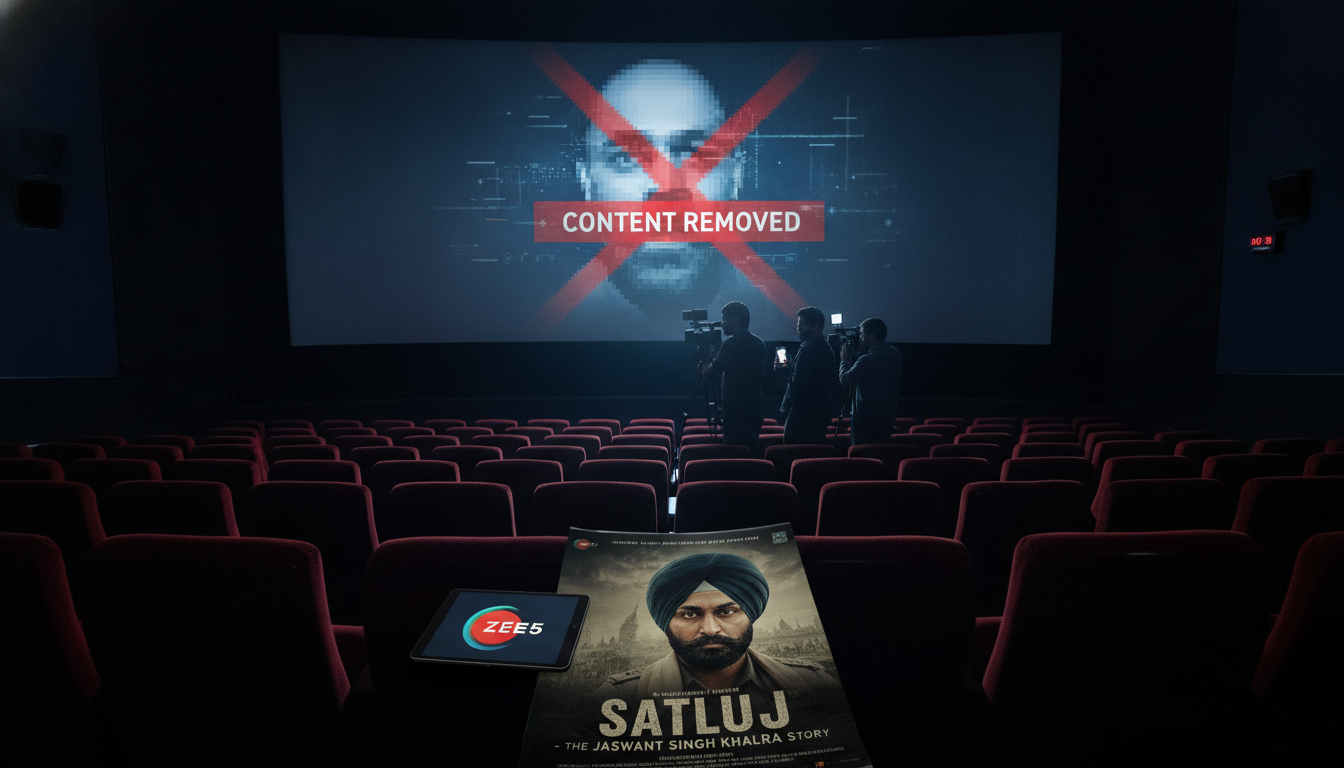
Satluj film removed from Zee5 after censor demands spark legal fight and public screenings
Satluj film pulled from platform after makers refused 127 cuts; takedown ignited bootleg screenings and renewed debate over censorship in India.
Online release and swift takedown
The Satluj film was released directly online after prolonged disputes with India’s Central Board of Film Certification, but the title was removed from Zee5 within 48 hours. Producers said the move followed repeated censor demands that they found untenable, and the streaming platform cited “current developments” in announcing the removal.
Officials speaking to local media said the takedown was ordered on security grounds and over concerns the film could be exploited by what they described as “anti-India forces.” The government has not issued a formal public statement outlining the reasons.
Censors’ 127-cut demand and legal route
Director Honey Trehan and the production team say the certification authority asked for 127 cuts and a series of other changes that effectively altered the film’s historical references. Court filings reviewed by the filmmakers list requests that included renaming the film, fictionalising central characters and removing references to the state, the national flag and certain historical events.
After multiple rounds of editing and appeals, the makers sought relief in the judiciary but were unable to secure a clearance that matched their creative intent. Faced with an impasse, the producers chose to publish the Satluj film online to reach audiences without the board’s approval.
Jaswant Singh Khalra’s story at centre of Satluj
Satluj focuses on the life and work of human rights activist Jaswant Singh Khalra, who documented enforced disappearances and extrajudicial killings in Punjab during the 1980s and 1990s. The film draws on long-standing allegations of police abuses that erupted amid a violent insurgency in the state, and it examines the consequences of that period for victims’ families and civil society.
The project was developed as a historical drama that explicitly engages with those documented abuses, and its initial title, Punjab ’95, referenced the year Mr. Khalra was abducted and killed, a detail that became a focal point in the certification dispute.
Filmmakers, star and rights advocates respond
Producer and director statements emphasise that the film’s makers exhausted formal channels before opting for an online release. The production’s budget, cited in court documents as roughly $4.5 million, and the participation of a major star, Diljit Dosanjh, heightened public interest in the dispute.
Mr. Dosanjh told fans the film’s subject was being discussed more widely after the removal, and constitutional lawyer Navroz Seervai warned that the episode could have a chilling effect on creators. Rights advocates argue the pattern of demands and the opaque nature of the certification process place a heavy burden on filmmakers tackling sensitive chapters of history.
Political context and film industry ramifications
The Satluj film dispute has reopened debate about the relationship between cinema, politics and state institutions in India. Critics point to recent productions that were cleared and widely promoted, noting that films seen as aligning with the ruling party’s narratives have sometimes received public endorsements, tax benefits and favourable attention.
Industry observers say the landscape has encouraged a degree of self-censorship among producers and writers, who often remove—or avoid altogether—material perceived as controversial to secure clearance and distribution. The result, detractors say, is a narrowing of mainstream cinematic perspectives on contested historical and social issues.
Public response: bootlegs, screenings and grassroots discussions
Following the removal, bootleg copies of the Satluj film began circulating online and community-led screenings reportedly took place in villages and places of worship in Punjab. Supporters and local organisers say these viewings have amplified discussion about Khalra’s case and the wider history the film addresses.
Streaming platforms, industry players and civic groups now face questions about enforcement, distribution responsibilities and the limits of digital content oversight. The rapid spread of unofficial copies underlines the difficulty of containing material once it reaches public consciousness.
The Satluj film episode has highlighted longstanding tensions between artistic expression, state oversight and public interest in contested histories. As debates continue over certification practices and the role of platforms in policing content, filmmakers and rights advocates are likely to press for clearer rules and transparent procedures that balance security concerns with the public’s right to access films that examine difficult chapters of the nation’s past.
