
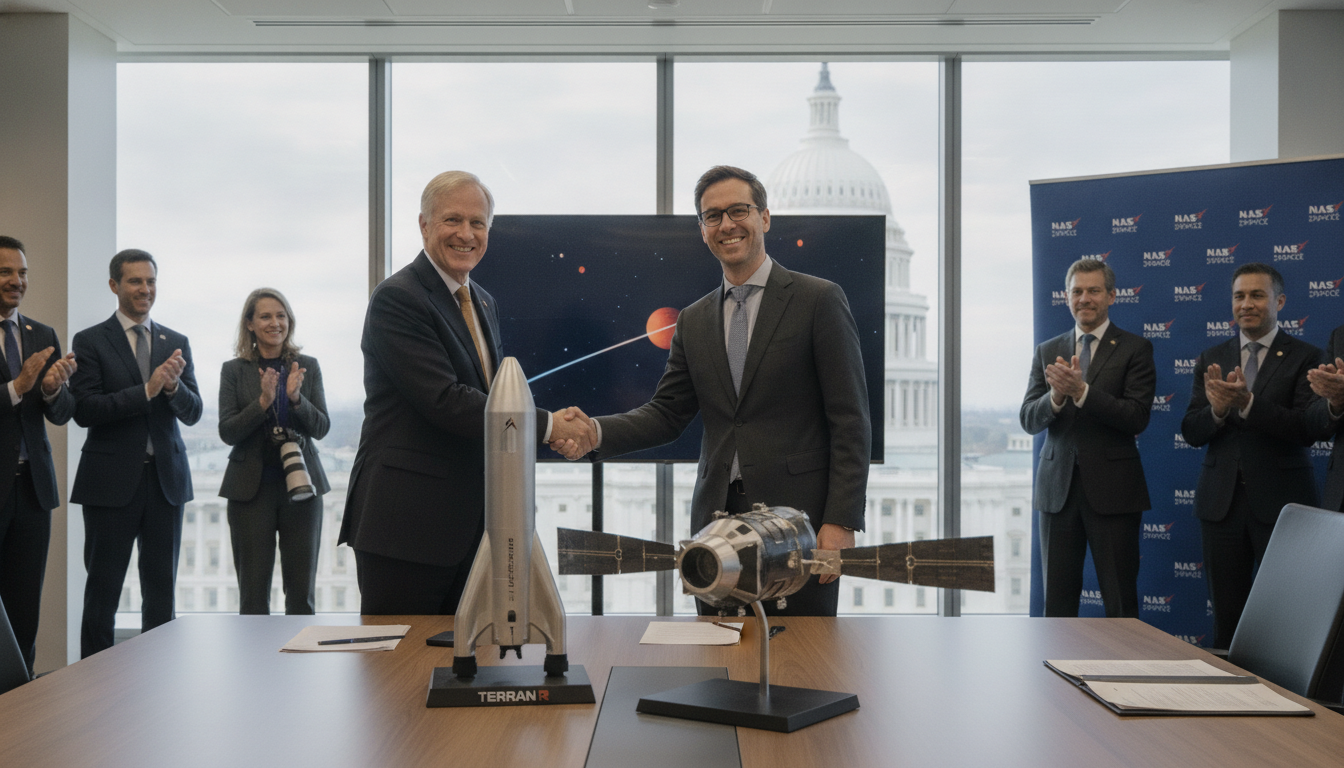
NASA Taps Relativity Space to Deliver Aeolus Mars Orbiter
NASA and Relativity Space to build Aeolus Mars orbiter, providing daily global weather maps to aid future human missions; launch planned no earlier than 2028.
The United States space agency has expanded its public‑private partnerships to include exploration of Mars by signing an agreement with Relativity Space to develop and launch the Aeolus Mars orbiter. Aeolus will carry four advanced scientific instruments designed to produce the first daily, planet‑wide maps of winds, temperatures, dust storms and clouds on Mars, and the launch is not scheduled before 2028. The data are expected to improve climate and weather forecasting for future crewed missions and to support a broader science campaign that includes shallow ice and subsurface rock studies.
NASA expands Mars partnerships
NASA said the deal reflects a shift toward using commercial providers for planetary science missions similar to models employed in low Earth orbit and lunar exploration. Under the agreement, Relativity Space will supply the orbiter and the launch vehicle while coordinating additional contributions from private companies, academic institutions and non‑profits. Agency officials framed Aeolus as both a scientific mission and a demonstration of a new contracting approach for cost‑efficient planetary investigations.
Scientific goals of the Aeolus orbiter
Aeolus is named after the Greek god of the winds to reflect its primary focus on atmospheric dynamics on Mars. The orbiter’s four instruments will, for the first time, produce near‑daily global snapshots of wind fields, thermal structure, dust storm development and cloud distributions across the planet. Those measurements will refine climate models, improve landing site planning and provide environmental context for both robotic surface missions and eventual human explorers.
Surface and subsurface investigations
Beyond atmospheric science, Aeolus is tasked with characterizing near‑surface ice layers and probing the geological structure beneath Mars’ regolith. Observations of shallow ice deposits will inform resource assessments for in‑situ utilization, while subsurface rock studies will help scientists reconstruct the planet’s geologic history. Together, these datasets aim to connect atmospheric processes with surface and near‑surface conditions in a way that smaller, single‑purpose missions cannot.
Relativity Space to build spacecraft and launch vehicle
Relativity Space will be responsible for manufacturing the Aeolus spacecraft and providing the launch service, and the company plans to solicit scientific payloads and co‑funding from industry and academia. Founded in 2015 to develop 3D‑printed, reusable rockets, the company shifted its strategy after an initial small‑launcher test flight reached space but failed to achieve its intended orbit. Relativity has since concentrated resources on its larger Terran‑R vehicle as the prospective launcher for Aeolus.
Terran‑R development and schedule
Terran‑R is designed to carry roughly 23.5 tonnes to low Earth orbit and represents Relativity’s bid to compete with mid‑to‑heavy lift providers in the commercial launch market. The company anticipates a first flight of Terran‑R later this year, and if validated, the rocket would serve as the orbital ride for Aeolus in the post‑2028 timeframe. Success of Terran‑R would not only enable the Aeolus schedule but could also expand Relativity’s access to new launch contracts and position it alongside other commercial suppliers.
Testing a commercial planetary science model
The Aeolus partnership with Relativity is being watched as a real‑world test of whether planetary science missions can be reliably executed under commercial contracts. U.S. administrations over the past two decades have progressively embraced public‑private collaboration, from cargo and crew transport to lunar lander development, and Aeolus extends that approach deeper into the solar system. If the mission succeeds, it could pave the way for smaller, more frequent scientific missions carried out by private firms, lowering per‑mission costs and broadening scientific participation.
Policy choices in Washington add urgency to the experiment. Current emphasis on the Artemis lunar program and proposals to tighten budgets for some planetary and Earth science efforts have prompted scientists to explore alternative funding and execution models. Aeolus therefore carries scientific objectives as well as programmatic significance for how future robotic exploration might be organized.
The Aeolus Mars orbiter represents a convergence of scientific ambition and commercial innovation, aiming to deliver unprecedented daily weather and climate data while testing a new path for planetary missions. Its success will depend on the development of Terran‑R, the integration of international and commercial science contributions, and the ability of NASA and its partners to manage risk while maximizing scientific return.
