
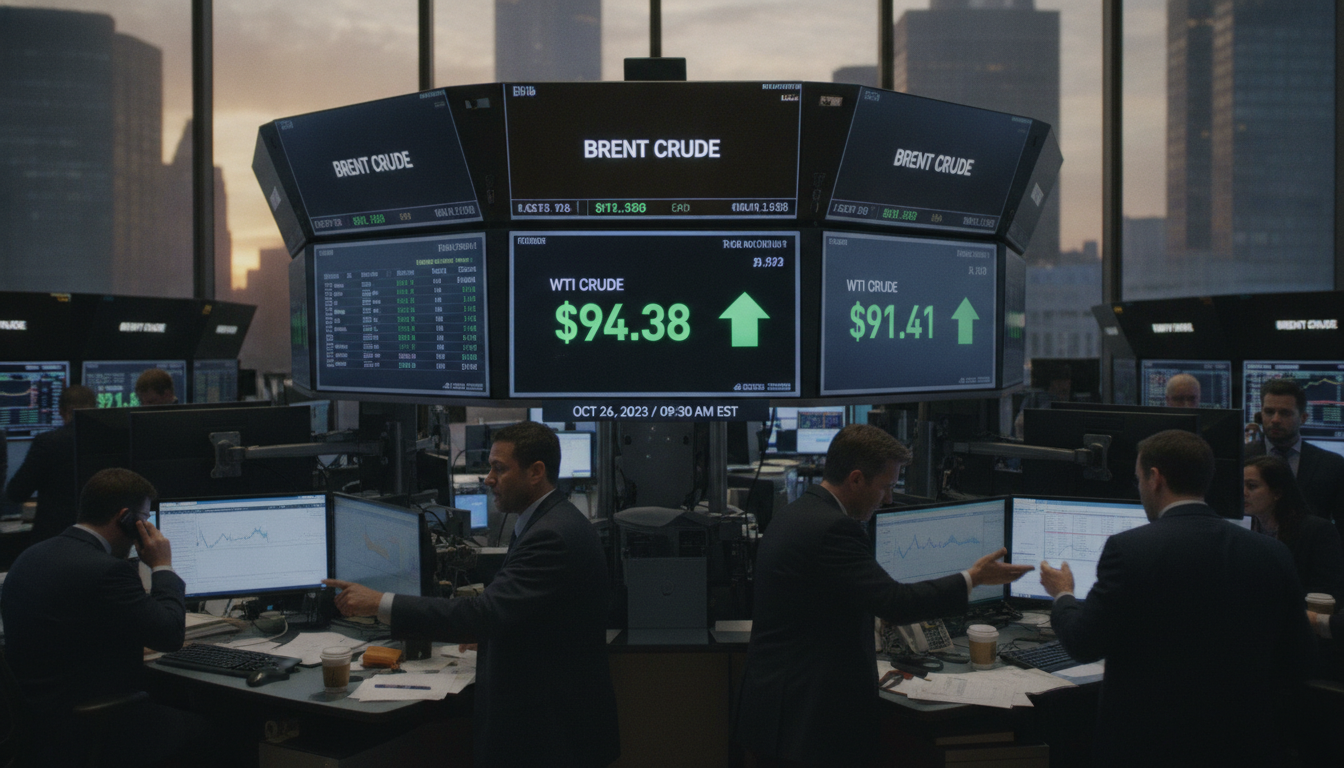
Oil prices rise as Brent hits $94.38 and US WTI reaches $91.41 in early trade
Oil prices edged up in early trading as Brent climbed to $94.38 per barrel and US WTI rose to $91.41 at 00:01 GMT, reflecting cautious investor sentiment and supply concerns.
The modest gains in oil prices came during the opening hours of global trade, with Brent futures up by $0.13, or 0.14 percent, and US West Texas Intermediate (WTI) rising $0.11, or 0.12 percent. Market participants described the move as tentative amid mixed economic signals and ongoing supply-side considerations. Traders continued to weigh the outlook for demand against persistent geopolitical and production factors that have tightened physical crude markets.
Early Trading Movements
Brent crude futures were quoted at $94.38 per barrel at 00:01 GMT, marking a small uptick from the previous session. US WTI similarly firmed to $91.41 per barrel, narrowing the gap between the two benchmarks on the session. The increases were slight but consistent across both Atlantic and US benchmarks, signaling a broadly cautious market tone.
Volume in the earliest contracts suggested investors were taking measured positions rather than committing to large directional bets. Analysts said such incremental moves often precede larger shifts once fresh economic data or policy statements arrive. For now, the market is pricing in incremental risk rather than a strong directional trend.
Brent and WTI Price Breakdown
Brent’s advance of $0.13—about 0.14 percent—contrasted with WTI’s $0.11 gain, roughly 0.12 percent, underlining relatively balanced buying interest. The Brent-WTI spread remained influenced by regional supply flows, Atlantic basin inventories and differing refinery demand patterns. Traders monitor the spread closely as it can reflect logistical tightness or surplus in specific markets.
Price action in the front-month contracts was orderly, with limited intraday volatility during the early European session. Market participants noted that the small percentage moves are typical when traders await clearer catalysts such as inventory reports or central bank commentary. Short-term technical levels around the $90–$95 band are likely to guide positioning in the coming days.
Supply Signals and OPEC+ Context
Market watchers pointed to ongoing supply-side signals as a key influence on the latest price move, including voluntary output adjustments and isolated production disruptions in certain regions. Observers said that any reports of outages or extended maintenance can tighten nearby physical markets and support futures. The broader OPEC+ stance on coordinated cuts continues to be a background factor for price formation.
At the same time, shipping and logistics developments remain relevant for regional flows into Asia and Europe, where refinery uptake influences benchmark arbitrage. Traders remain attentive to announcements from major producers, as even limited reductions in available cargoes can lift prompt prices. The cumulative effect of modest cutbacks and supply uncertainties has kept a floor under prices despite softer demand cues.
Demand Outlook and Global Economic Signals
On the demand side, the market is watching economic indicators from major consumers for signs of momentum or weakness. Manufacturing and mobility data, particularly from China and the United States, are repeatedly referenced by analysts when assessing near-term crude consumption. Mixed macro readings have produced a cautious market posture, with investors reluctant to extrapolate strong demand growth.
Refinery runs and seasonal consumption patterns will also shape demand expectations in the weeks ahead. Any surprise uptick in processing activity typically absorbs more crude and can narrow prompt differentials, while slower runs tend to loosen nearby markets. For now, traders are balancing hopes for steady demand against the reality of economic variability.
Implications for UAE and Regional Markets
Rising oil prices carry direct implications for the UAE and the broader Gulf region, where hydrocarbon revenues underwrite public finances and investment plans. Higher benchmark levels can support fiscal balances and reinforce government revenue projections, while also affecting regional refining margins and downstream fuel pricing. Local market participants track Brent and regional markers closely to gauge export profitability.
For traders and refineries across the Gulf, subtle price moves may influence liftings and term contracting strategies for the coming months. Port call schedules, storage availability and regional refining turnarounds will all interact with headline crude prices to determine commercial outcomes. Policymakers and energy firms in the Emirates typically factor such developments into short- and medium-term planning.
Market Reaction and Near-Term Outlook
Ports and trading desks signaled a subdued but alert market stance, with participants awaiting further data points such as weekly inventory releases and upcoming economic reports. Analysts expect volatility to increase around scheduled releases from major agencies and any geopolitical headlines that could affect supply routes. For now, the market appears to be consolidating within a narrow range while participants reassess positioning.
Short-term traders are likely to focus on technical support and resistance near the $90 and $95 levels, while longer-term investors monitor fundamentals and strategy updates from large producers. The confluence of modest supply tightness and uncertain demand growth suggests prices could trend higher if positive demand data emerges, though downside risks remain if economic indicators worsen.
The market’s immediate trajectory will depend on fresh information on inventories, refinery activity and any shifts in production policy, with investors advised to watch for data releases and official statements that could substantively change the supply-demand balance.
