
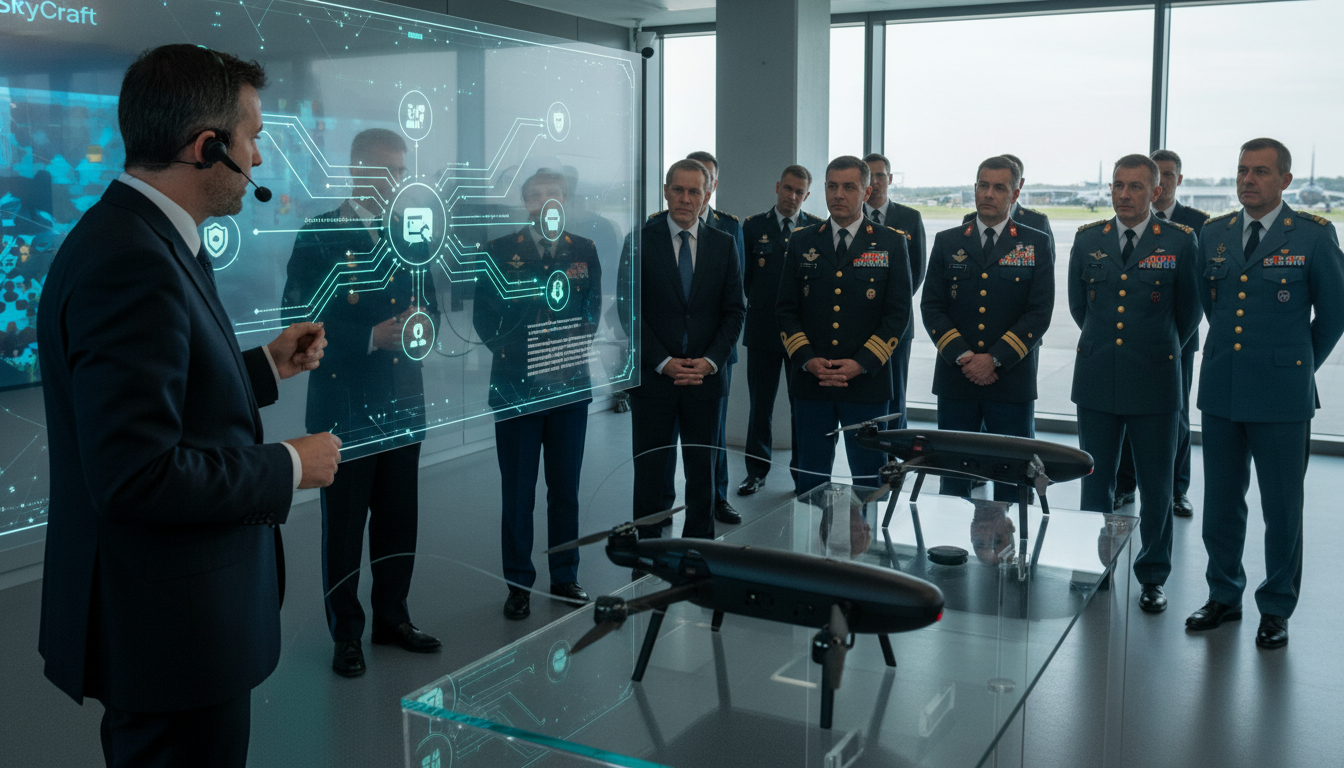
Dubai evaluates fiber-optic strike drones from SkyCraft as Gulf cities seek jamming-resistant drone options
Dubai examines SkyCraft fiber-optic strike drones for urban defense and security operations, assessing EW-resilient tethered systems for jammed environments.
SkyCraft, a Ukrainian developer of tethered unmanned aerial systems, has drawn the attention of Dubai authorities and Gulf security planners with its line of fiber-optic FPV systems designed to operate where radio-frequency links are compromised. The city is assessing how fiber-optic strike drones could permit real-time, high-quality video guidance and command in electromagnetically contested airspace. Officials and defense procurement advisers say the systems promise a capability gap fill for missions in dense urban and industrial zones where conventional drones risk being disabled by jamming.
SkyCraft’s fiber-optic systems and the rationale for evaluation
SkyCraft markets tethered platforms that transmit control signals and live video over a physical fiber-optic cable, removing dependence on radio links that are vulnerable to electronic warfare. This architecture is being presented as a solution for strike and reconnaissance roles in environments where adversaries can deploy broad-area or directional jamming. For Dubai, a city with critical infrastructure, heavy maritime traffic, and dense urban vertical terrain, the appeal lies in maintaining uninterrupted situational awareness and command when radio spectra are degraded.
The fiber connection carries data as pulses of light, a transmission medium not affected by radio-frequency interference, which means the operator remains connected even inside dense electromagnetic noise. That inherent immunity addresses a primary tactical vulnerability faced by standard remotely piloted aircraft. Decision-makers in the Gulf region are emphasizing the operational continuity and reduced detection signature afforded by a tethered, non-radio approach.
SkyCraft’s systems also claim to deliver higher bandwidth and lower latency than many radio links, supporting real-time first-person-view (FPV) video streams essential for precision targeting and rapid assessment. In scenarios where split-second decisions are required, the combination of stable imagery and a secure physical link may materially change mission outcomes. Procurement teams are weighing these performance factors against deployment logistics and cost.
Design, materials and durability for urban operations
The physical tether is central to the platform’s operational reliability, and SkyCraft’s design uses lightweight fiber-optic cable with high-strength polymer jackets to withstand deployment stresses. The cable’s reduced mass helps preserve the drone’s aerodynamic performance and maneuverability, while protective coatings are intended to limit moisture ingress and abrasion during flight. Operators are briefed that modern spooling mechanisms and reinforced sheathing mitigate common field risks such as tangling or abrasion against sharp corners.
Manufacturers emphasize that the spooling system must release and retrieve cable smoothly to avoid sudden drag forces that could affect flight stability during aggressive maneuvers. For urban strike missions, where the aircraft may need to navigate between buildings or around infrastructure, the tether’s flexibility and tensile strength are operationally significant. Maintenance cycles and replacement schedules for high-wear components form part of any evaluation, given the maintenance demands of regular operational use.
Engineering trade-offs remain: a fiber-optic tether provides an unbroken data link but also imposes a physical constraint on maximum range and requires careful mission planning to avoid entanglement risks. Dubai’s evaluation teams are testing scenarios that simulate dense built environments to measure how the tether behaves in close-quarters flight. The results will influence whether tethered systems are fielded for specific mission sets or integrated as a complementary capability alongside untethered drones.
Operational range, bandwidth and mission profiles
Tethered systems offer a practical operating radius defined by spool length and flight envelope, with several kilometers cited as typical for contemporary designs. Within that span, the fiber cable supplies both high-bandwidth data and, in some configurations, power to the platform, reducing dependence on onboard batteries for extended loiter times. This endurance profile supports missions such as persistent surveillance, inspection of critical assets, and time-sensitive strike tasks where longer on-station presence is advantageous.
High-throughput fiber links permit low-latency, high-resolution video feeds that are critical for precision engagement and dynamic tactical assessment. Analysts note that bandwidth advantages are particularly useful for integrating auxiliary sensors such as thermal cameras, laser designators, and encrypted telemetry. In practice, the tethered approach enables operators to maintain clearer sensor fusion and target discrimination when RF channels are being contested or monitored.
Flight profiles for fiber-optic strike drones in urban theaters typically prioritize controlled, line-of-sight corridors and preplanned approach vectors to minimize tether interaction with the environment. Mission planners balance the benefits of an immune data link against the need for stealthy ingress and rapid egress. Dubai’s security planners say they are modeling missions that combine tethered assets for the terminal phase of an operation with other platforms for broader area awareness.
Implications for electronic warfare and operator safety
Electronic warfare developments have pushed defensive planners to reassess dependency on radio links for command-and-control of unmanned systems. Fiber-optic strike drones remove radio emissions that adversaries can detect, locate, or jam, thereby reducing the electromagnetic signature footprint of an operation. For operators, this lowers the risk of RF-based geolocation and improves operational security when entering contested airspace.
The lack of a radio signature may also complicate adversary countermeasures that rely on intercepting or disrupting telemetry. However, the tether itself introduces a new operational consideration: the physical connection can be observed visually or via electro-optical sensors, and its existence must be factored into concealment and approach tactics. Commanders reviewing the systems emphasize combined tactics, where tethered platforms operate in coordination with decoys, emission control measures, and other force-protection steps.
Training and standard operating procedures will need updating to reflect tethered flight dynamics and emergency procedures for cable compromise. Dubai’s technical teams are evaluating fail-safe mechanisms such as controlled cable release or contingency recovery protocols should the tether become fouled or damaged. Ensuring operator safety and minimizing collateral risk in densely populated areas remain top priorities during the assessment phase.
Gulf interest and procurement considerations for Dubai
Gulf states oversee some of the world’s busiest ports, high-rise developments, and major energy installations, and policymakers in the region are increasingly focused on resilient air-domain capabilities. Dubai’s interest in fiber-optic strike drones is rooted in the need to protect critical infrastructure while maintaining lawful operational constraints in urban settings. The city’s evaluation extends beyond immediate security needs to include regulatory, legal, and procurement frameworks that would govern deployment.
Procurement officials are examining the integration path for tethered systems into existing airspace management regimes and civil aviation rules. Factors under review include no-fly zone coordination, clearances for tethered flights over populated areas, and rules of engagement for weapons-capable platforms. Dubai’s municipal safety agencies are also analyzing how tethered drones would interact with emergency services and first-responder protocols during crisis scenarios.
Budgetary considerations and lifecycle costs are a central part of the procurement dialogue, with assessments covering initial acquisition, training, spares, and sustainment. Officials are balancing the tactical advantages of fiber-optic strike drones against alternative approaches such as hardened RF systems, frequency-hopping radios, and satellite-based command links. The final procurement decision will weigh operational effectiveness, legal compliance, and long-term sustainment.
Tactical uses, limitations and integration with existing forces
Operational planners see specific roles where fiber-optic tethered platforms could offer decisive utility, particularly in the final phase of precision engagements in electromagnetic-contested skies. These roles include terminal guidance for precision munitions, critical asset inspection under jamming conditions, and persistent overwatch of high-value targets where uninterrupted video is a necessity. The combination of long loiter time and reliable data links makes tethered systems particularly suited for scenarios that demand continuous situational awareness.
Limitations remain, notably the finite tether length and the potential visibility of the cable during approach. In highly cluttered urban landscapes, cable management becomes operationally taxing, and risk assessments must account for the danger of entanglement or unintended contact with infrastructure. Commanders plan to mitigate these risks by incorporating tethered systems into layered mission architectures, using them as a final-stage tool rather than a sole solution.
Integration efforts focus on ensuring tethered platforms can operate alongside manned aircraft, untethered drones, and ground-based sensors. Data-sharing protocols and secure interfaces will be essential to enable real-time intelligence fusion. Dubai’s defense and security planners are running interoperability trials to ensure that tethered feeds can be consumed by existing command-and-control systems without delay or degradation.
Export, certification and international validation
SkyCraft’s systems are marketed from Ukraine and are being positioned as battle-tested solutions supported by wartime operational experience. That operational background is a central selling point for international customers concerned with real-world validation. For Dubai and other Gulf partners, the presence of combat-proven performance provides a measure of assurance that documented capabilities have been exercised under the pressures of actual operations.
Export controls, end-user certification, and compliance with international arms-transfer regulations are part of the procurement calculus. Dubai’s procurement offices are conducting due-diligence reviews to ensure any acquisition satisfies bilateral agreements and regional legal frameworks. Certification processes for safety, electromagnetic compatibility, and flightworthiness are also being examined to meet both military and civil aviation standards.
International validation may accelerate adoption if independent testing confirms the claimed immunity to RF jamming and the operational durability of the tether under diverse conditions. Dubai’s testing regimen includes simulated jamming exercises and flight trials that reproduce local climatic factors such as high humidity and coastal salt exposure. Results from those trials will shape any potential acquisition timeline.
Final evaluation and next steps
Dubai’s assessment of fiber-optic strike drones is part of a broader regional reappraisal of unmanned systems in a contested electromagnetic domain. Procurement and operational teams are moving from concept testing toward integrated trials that will determine how tethered platforms fit into existing defense ecosystems. The balance of promise and limitation will be tested in scenarios that mirror the city’s unique urban and maritime environment.
If trials demonstrate consistent performance, Dubai could employ tethered systems for niche roles where uninterrupted data links are mission-critical. Otherwise, tethered platforms may be incorporated selectively, complemented by hardened radio systems and alternative redundancy measures. The decision pathway will hinge on demonstrable operational benefits, regulatory clearance, and long-term sustainability.
SkyCraft’s fiber-optic FPV systems have catalyzed a strategic conversation in the Gulf about how cities can preserve unmanned capabilities when the radio spectrum becomes a battlefield. Dubai’s evaluations will be watched closely across the region as other urban hubs consider how to maintain critical aerial functions under the growing pressure of electronic warfare.
Public officials, security analysts, and procurement experts alike recognize that the emergence of tethered, fiber-based solutions represents a pragmatic adaptation to the changing character of air-domain conflict. The coming months of trials and regulatory review will define whether fiber-optic strike drones become a standard tool in Gulf cities’ security toolkits or remain a specialized capability reserved for narrowly defined missions.
