
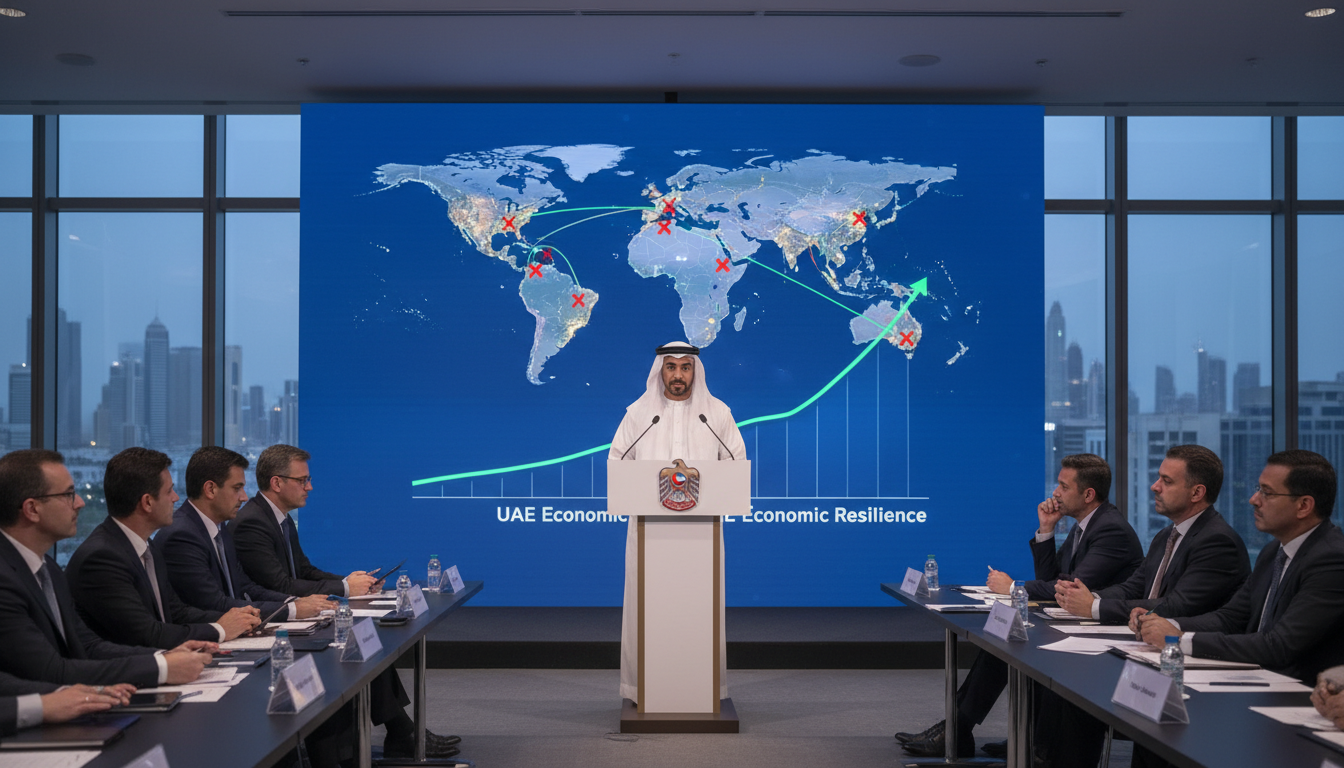
UAE economic resilience holds as regional shipping and trade face disruption
UAE economic resilience tested by regional shipping and trade disruptions — bolstered by deep financial buffers, swift policy measures and investor confidence.
The UAE’s economic resilience has been thrust into the spotlight after recent disruptions to regional shipping lanes and trade corridors, and officials say core systems continued to operate under pressure. H.E. Badr Jafar, speaking in his roles as Special Envoy for Business and Philanthropy and as CEO of Crescent Enterprises, described how the immediate impacts on aviation, logistics and commodity markets rippled from Asia to Europe and beyond while the country maintained continuity. The episode has prompted investors and policymakers to reassess how connectivity, financial depth and rapid policy action combine to determine competitiveness in a more stress-prone global economy.
Regional shipping and aviation disruptions
The past weeks saw interruptions to freight and passenger flows that raised transport costs and strained supply chains across multiple continents. Airlines rerouted flights, shipping schedules were altered and some import-dependent businesses faced higher input costs and delivery delays. Officials and private operators in the UAE emphasised that contingency routing and port operations adjustments limited systemic spillovers compared with what might have happened elsewhere.
Decades of economic diversification
Long-term policy choices have reshaped the UAE economy from a predominantly oil-driven model into a broadly diversified platform over several decades. GDP has expanded from tens of billions in the early 1980s to more than half a trillion dollars in recent years, with non-oil activity now representing the vast majority of output and non-oil trade posting strong year-on-year gains. This structural shift has created more varied revenue streams and reduced single-sector exposure at a time when external shocks are becoming more frequent.
Financial architecture and national buffers
Beyond diversification, the UAE has amassed financial buffers that provide substantial room to respond to shocks and support markets during volatility. Sovereign and state-held assets are measured in the trillions of dollars, foreign exchange reserves sit in the hundreds of billions, and the banking sector remains well capitalised and liquid. Those resources, together with consistently high levels of foreign direct investment and an expanding network of trade agreements, give the economy tangible cushions that helped preserve confidence through the disruption.
Swift policy measures to stabilise markets
Policy responsiveness proved decisive in preventing a localised disruption from becoming a broader economic dislocation, according to senior officials involved in the response. Central bank liquidity measures quickly ensured access to dirham and dollar funding, while targeted private sector support in Dubai and coordinated regulatory steps across agencies helped sustain payrolls and commerce. The combination of monetary, fiscal and regulatory actions was presented as evidence that institutional nimbleness can be as important as underlying strength when systems are stress-tested.
Trust, workforce behaviour and civic response
Equally important, leaders pointed to social cohesion and workforce decisions as key elements of resilience during the episode, noting the UAE’s diverse population and multinational business community. Rather than mass departures, the majority of residents remained, and many who briefly left returned, enabling businesses to maintain operations and services. Philanthropic mobilisations also featured in the national response, with high-profile campaigns raising sizeable sums to address urgent social needs amid the disruption.
Investor sentiment and the UAE’s trade role
Global investors and corporations are reassessing where to place capital in light of demonstrated crisis performance, and many are asking which markets combine connectivity with institutional depth. The UAE’s large annual trade volumes, extensive port links and major international aviation hub position it as a critical logistics and financial node for the region and for long-distance trade. Market participants describing their strategies say capital tends to flow toward jurisdictions that have shown they can preserve continuity under stress rather than those that only promise stability in calm conditions.
Looking ahead, the episode is likely to accelerate a broader recalibration of global supply chains and investment decisions toward resilience-informed geoeconomics, where the ability to absorb and adapt to shocks commands a premium. For the UAE, the recent stress test has reinforced long-standing policy choices while highlighting the continuing need to invest in contingency planning, diversified logistics routes and human capital. The conclusion from officials is clear: resilience is not a cost to be minimised but a strategic asset that will shape economic competitiveness in the years to come.
