
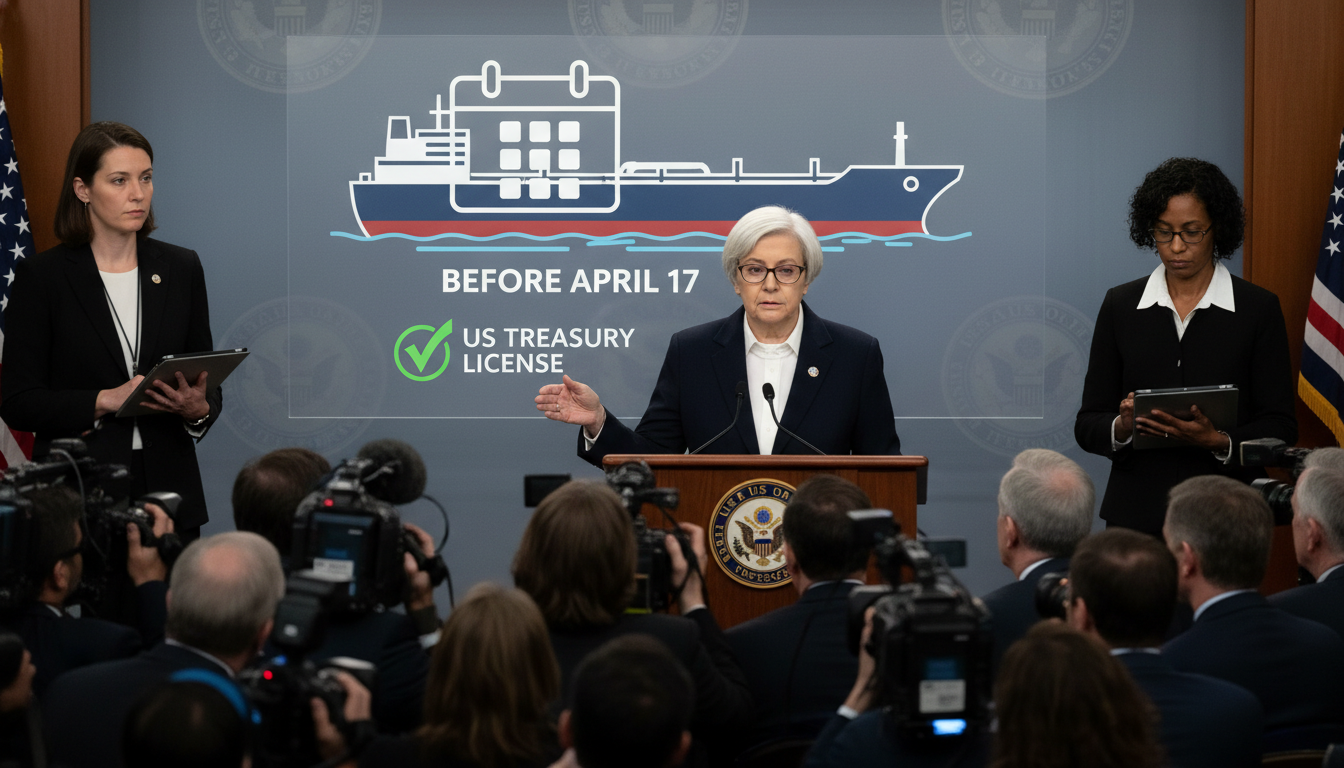
US Treasury Issues General License for Russian Oil Loaded Before April 17
US Treasury general license for Russian oil allows sale and delivery of crude and petroleum products loaded before 12:01 a.m. Eastern Time on April 17, valid until May 16.
The US Treasury issued a general license permitting the delivery and sale of Russian crude oil and petroleum products that were loaded onto vessels prior to 12:01 a.m. Eastern Time on April 17. The license, the Treasury said, will remain in effect until 12:01 a.m. Eastern Time on May 16, creating a defined window for cargoes already at sea or loaded onto ships before the stated cutoff. The move directly affects commercial contracts and shipments that were in transit or due to sail around the mid-April cutoff.
Treasury statement and legal scope
The Treasury’s announcement specified that the general license applies only to oil cargoes loaded onto vessels before 12:01 a.m. Eastern Time on April 17 and that the authorization will expire at 12:01 a.m. Eastern Time on May 16. The department framed the license as a narrowly tailored, time-limited authorization linked to Russia, without extending permission beyond the defined loading and expiration times. Officials did not elaborate on additional administrative guidance in the brief notice, leaving key operational details to be clarified by subsequent Treasury or regulatory communications.
Timing and operational consequences for shippers
Shipping companies, charterers and commodity traders now have a clear legal window to complete sales and deliveries for cargoes loaded before the April 17 cutoff, but they must weigh documentation and compliance risks carefully. Vessels that took on cargo prior to 12:01 a.m. ET on April 17 will still face operational procedures at ports, including customs checks and carrier vetting, while insurers and P&I clubs will reassess exposure tied to shipments covered by the temporary authorization. The fixed expiration at 12:01 a.m. ET on May 16 creates a finite period during which counterparties may finalize transactions while avoiding potential breaches of wider sanctions frameworks.
Commercial and market implications
By allowing previously loaded cargoes to move and be sold, the Treasury’s license is likely to reduce immediate logistical bottlenecks and limit spot-market dislocations tied to abruptly stranded shipments. Buyers who contracted for delivery before the cutoff will find contractual continuity, which can ease last-minute renegotiations and potential litigation over failed deliveries. Market participants, however, will monitor liquidity and insurance availability closely, as renewed uncertainty after the May 16 expiration could prompt volatility in freight rates and prompt short-term repositioning of crude flows across global trade lanes.
Regional and UAE shipping considerations
The Gulf region’s role as a major bunkering and transshipment hub makes the temporary license particularly relevant to ports and service providers in the United Arab Emirates and neighbouring states. Ship operators calling at UAE ports will need to demonstrate compliance with local port state regulations and the documentation tied to the Treasury authorization if cargoes were loaded before the stated cutoff. Maritime service firms in the region may see increased demand to assist with compliance checks, cargo certification and the administrative processes required to move oil covered by the license through international supply chains.
Sanctions backdrop and international context
The license comes against a backdrop of coordinated sanctions and a price cap regime instituted by a group of like-minded countries to restrict revenue flows while permitting limited commercial activity under defined conditions. The Treasury framed the authorization as specific to cargoes loaded prior to the April 17 cutoff and limited in duration, reflecting the balance authorities are attempting to strike between enforcing restrictions and avoiding abrupt disruptions to established commercial arrangements. International partners and financial institutions will continue to interpret the scope of the license in light of their own sanction regimes and compliance obligations.
Compliance challenges for financial and insurance sectors
Banks, insurers and maritime service providers will need to reconcile the Treasury’s temporary authorization with internal risk policies and the compliance checks they routinely apply to oil transactions. Even with a general license in place for qualifying cargoes, counterparties must ensure that funds transfers, documentation and vessel clearances adhere to Treasury guidance and any overlapping restrictions imposed by other jurisdictions. The narrow time window and precise loading cutoff place a premium on rapid due diligence and clear recordkeeping to demonstrate that transactions meet the license’s criteria.
The Treasury’s general license creates a temporary corridor for Russian crude and petroleum products loaded before 12:01 a.m. Eastern Time on April 17 to be delivered and sold through 12:01 a.m. Eastern Time on May 16, offering immediate relief for shipments already in motion while setting a firm expiration that market participants and regulators will watch closely.
