
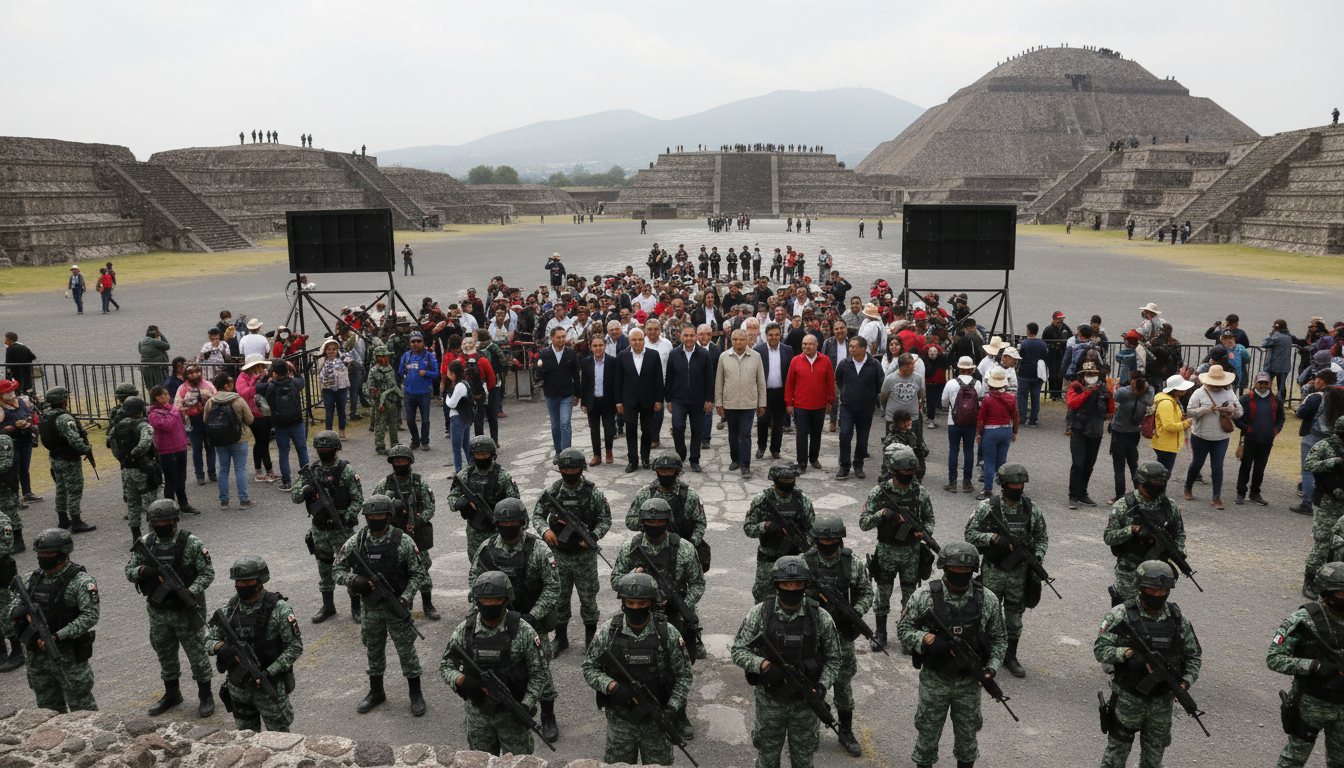
Mexico tightens security after Teotihuacan shooting kills tourist and injures 13
Mexico strengthens security at Teotihuacan after April 20 shooting that killed a tourist and injured 13, heightening concerns ahead of World Cup 2026.
On April 20, 2026 a lone gunman opened fire atop one of the pyramids at Teotihuacan in an attack that killed one Canadian tourist and wounded 13 others. The Teotihuacan shooting has prompted Mexican authorities to announce immediate security reinforcements at archaeological sites and major tourist destinations ahead of the FIFA World Cup 2026. President Claudia Sheinbaum acknowledged gaps in site security and said the federal government would act to prevent similar incidents.
Details of the attack
The shooting occurred on top of a pyramid at the UNESCO World Heritage Site roughly an hour from Mexico City. Visitors and archeological staff were present when the attacker fired, causing panic and injuries before security and emergency services responded. Authorities have described the incident as carried out by a single individual who appeared to have been influenced by foreign attacks, citing a reported reference to the 1999 Columbine massacre.
Initial medical evacuations and on‑site aid were provided to the injured and the scene was secured while investigators collected evidence. Federal and local police have opened an inquiry into the attacker’s motives and movements leading up to the shooting, and officials said forensic teams are working to confirm any external links or influences.
President admits security gaps at site
President Sheinbaum told reporters on April 21 that the archaeological site lacked screening filters that might have detected and prevented the attack. She described the event as an isolated incident for such a public and cultural location, but accepted responsibility for strengthening protections. The president stressed that the government must take “appropriate measures” to ensure public safety at heritage and tourist sites going forward.
Sheinbaum also reiterated government statistics showing a broader decline in homicides since she took office while acknowledging the challenge of addressing different forms of violence. Her comments were aimed at balancing public reassurance with a recognition that existing measures did not anticipate this kind of attack at a major tourist attraction.
Security forces ordered to boost protection
Mexico’s Security Secretary Omar Garcia Harfuch announced stepped up deployments to archaeological zones and other high traffic cultural sites nationwide. The response includes increased presence of the Mexican National Guard, enhanced security checks at access points and improved surveillance technology to detect and deter threats. Officials said the objective is to rapidly identify risks and prevent any recurrence ahead of large international events.
The federal plan builds on measures already announced for the World Cup, which include a heavy security footprint in host cities. Authorities have signalled coordinated operations between federal, state and municipal agencies to secure visitor routes, parking areas and historical precincts that attract large crowds.
World Cup hosting raises security stakes
Mexico will co‑host the FIFA World Cup with the United States and Canada in June and July 2026, and Teotihuacan had been promoted as a key destination for visiting fans. Local lawmakers had recently moved to revive a suspended night time light show at the pyramids as part of planned activities for World Cup visitors. The shooting has increased scrutiny over how public heritage sites will be protected during the tournament period.
Government officials earlier pledged extensive security preparations for the World Cup including the deployment of tens of thousands of personnel and military assets in and around the three Mexican host cities. The federal administration has highlighted a reduction in homicides and targeted operations against major cartel figures as part of a wider security narrative, while international organisers including FIFA have expressed confidence in Mexico’s ability to host safe matches.
Impact on tourism and public confidence
The attack has prompted immediate questions from the tourism industry and international visitors about safety at heritage sites and cultural attractions. Teotihuacan is among Mexico’s most visited archaeological complexes and any perception of vulnerability could affect visitor numbers, particularly during the high profile World Cup period. Tourism officials are working with security agencies to communicate new measures and reassure travellers.
Local tour operators and hotel groups have signalled cooperation with authorities to implement enhanced access controls and to provide clear guidance to guests. Canadian consular services and other foreign missions are monitoring the situation closely and have issued advisories for their nationals while investigations continue.
The federal response is intended to both address the specific security failures identified at Teotihuacan and to demonstrate preparedness for the surge of international visitors expected for World Cup 2026. Authorities say they will continue to assess and adapt measures as the tournament approaches.
