
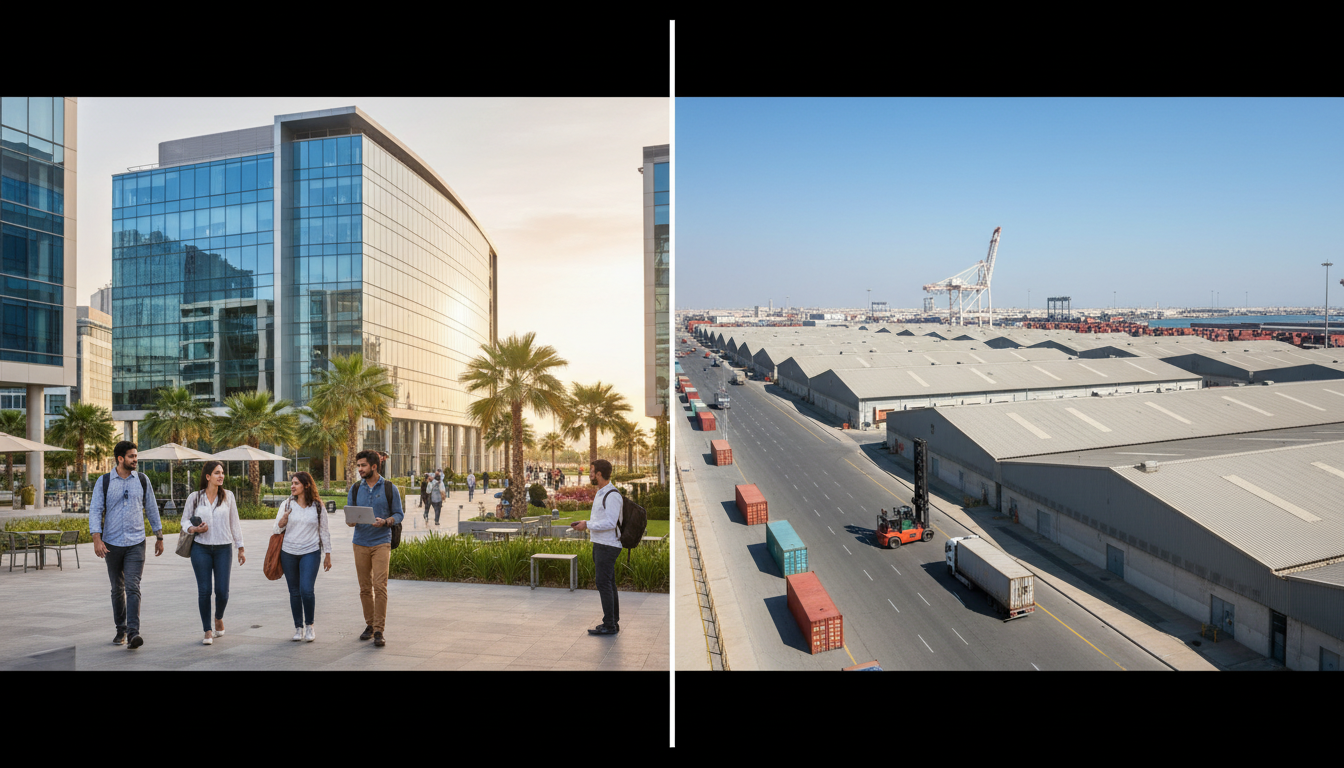
Abu Dhabi free zones: Choosing between Twofour54 and KIZAD for media, trade and logistics
Compare Twofour54 and KIZAD — costs, visas, workspace and activity limits to choose the right Abu Dhabi free zones for media, trade and logistics startups.
Abu Dhabi free zones are attracting startups and established firms alike as the emirate continues to diversify its economy, and a clear choice is emerging between Twofour54 and KIZAD for many businesses. Twofour54 markets itself as the destination for media, content and creative production, while KIZAD positions its infrastructure toward trade, logistics and light industry. This analysis compares licensing costs, visa structures, workspace options and activity permissions to help founders and managers decide which free zone best fits their operations and growth plans.
Twofour54 media-focused licensing and cost profile
Twofour54 offers licensing packages designed around media and creative services, with entry-level fees positioned to make initial setup straightforward for producers, freelancers and small agencies. Reported starting costs for a standard corporate license are in the vicinity of AED 15,000, with some packages structured to reduce or waive fees in the earliest years to lower initial cash outflow. Freelance permits are offered at a lower price point, enabling solo professionals to formalize their activities without the overhead of a full company license.
The zone also provides flexible work arrangements such as flexi-desks and shared office spaces, which keep fixed overheads minimal for teams that are testing the market or operating lean. These options are deliberately tailored to creative enterprises that need access to collaborative space, production facilities and networking opportunities rather than heavy industrial infrastructure. However, the trade-off for that convenience is a narrower scope of permitted activities focused specifically on media and allied services.
Companies that require cross-sector trading or supply-chain functions may find Twofour54’s activity list limiting, and they typically need separate arrangements outside the free zone to conduct non-media commercial operations. For businesses whose core product is content, broadcasting, film production or creative services, Twofour54’s package structure, cost reliefs and industry ecosystem can accelerate market entry while keeping short-term expenses predictable.
KIZAD positioning for trade, logistics and manufacturing
KIZAD, formally Khalifa Industrial Zone Abu Dhabi, is aimed at businesses that need warehousing, assembly, import-export facilitation and light manufacturing capabilities. Its licensing and fee model starts at a lower headline figure for a one-visa license, with entry-level packages beginning around AED 9,450, making it an attractive option for traders and logistics operators mindful of visa and personnel costs. As companies scale and add visa allocations or larger premises, license fees and related charges increase accordingly.
Unlike media-centred free zones, KIZAD emphasizes physical space: industrial plots, warehousing units and logistics yards are core assets of the zone, enabling firms to establish supply-chain nodes within Abu Dhabi’s port and transport network. The availability of physical infrastructure supports businesses that require customs-ready facilities, storage and distribution capabilities, and those that plan to integrate directly with manufacturing or fulfillment operations. For import-export ventures, KIZAD’s setup is often more conducive to operational continuity.
Because many of KIZAD’s permitted activities assume a physical footprint, it is generally less flexible for entirely virtual businesses that want to minimize premises-related commitments. Firms that plan to operate primarily online or provide professional services without physical inventory should weigh whether the benefits of lower visa costs and industrial infrastructure offset the requirement to secure space within the zone.
Comparing license fees, visas and first-year costs
A direct comparison of headline fees shows KIZAD offering lower starting figures for one-visa packages while Twofour54 typically starts higher but offsets that with media-specific incentives and occasional introductory waivers. For a business choosing between the two, total first-year cost is the critical metric: besides the license fee, companies must budget for visas, office or desk rental, insurance, registration charges and any mandatory sponsorship or regulatory compliance expenses. Those add-ons can change the effective cost differential more than the headline license price alone.
Visa allocation and per-visa costs represent a major component of ongoing expense and administrative effort. KIZAD’s entry-level offerings are designed to keep visa-related charges modest at the outset, which benefits small trading teams or logistics operators. Twofour54, by contrast, packages solutions that are friendly to freelance and project-based staffing models, allowing media producers to scale talent up and down without committing to large office footprints. For founders, modeling three-year cost scenarios that include renewals and growth-related charges usually clarifies which zone is more economical.
Longer-term planning should also include an assessment of potential fee escalations and the zone’s renewal policies, since an initially attractive waiver or discount may increase the cost in subsequent years. Business owners who emphasize predictable cash flow should request detailed renewal schedules and a breakdown of recurring costs from free zone authorities before committing.
Workspace models and operational flexibility
Twofour54’s workspace offerings range from flexi-desk arrangements to specialized production studios and shared creative hubs, which cater directly to the workflows of media teams. These shared models reduce fixed costs and provide access to industry-specific facilities such as sound stages, post-production suites and communal meeting spaces that can be expensive to replicate independently. The creative environment also facilitates networking, co-productions and access to local talent pools.
KIZAD’s model focuses on plot-based leases, warehouses and dedicated industrial units that allow for significant operational control and customization for manufacturing and logistics requirements. Tenants gain the ability to design storage systems, loading docks and production lines tailored to their goods and processes. The industrial nature of KIZAD’s offerings means companies will usually assume more responsibility for fit-out and operational compliance but gain greater scalability for inventory-heavy operations.
For hybrid businesses that combine creative services with product distribution, the choice of workspace model matters. Twofour54 enables low-cost creative operations but may force separate arrangements for physical goods, whereas KIZAD supports goods movement and storage but is less suited to concentrated creative production without additional investment in facilities suited to media work.
Activity permissions and market access implications
Permitted activities within each free zone determine not only what you can legally perform under the license but also how easily you can address adjacent market opportunities. Twofour54 restricts permitted activities to media, content production and allied professional services, which is advantageous for companies whose revenue and operations align closely with that ecosystem. The targeted activity list reduces regulatory ambiguity for creative services but limits cross-industry trading under the same license.
KIZAD permits a wider array of industrial, storage and trading activities that are relevant to import-export, distribution and light manufacturing. This breadth of permitted actions facilitates integrated supply-chain solutions and allows firms to centralize warehousing and logistics within the same jurisdictional framework. It is, therefore, more suitable for businesses whose core operations involve physical goods, movement of inventory or manufacturing processes.
Companies that need to operate across both spectrums—creative content and physical product distribution—should anticipate the requirement to hold multiple licenses or establish separate legal entities to comply with each free zone’s activity list. That structural choice has implications for taxation, customs processing and contractual relationships, and it should be accounted for in the initial business plan and legal setup.
Decision factors for founders and managers selecting a zone
Founders deciding between Twofour54 and KIZAD should begin by mapping core business activities to each free zone’s permitted services, then overlay cost modeling for the first three years. If the venture’s primary product is media, content or creative output and the priority is low overhead with industry connections, Twofour54 is often the more efficient route. If the venture focuses on trade, logistics, warehousing or assembly and requires real industrial capacity, KIZAD typically offers better infrastructure alignment and lower visa costs per head at entry.
Other decision factors include the need for customs facilitation, proximity to ports and transport hubs, access to specialized production facilities, and the anticipated pace of hiring and scaling. Regulatory compliance, ease of obtaining visas, and the availability of local partnerships or service providers also weigh heavily in favor of one zone over the other. Entrepreneurs should request a detailed fee schedule, sample lease agreements and activity confirmations from each free zone authority to avoid surprises during the transition from setup to operation.
Practical advice for most applicants includes preparing a clear statement of intended activities, realistic projections for personnel and office needs, and contingency plans for needing additional licenses or external trade arrangements. Early consultation with local business setup advisors or legal professionals who understand free zone nuances can reduce setup delays and ensure the license aligns with the operational model.
Twofour54 and KIZAD present contrasting but complementary options within Abu Dhabi’s wider economic landscape, and each zone’s design reflects targeted policy goals: fostering creative industries in one case and supporting industrial trade and logistics in the other. Choosing the right free zone hinges on aligning a company’s operational needs with those policy-driven strengths, while accounting for total cost of ownership rather than headline prices alone.
Careful upfront analysis and a three-year operational model will typically indicate the more suitable free zone, whether your business is anchored in media production or in moving and storing goods. The decision is rarely irreversible, but it does shape initial market access, regulatory relationships and capital allocation for growth. Companies should therefore prioritize clarity on permitted activities and long-term cost trajectories when selecting a base in Abu Dhabi free zones.
As a final practical step, prepare documentation that clearly defines your intended business activities, estimate your staff and visa needs, and secure written confirmation of permitted activities from the chosen free zone authority to ensure compliance and to prevent costly adjustments after incorporation.
