
Northern Lights Sightings Rekindle Scientific Inquiry and Public Awe
Northern Lights sightings and new research, including a 10,000-antenna radar, are renewing public awe and driving scientific study of auroral electromagnetism.
The unexpected appearance of the Northern Lights over populated and rural areas has reignited both popular fascination and renewed scientific scrutiny of auroral phenomena. Observers and researchers alike are pointing to vivid eyewitness accounts and recent reporting on large-scale instrumentation as signals that the study of auroras is entering a new phase. The phenomenon—commonly called the Northern Lights—remains one of the most visible examples of electromagnetism at work in Earth’s atmosphere.
Unplanned Sightings Bring Wide Public Attention
Several recent accounts describe chance sightings of the Northern Lights in locations far from the Arctic, underscoring how sporadic geomagnetic activity can produce dramatic displays. These unplanned events often occur without warning and prompt a strong emotional response from those who witness them. Social media posts and local reports following such nights have helped scientists and amateur observers coordinate follow-up observations and data collection.
Historic Experiment Revisited
Interest in auroras has a long history, including late 19th-century experiments by Finnish physicist Karl Lemström, who attempted to recreate auroral light with a copper-wire apparatus. Lemström’s mechanism was based on atmospheric electricity and, while it did not replicate true auroral physics, his work generated luminous effects similar to St. Elmo’s fire. Contemporary commentators have revisited his efforts as an example of early experimental curiosity and the limits of period knowledge about charged particles and magnetic interaction.
New Radar Network Aimed at Mapping Auroral Structure
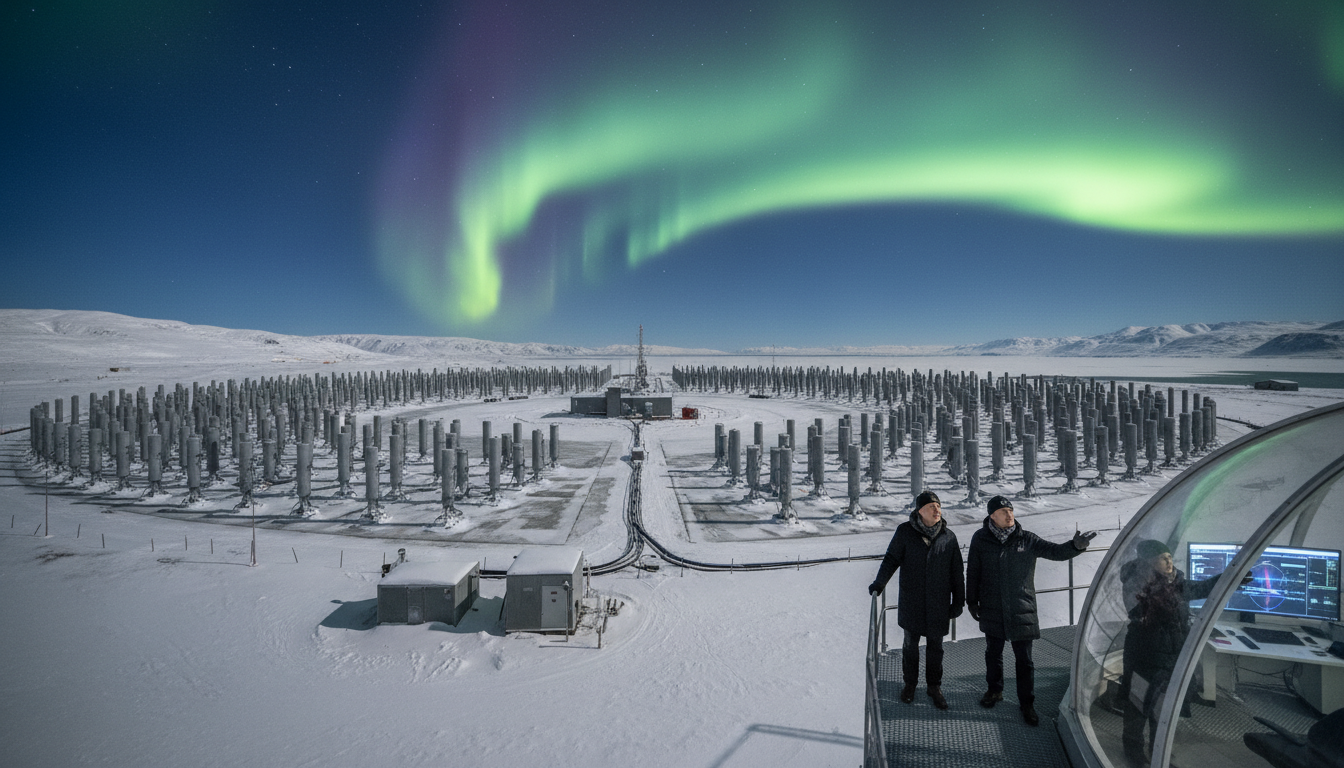
Recent reports have highlighted plans for a major radar installation in Norway that would deploy thousands of antennas to probe fine-scale auroral structure and dynamics. The proposed 10,000-antenna array is intended to measure variations in plasma density and motion with unprecedented spatial resolution. Researchers expect the system to clarify why auroral curtains and columns form, how they shift, and what drives rapid structural changes during geomagnetic storms.
Electromagnetism Connects Space Weather and Life on Earth
Scientists say the aurora is the visible outcome of charged particles from the solar wind interacting with Earth’s magnetic field and atmosphere. That same electromagnetic framework underpins a wide range of natural behaviours, from bird navigation to shark electroreception and the electrical signals that coordinate human physiology. Researchers stress that studying auroras helps improve understanding of space weather, which can affect satellite operations, communications and power grids.
Science and Spectacle Coexist
For many observers, scientific explanation does not diminish the emotional power of the Northern Lights; it often enhances it. Witness accounts frequently describe an abrupt shift from ordinary night to brilliant, shifting light, an experience that leaves lasting impressions of wonder. Scientists and communicators say that sharing both data and personal narratives can deepen public appreciation and encourage responsible observation practices.
Questions Driving Current Research
Key unknowns remain at the forefront of auroral research, including the mechanisms that set the scale for auroral filaments and the processes that determine their rapid motion. Large-scale instrumentation such as multi-antenna radars and coordinated satellite passes are being used to test competing models of magnetospheric and ionospheric coupling. Researchers emphasize international collaboration and real-time data sharing as essential to resolving those questions.
As instrumentation improves and as chance sightings continue to draw attention, interest in the Northern Lights is likely to grow among both scientists and the general public. Observers are being urged to report sightings and to support scientific campaigns that can turn those moments of surprise into improved understanding of the electromagnetic forces that shape our skies.
