
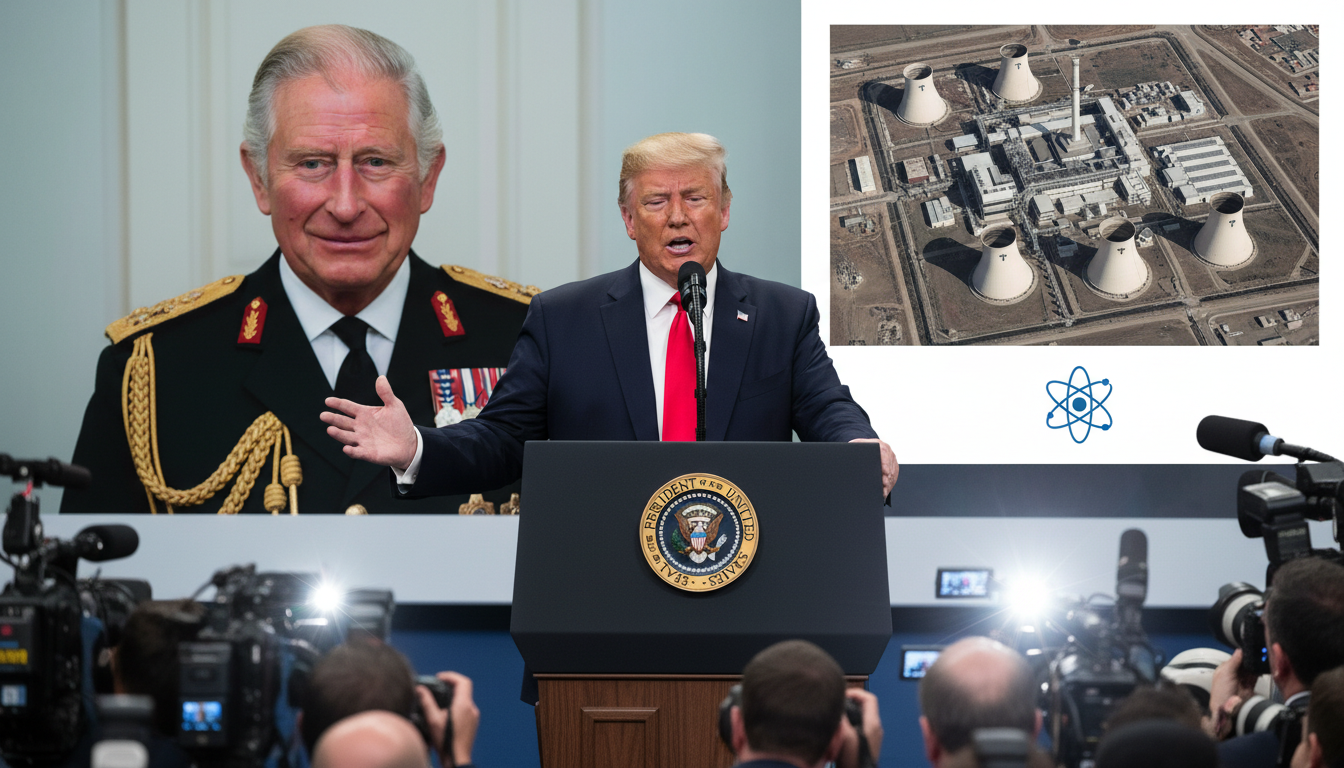
Trump Says King Charles Agrees Iran Must Not Have Nuclear Bomb During State Visit
Trump says King Charles agrees Iran must not have a nuclear bomb and claimed the US ‘defeated Iran militarily’ during the British monarch’s state visit.
President Donald Trump said on the sidelines of King Charles’s state visit that the British monarch agrees Iran must not possess a nuclear bomb, repeating a firm stance on Tehran’s nuclear ambitions. Trump also asserted that the United States had “defeated Iran militarily,” remarks that underline the security rhetoric surrounding the royal trip. The comments, delivered publicly during the high-profile diplomatic engagement, link the UK monarch’s presence in Washington to a renewed focus on Iran’s nuclear program.
Trump’s Statement During the State Visit
President Trump framed his comments as reflecting an alignment with King Charles on the issue of an Iran nuclear bomb. He told reporters that the monarch “agrees” Iran cannot be allowed to develop such a capability, placing the topic at the center of the visit. The remarks were part of a broader series of public statements made while hosting the British sovereign in Washington.
The depiction of King Charles’s view by the U.S. president was presented without an immediate, separate statement from the British palace confirming the exact wording. Diplomats and officials typically manage such cross-government messaging carefully, and the president’s comments will likely be reviewed in both London and Washington.
Claim That the US ‘Defeated Iran Militarily’
In the same exchange, Trump said the United States had “defeated Iran militarily,” language that escalates the administration’s posture on the region. That assertion appears intended to highlight the U.S. military’s role and to underscore pressure on Tehran over its nuclear program and regional behavior. It is an uncommon formulation for describing U.S.-Iran tensions and is likely to draw scrutiny from foreign policy analysts.
Such statements can influence diplomatic dynamics, particularly as they are made during a state visit that traditionally emphasizes unity and ceremonial ties. Observers will watch for follow-up remarks or clarifications from the White House or the Department of Defense to contextualize the remark.
King Charles’s Role and the State Visit Agenda
King Charles’s state visit to the United States included customary ceremonial events and meetings with senior U.S. officials, offering a stage for broader policy discussions. While monarchs typically avoid direct political intervention, state visits can be used by hosts to raise concerns or reiterate shared commitments with visiting leaders. The issue of Iran’s nuclear ambitions emerged in public comments during the bilateral engagements.
Officials from both capitals typically coordinate the agenda and public messaging for such visits, and any reference to foreign policy priorities is closely managed. The prominence of Iran in the discussion reflects how nuclear non-proliferation remains a key security concern for Western allies.
Diplomatic Implications for UK–US Coordination on Iran
Trump’s claim of shared views with King Charles signals an intention to show UK–US coordination on Iran, though the constitutional position of the British monarch is largely ceremonial. Government ministers in London are responsible for setting and stating the United Kingdom’s foreign policy, and the palace generally avoids commenting on policy specifics. The White House portrayal of agreement may therefore be read as a symbolic expression of allied unity rather than a change in formal diplomatic channels.
Policy coordination between the U.S. and UK on Iran typically involves ministries and diplomatic services rather than royal statements. Analysts will assess whether Washington and London follow up with joint statements or actions that translate the expressed alignment into diplomatic measures.
Regional Security and Nuclear Non‑Proliferation Considerations
The reference to an Iran nuclear bomb brings renewed attention to non‑proliferation frameworks and regional security in the Middle East. Preventing Iran from acquiring a nuclear weapon has been a central objective of Western diplomacy for decades, involving sanctions, negotiations, and diplomatic pressure. Any high-profile public statement by major allies reinforces messaging aimed at Tehran and regional partners.
Experts caution that statements from heads of state or visiting dignitaries can shape perceptions but are most effective when backed by concrete policy steps, including diplomatic engagement, inspections, or coordinated sanctions. The international community will be watching for measurable actions that align with the rhetoric.
Potential Reactions in London, Tehran and Washington
Trump’s remarks are likely to elicit responses from British officials, who may seek to clarify the government’s official position, and from Tehran, which routinely rejects external restrictions on its nuclear program. Washington’s allies and adversaries will interpret the comments within the wider context of current tensions and diplomatic efforts. Public declarations during a state visit can prompt rapid political and media reaction across capitals.
How governments choose to respond formally — through statements, diplomatic notes, or policy moves — will determine whether the comments have a short‑lived media impact or lead to more sustained diplomatic consequences.
The president’s public characterization of King Charles’s view, and his claim about having “defeated Iran militarily,” add a high‑profile line to the record of the state visit and to ongoing debates about how best to prevent Iran from acquiring a nuclear weapon.
