
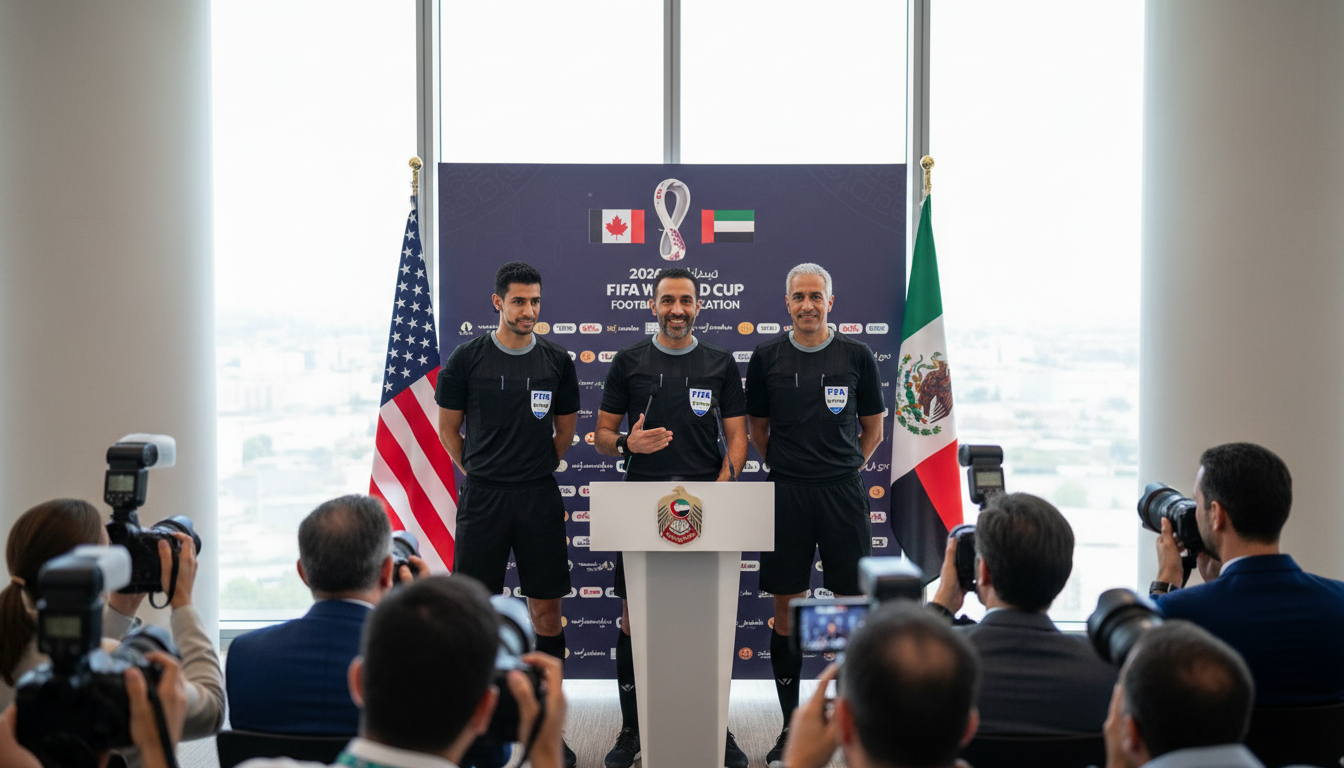
Emirati Referees Lead UAE Presence at FIFA World Cup 2026 with Omar Al Ali
Emirati referees led by Omar Al Ali named to FIFA World Cup 2026 roster, marking the UAE’s eighth appearance and strengthening confidence in Emirati refereeing.
The UAE will be represented at the FIFA World Cup 2026 by a three-man Emirati refereeing team led by international referee Omar Al Ali, a selection that marks the eighth time referees from the country will officiate at football’s flagship tournament. The appointed team includes assistant referee Mohammed Ahmed Yusuf and video assistant referee Mohammed Obaid, and their names on FIFA’s list were welcomed as a significant achievement for Emirati refereeing. The selection arrives amid ongoing domestic debate over the use of foreign referees in the UAE Pro League and is being hailed by former officials as proof of local officials’ quality and readiness for the global stage.
UAE Trio Selected for 2026 World Cup
The trio selected by FIFA to officiate at the 2026 tournament will travel as a unified crew, with Omar Al Ali taking the lead on the field. FIFA’s selection criteria combine fitness, match performance, technical assessments and experience in international competitions, standards the Emirati officials reportedly met. This appointment continues a pattern of UAE representation at the World Cup and signals sustained recognition of Emirati refereeing within FIFA’s global framework.
Former referees and industry observers noted the symbolic weight of a full Emirati team being chosen, not only an individual. They emphasized that having a referee, an assistant and a VAR official selected together demonstrates depth in refereeing training and coordination. The inclusion of a dedicated VAR official reflects FIFA’s emphasis on integrated match management teams at the highest level.
Omar Al Ali Clears FIFA Assessments After International Campaign
Omar Al Ali’s path to the World Cup roster followed a series of FIFA evaluations and tournament assignments that tested his refereeing across continents. His recent appearances at major competitions, including the 2025 FIFA Club World Cup in the United States and the 2023 youth World Cup in Indonesia, were cited by peers as key milestones that strengthened his candidacy. Officials say Al Ali completed the mandatory fitness tests and technical assessments required of all referees shortlisted for World Cup duty.
Colleagues noted that Al Ali’s steady progression through FIFA’s development pathways, including the Asian Football Confederation programs, positioned him favorably. His relatively young age among elite referees was framed as an asset, offering the potential for multiple World Cup cycles if his performance remains strong.
Former Officials Say Selection Is Merit-Based
Former international referees and analysts praised the selection as a reward for merit and consistent performance, countering criticism that domestic reliance on foreign referees undermines local opportunities. Abdullah Al Ajel, a former FIFA-listed referee, highlighted the appointment as evidence that quality and diligence override external narratives. Observers pointed out that assistant referee Mohammed Ahmed Yusuf will be representing the UAE at his third consecutive World Cup, a continuity that speaks to both experience and trust.
Ibrahim Al Muhairi and Ahmed Al Shamsi, also former referees, emphasized that the trio’s selection followed rigorous review and was not the product of chance. They urged stakeholders and fans to view the choice as validation of long-term investments in referee education and international exposure.
Impact on Domestic Debate Over Foreign Referees
The appointment is likely to reframe discussions within Emirati football about the regular use of foreign referees in top-tier domestic matches. Critics of foreign appointments have argued that their prevalence might limit match experience for local officials, while proponents say foreign referees bring independence and high standards. The new World Cup selection has prompted calls for a balanced approach that preserves match integrity while expanding development pathways for Emirati referees.
Sports administrators and league officials were urged to convert this moment into policy, increasing assignments for promising local referees in important fixtures. Several former referees recommended structured mentorship programs linking veteran international referees with domestic prospects to accelerate learning without compromising match management.
Calls for Increased Investment in Refereeing Infrastructure
Leading figures in the refereeing community are asking the UAE Football Association and the Pro League to leverage the World Cup selection by boosting financial, technical and administrative support for referees. Proposals include enhanced fitness and match-simulation facilities, more international exchange opportunities, and a clear career pathway from academy to elite international appointments. Advocates argue that such measures would sustain progress and produce a steady pipeline of officials ready for future World Cup cycles.
There are also calls to expand educational initiatives, including referee academies and workshops aligned with FIFA and AFC standards, to ensure consistent interpretation of laws and modern officiating techniques. Former referees stressed that investment in VAR training and center-field decision-making is particularly urgent given the evolving technological demands on match officials.
The appointment of Omar Al Ali and his colleagues to the FIFA World Cup 2026 roster has been welcomed across the Emirati football community as both a national milestone and a practical rebuttal to critics of domestic referee development. As the team prepares for the tournament, stakeholders are urging that this achievement be translated into sustained support, so the UAE can continue to produce officials capable of operating at football’s highest levels.
