
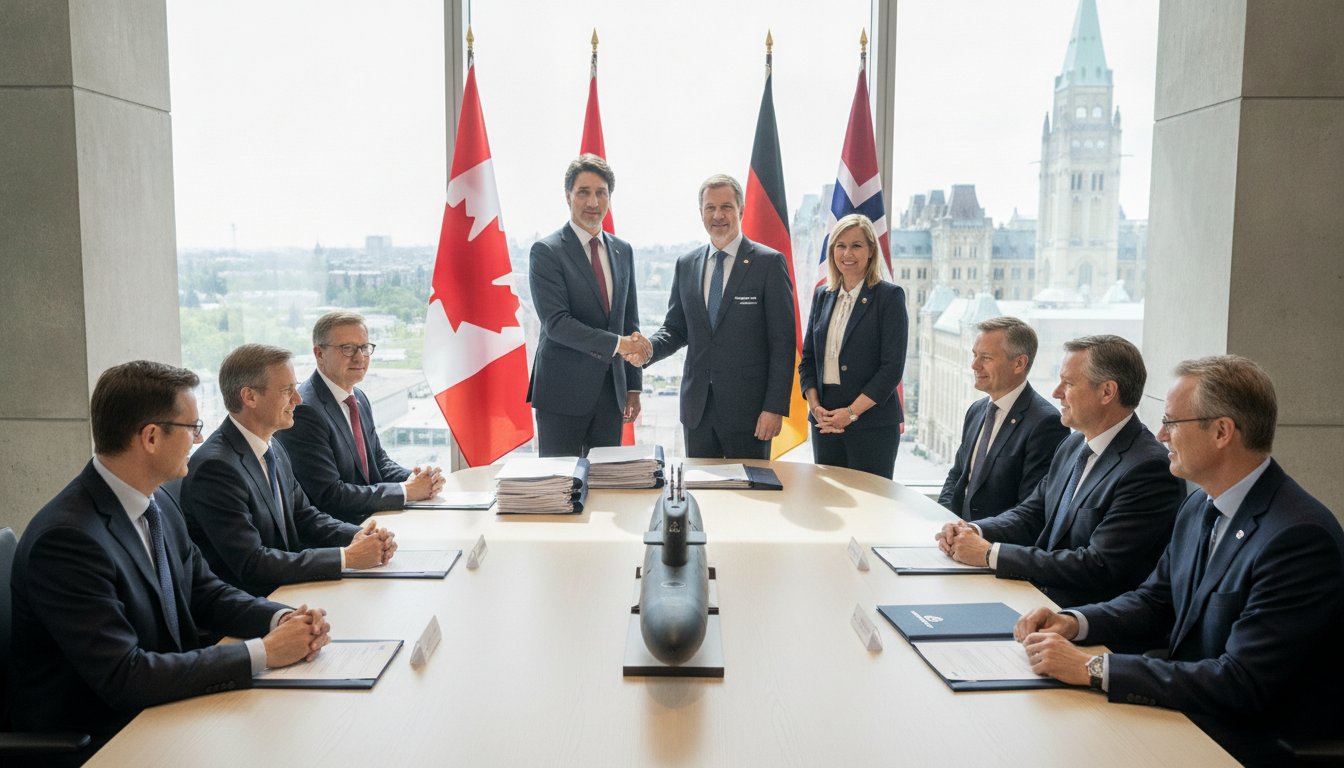
Canada submarine contract awarded to German-Norwegian consortium to build Type 212CD fleet
Canada submarine contract: Ottawa picks German-Norwegian consortium to deliver Type 212CD diesel-electric boats, strengthening Arctic security and trade.
Canada announced on Monday that it has awarded a landmark Canada submarine contract to a German-Norwegian consortium to build a new fleet of diesel-electric submarines for the Royal Canadian Navy. The procurement, described by government officials as the largest military purchase in the country’s history, names ThyssenKrupp Marine Systems in partnership with Norwegian partners as the preferred supplier for up to a dozen Type 212CD submarines. The decision directly ties defence planning to Ottawa’s wider aims of boosting domestic industry, expanding Arctic presence and reducing reliance on U.S. suppliers.
Ottawa selects German-Norwegian consortium
The federal government said it chose a partnership led by ThyssenKrupp Marine Systems to supply the Type 212CD boats after a competitive evaluation that also included a South Korean bidder. Officials framed the award as a balance of strategic, security and economic priorities, noting alliance ties and delivery assurances shaped the outcome. The prime minister emphasized the selection process sought the “absolute best platform and partnership” to meet Canada’s long-term maritime needs.
Type 212CD diesel-electric platform details
The selected Type 212CD is a modern diesel-electric design that combines conventional propulsion with air-independent fuel cell technology to extend submerged endurance. The platform has been offered to several European navies and, while not yet in full operational service for all customers, draws on proven German and Norwegian submarine engineering. The government highlighted the design’s stealth, endurance and adaptability for patrols in cold, shallow waters as reasons it suited Canada’s geography.
South Korea’s bid and public campaign
Hanwha Ocean, the South Korean contender, mounted an extensive and public campaign in Canada that included advertising and outreach to underscore its industrial proposals. Ottawa acknowledged the strength of that bid but said comparative evaluations found both offers broadly capable, each with distinct advantages. Prime Minister Mark Carney spoke with South Korean officials after the announcement and signalled that talks could resume should negotiations with the preferred bidder fail.
Industrial offsets and job promises
Economic benefits and domestic industrial participation were central to the procurement calculus, with both bidders submitting substantial nonbinding commitments on jobs and investment. The government said the programme is expected to generate significant employment across Canada, with official estimates pointing to tens of thousands of positions tied to build, maintenance and supply chains over several decades. Ministers also pressed bidders to firm up concrete manufacturing and supply arrangements inside Canada as part of final contract negotiations.
Arctic strategy and defence spending goals
The submarine procurement is explicitly linked to a broader push to strengthen Canada’s presence in the Arctic as geopolitical competition in polar regions intensifies. Ottawa has been expanding defence spending and has committed to NATO targets; submarines are seen as key assets for long-range maritime surveillance and sovereignty patrols in northern waters. Some naval analysts caution diesel-electric boats have limitations in Arctic operations compared with nuclear-powered submarines, but officials cited cost, logistics and industrial considerations in favour of the selected diesel-electric platform.
Delivery timeline and current fleet shortfall
Government officials said Germany and Norway agreed to shift planned hull allocations to accelerate Canadian delivery, a measure intended to shorten the gap between selection and in-service dates. Final contract value and precise delivery milestones were not disclosed as negotiations remained ongoing, but Ottawa described the programme as a priority that will be implemented “as quickly as possible.” Canada’s existing submarine capability is limited, with only a small number of secondhand hulls in service and a pressing operational need for modern replacements.
The award of the Canada submarine contract reflects an intersection of defence strategy, industrial policy and alliance diplomacy, with Ottawa betting that a European-led build will deliver the capabilities and domestic benefits it seeks. Final contract talks, delivery schedules and the scale of Canadian industrial participation will determine how quickly the Royal Canadian Navy can close its capability gap and project sustained presence in the Arctic.
