
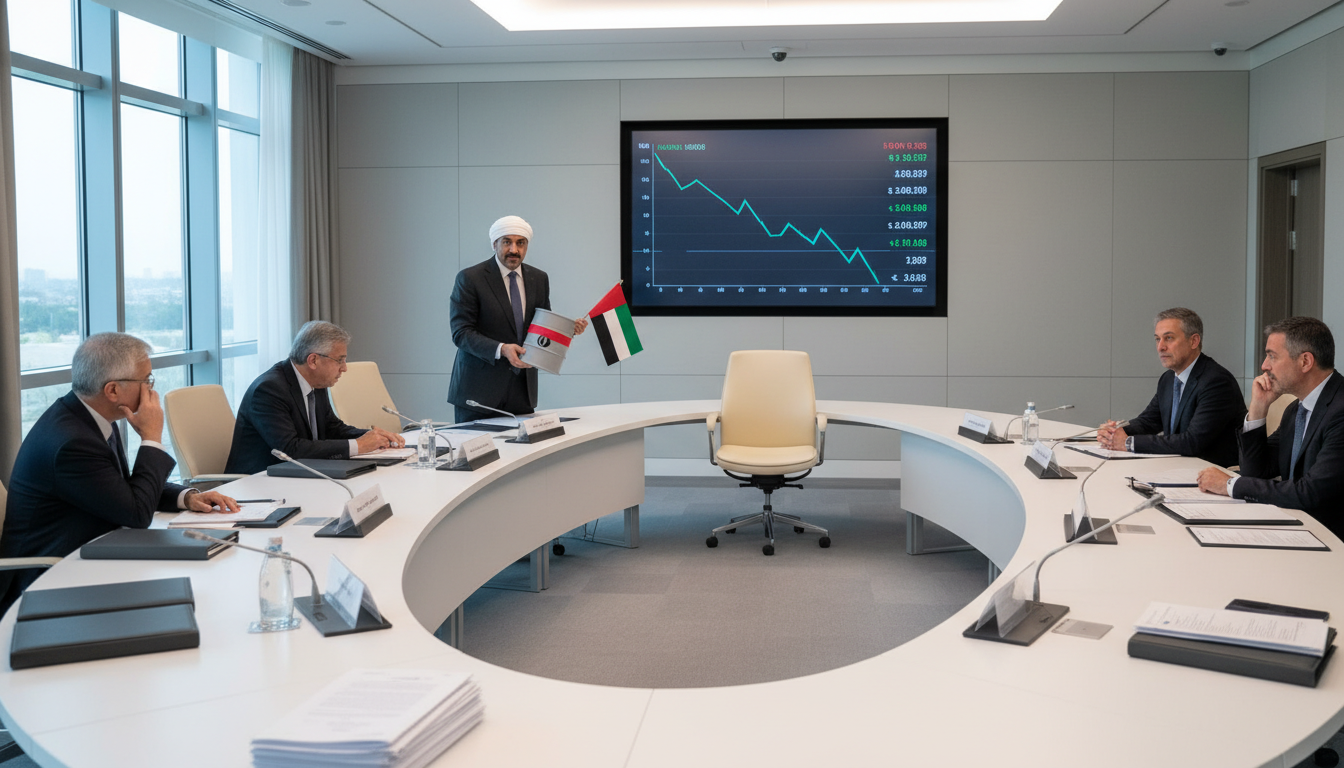
UAE OPEC exit frees one million barrels of spare capacity, analysts warn of wider OPEC erosion
UAE OPEC exit frees about one million barrels of spare capacity, prompting analysts to warn Kazakhstan and Venezuela may follow and weaken OPEC’s pricing power.
The United Arab Emirates’ decision to leave OPEC has released roughly one million barrels of spare capacity back into global markets, industry analysts said on April 30, 2026, in comments that raise fresh questions about the future leverage of the producer cartel. The development, flagged by Chris Weafer, chief executive of Micro‑Advisory Partners, came after the UAE formalised its departure and has sparked warnings that other members such as Kazakhstan and Venezuela could consider similar moves. Market participants and policy makers are now reassessing how OPEC will coordinate output and influence prices with an altered membership dynamic.
Spare capacity and immediate supply impact
The UAE’s exit is estimated to add about one million barrels per day of spare capacity to the global oil system, according to industry analysis cited on April 30, 2026. That additional buffer changes how traders and consuming nations view short‑term supply security, reducing reliance on collective OPEC interventions to steady markets.
Producers with accessible spare capacity tend to blunt price spikes by signalling an ability to increase flows without the need for multilateral decisions. The freed capacity from the UAE therefore not only adds physical optionality but also shifts market psychology toward a less OPEC‑centric outlook.
Analysts flag potential follow‑on exits by Kazakhstan and Venezuela
Chris Weafer of Micro‑Advisory Partners warned that Kazakhstan and Venezuela could be candidates to depart OPEC, a scenario that would further dilute the cartel’s cohesion. Both nations have unique domestic and geopolitical pressures that could make unilateral policy moves more appealing than collective action.
If either Kazakhstan or Venezuela were to follow, the balance of supply coordination within OPEC would be strained, complicating efforts to manage output and price targets across a broader and more fragmented group of oil exporters.
Market reaction and price outlook
Traders responded to news of the UAE’s exit with increased short‑term volatility in benchmark crude prices as markets digested the change in surplus capacity. Analysts said the immediate effect is likely a modest dampening of price spikes, although longer‑term direction will depend on global demand growth and spare capacity deployments.
Risk premia tied to geopolitical outages may look smaller with more independent capacity outside OPEC’s direct control. However, if coordination among remaining OPEC members tightens or Russia and other partners on OPEC+ adjust output, the net effect on prices will be more complex and potentially temporary.
Implications for OPEC’s coordination and global influence
The UAE’s departure represents a meaningful test of OPEC’s ability to maintain influence when a significant Gulf producer steps away from the group’s collective framework. OPEC’s historical strength has rested on member discipline and the capacity to present unified output strategies to global markets.
A succession of exits would force remaining members to rely more heavily on bilateral arrangements or on informal alliances, potentially weakening OPEC’s role as a central arbiter of oil price stability. Policymakers in consuming nations are likely to reappraise strategic stockpile policies in response to a less predictable cartel.
Regional and UAE policy considerations
For the UAE, exiting OPEC appears aligned with a strategy to secure greater unilateral control over production flexibility and to prioritise national commercial and investment interests. Abu Dhabi has been diversifying its energy portfolio and expanding downstream and renewable projects, moves that can be pursued independently of OPEC’s collective commitments.
Domestically, the shift allows the UAE to manage output decisions in line with fiscal targets and long‑term economic plans, while preserving relationships with major buyers. The government will also face the task of communicating the implications of the move to investors and regional partners to limit market uncertainty.
Responses from producers and consumers
Other producers and large consuming countries are monitoring the situation closely, with officials signalling a preference for stability and predictability in supply. Should Kazakhstan or Venezuela indicate interest in leaving, diplomatic and commercial channels are likely to be used to dissuade abrupt changes that could unsettle markets.
Importers dependent on Middle Eastern and Caspian supplies will weigh the benefits of more independently managed capacity against potential coordination shortfalls. Energy firms and traders are already adjusting hedging strategies and supply contracts to reflect a market with greater bilateral negotiation and less collective oversight.
The UAE’s exit from OPEC has injected fresh uncertainty into the global oil landscape by returning one million barrels of spare capacity to the market and prompting warnings that Kazakhstan and Venezuela may follow. As traders, governments and producers reassess exposure, the evolution of OPEC’s internal cohesion and the responses of remaining major suppliers will determine whether the cartel retains its historical sway over prices or becomes one of several competing centers of influence.
