
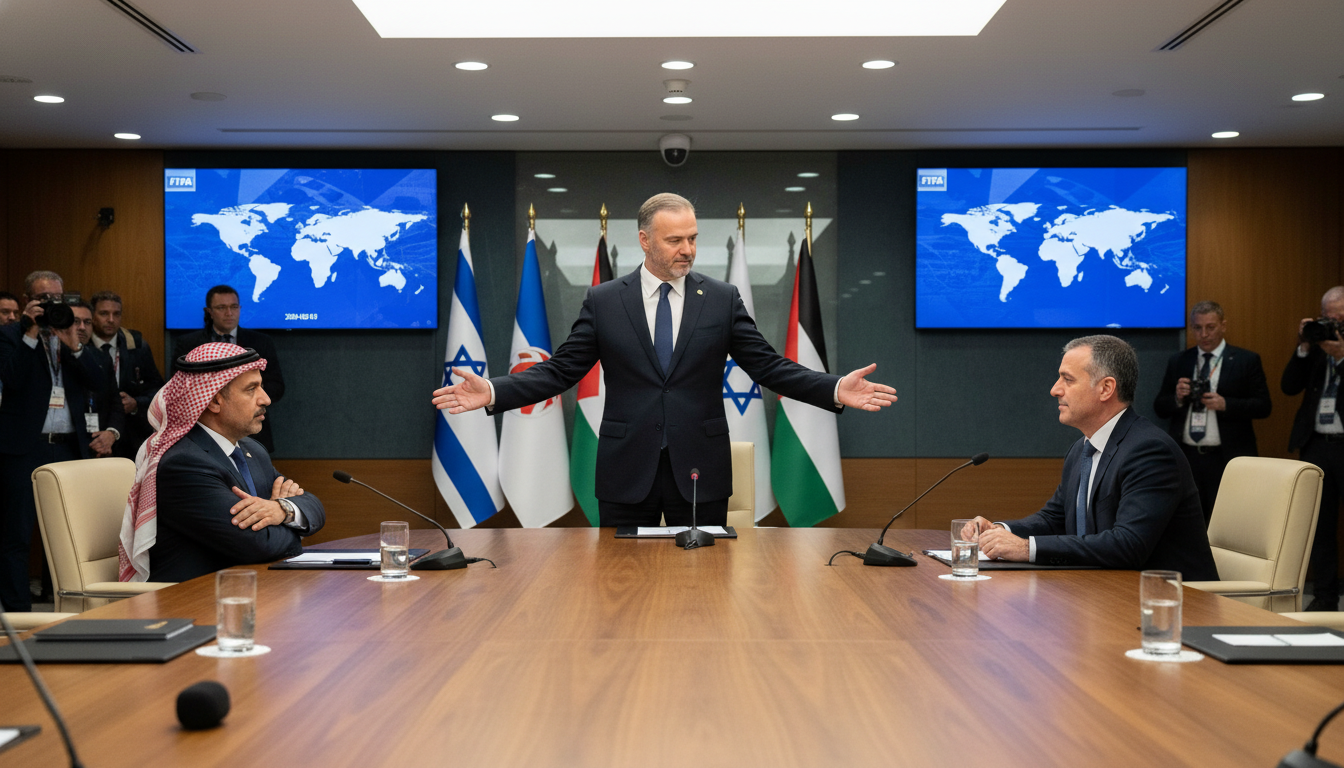
FIFA handshake at congress declined by Palestine FA president Jibril Rajoub
FIFA handshake at the May 1, 2026 congress was declined by Palestine FA president Jibril Rajoub, underscoring political tensions within international football.
Infantino invited a gesture of reconciliation at FIFA congress
FIFA President Gianni Infantino called for a symbolic gesture on May 1, 2026, inviting representatives of the Palestinian and Israeli football associations to shake hands during the organisation’s annual congress. The invitation was presented as an effort to emphasise sport as a bridge between divided communities and to keep political tensions off the football field. Delegates and media present at the congress observed the moment closely, recognising its potential diplomatic and symbolic significance. The request came amid growing debate about how international sporting bodies should handle politically sensitive encounters.
Palestine FA president Jibril Rajoub declines to shake hands
Palestine Football Association President Jibril Rajoub publicly explained his refusal to accept the handshake proposal from his Israeli counterpart, saying his decision was informed by political and moral considerations. Rajoub framed the refusal as a protest against policies and actions he associated with the Israeli state, arguing that ordinary sporting gestures could not be separated from the broader context. He said that accepting the handshake would have been interpreted domestically and regionally as a political endorsement he was not prepared to give. His stance drew immediate attention and set the tone for subsequent reactions within the congress.
Immediate reactions inside the congress and across federations
Reactions among delegates were mixed, with some expressing disappointment at the missed opportunity for a reconciliatory gesture and others defending Rajoub’s choice as consistent with the political realities he represents. FIFA officials reiterated their long-standing position that sport should remain a neutral ground, but also acknowledged the sensitivity of situations where symbolism overlaps with geopolitics. Several national associations—particularly those from the Middle East and North Africa—released measured statements emphasising the need to respect members’ sovereign positions. Media coverage and social media amplified the episode quickly, framing it as another instance where politics and football intersect.
Historical context of sports diplomacy involving Israel and Palestine
The incident is the latest in a series of encounters where Israeli and Palestinian sports representatives have navigated politically charged interactions on international stages. Over past decades, matches and formal meetings have periodically been suspended, boycotted, or politicised in ways that reflect broader diplomatic tensions. International federations including FIFA have faced repeated calls to take clearer positions or to enforce rules that separate politics from sport, while member associations have pushed back, arguing that sport cannot be divorced from human rights and national sovereignty concerns. The May 1 episode underscores how deeply entrenched this history remains and how sporting gestures can be interpreted through multiple political lenses.
Potential implications for FIFA policy and regional football relations
FIFA may feel renewed pressure to review guidance for symbolic gestures between delegations with adversarial political relationships, particularly ahead of major tournaments and high-profile meetings. Policy options could include clearer neutral protocols for greetings, more private bilateral facilitation by FIFA mediators, or reaffirmed statements about the limits of sports diplomacy. Regional confederations and individual football associations in the Middle East may also reassess how they manage diplomatic optics at meetings and competitions. Observers noted that any change in approach would need to balance the organisation’s mission to promote football globally with the political realities its members face.
Calls for dialogue and follow-up statements from stakeholders
Following the congress, several stakeholders called for calm and dialogue, urging both football authorities and political leaders to avoid escalation over a single gesture. Humanitarian and sports advocacy groups emphasised that while symbolism matters, sustained engagement and concrete measures—such as cooperation on youth development and cross-border programmes—can produce tangible benefits. FIFA has the capacity to facilitate technical cooperation without forcing political reconciliation, and some officials suggested parallel tracks for sport-related collaboration and formal political dialogue. Both Palestinian and Israeli associations were expected to issue further statements clarifying their positions in the coming days.
The episode at FIFA’s annual congress on May 1, 2026, demonstrates that symbolic acts like a FIFA handshake continue to carry weight well beyond the football field, reflecting unresolved political disputes and divergent expectations among member associations. The refusal by Palestine FA president Jibril Rajoub has sparked discussion about where sport ends and politics begins, and it has prompted calls for careful, respectful handling of similar encounters in future football forums.
