
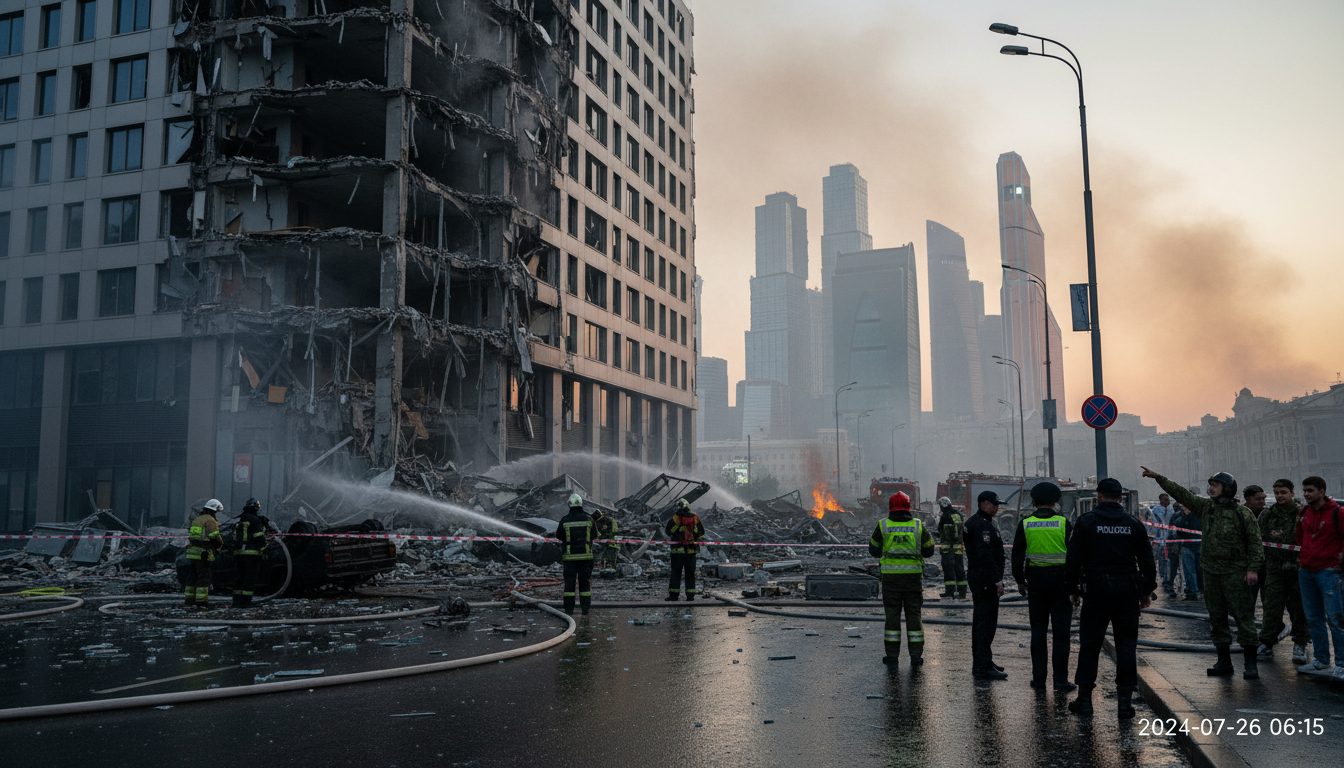
Ukrainian drone strikes kill at least four across Russia, including Moscow suburbs
Ukrainian drone strikes killed at least four people across Russia, including in Moscow suburbs, in Kyiv’s largest assault this year as long-range operations intensify.
Deadly strikes hit Moscow suburbs and other towns
At least four people were killed and more than a dozen wounded after drones struck residential areas in the Moscow region, Russian officials said. Regional governor Andrei Vorobyov reported three fatalities and 12 injuries in the suburbs of Khimki and Mytishchi, and said homes and apartment complexes were also damaged in four other towns.
The strikes mark the most significant Ukrainian drone operation directed at Russian territory this year and underline a pattern of long-range attacks reaching deep into areas close to Russian power centers. Russian state media and officials said the attacks reached locations near key infrastructure and residential districts.
Russian military tallies and Ukrainian claims differ
Russia’s Ministry of Defense reported that 556 Ukrainian drones had been intercepted or shot down across more than a dozen regions. Those figures were released through Russian state channels and highlight Moscow’s assessment of the scale and breadth of the incoming attacks.
Ukrainian authorities framed the operation as a calibrated response to Russian strikes on Ukrainian cities, and Kyiv has publicly signaled an intention to expand the reach and intensity of long-range strikes. Both sides’ tallies and descriptions of events vary, reflecting the contested information environment surrounding the conflict.
Impact on transport and energy infrastructure
Moscow Mayor Sergei S. Sobyanin said a drone struck a checkpoint near the Moscow Oil Refinery, injuring construction workers but not disrupting refinery operations. Local authorities also reported debris and damage at transport facilities, raising concerns about wider disruptions to civilian services.
Videos circulated by independent Russian outlets showed a fire on a runway at Sheremetyevo airport and officials said drone debris landed at a safe distance from passenger areas. The airport announced that roughly 200 flights were canceled, delayed, or rerouted as a result, according to local reports.
Kyiv’s stated justification and presidential remarks
President Volodymyr Zelensky described the attacks on the Moscow region as an “entirely justified” response to Russian strikes on Ukrainian cities, framing them as part of a broader campaign to pressure Russia’s ability to sustain the war. He also said the operations were intended to convey a strategic message to Moscow about the costs of continued aggression.
In social media statements, Mr. Zelensky indicated Kyiv would continue to extend the reach of its strike capability, and he posted footage Kyiv says shows recent long-range operations. Ukrainian leaders have linked their intensified campaign to Russian attacks that caused civilian casualties in Ukraine earlier in the week.
Civilian toll and emergency response
Emergency services in affected Russian towns were mobilized to extinguish fires, evacuate residents, and assess structural damage after the strikes. Local authorities reported a mix of residential and service buildings affected, with search-and-rescue operations ongoing in some areas.
Healthcare facilities treated dozens of injured civilians, and regional officials appealed for calm while investigations proceeded. The strikes have prompted renewed public concern in communities close to Moscow, where residents reported disrupted services and visible damage to neighborhoods.
Broader military dynamics and recent exchanges
The latest cross-border drone operation comes amid an intensifying cycle of strikes by both sides. Russian forces launched a separate wave of roughly 287 attack drones against targets across Ukraine overnight, and Ukraine’s Air Force reported that nearly all of them were intercepted, with only eight reportedly reaching their aims. Ukrainian authorities said the Russian barrage caused at least two deaths and injured around two dozen people inside Ukraine.
Observers note that the heightened tempo of long-range drone activity influenced the Kremlin’s recent decision to scale down national parade activities on May 9 and to accept a temporary lull around that event for security reasons. Officials in Moscow have repeatedly said they are adapting air defenses and civil protections in response to the evolving threat.
The concentrated use of drones by both sides underscores how unmanned systems have altered front-line and rear-area dynamics, enabling strikes at distances that previously would have been harder to achieve without manned aircraft or ballistic systems. Analysts warn that continued escalation could broaden the geographic footprint of attacks, increasing the risk to civilian infrastructure and non-combatants.
The unfolding incidents will be closely monitored by international observers and policymakers, as the pattern of reciprocal long-range strikes shapes diplomatic calculations and humanitarian concerns in the months ahead.
