
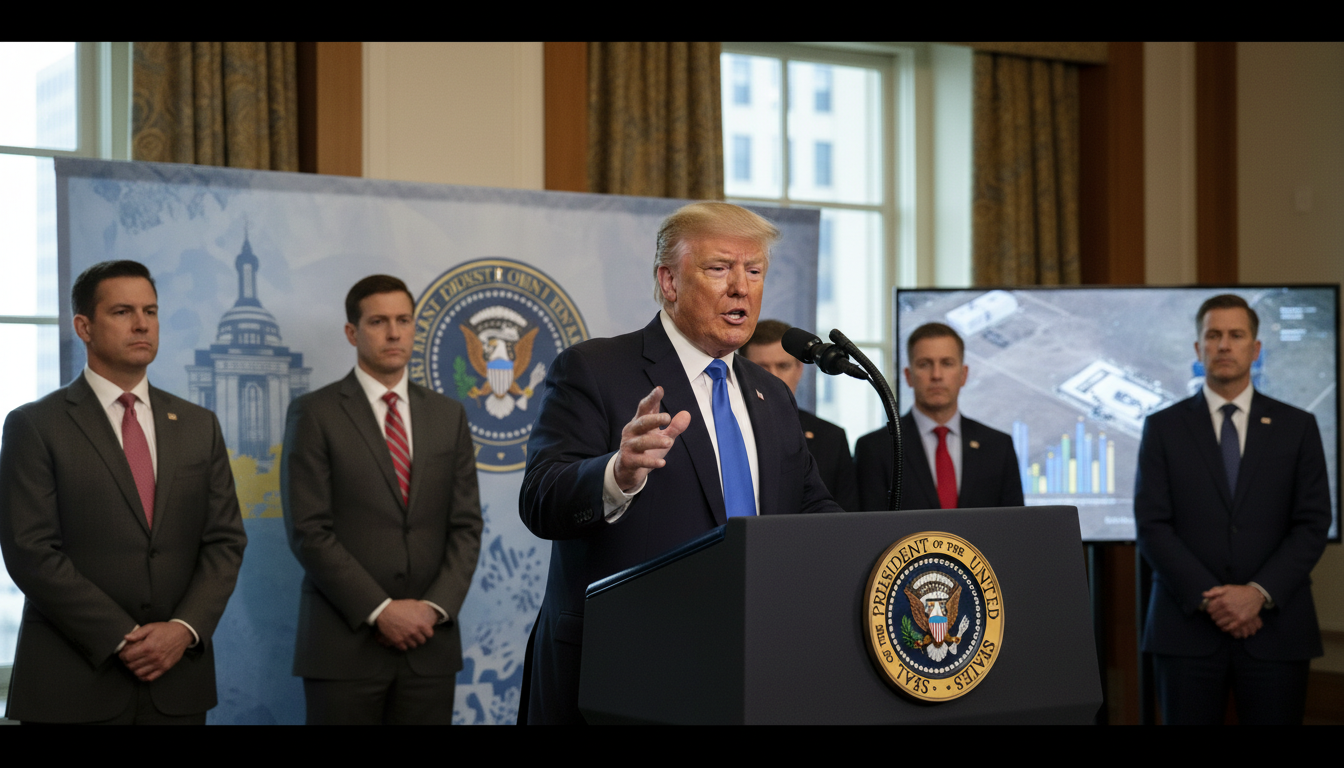
Trump Iran comments: President Dismisses Tehran’s Military Threat and Warns Against Nuclear Arms
President Donald Trump’s Iran comments portray U.S. action as a “minor skirmish,” label Iranian leaders as “mentally ill,” and warn that Washington will prevent Tehran from acquiring nuclear weapons.
President Donald Trump on Monday delivered a pointed assessment of U.S.-Iran tensions, describing recent American measures as a “minor skirmish” and reiterating a vow to block Tehran from obtaining nuclear arms. The president’s remarks, which form the core of his Trump Iran comments, also included sharp characterizations of the Iranian regime and forceful claims about Iran’s military capabilities. His statements are likely to shape diplomatic messaging in the coming days and draw responses across the region.
Trump Frames U.S. Action as ‘Minor Skirmish’
In his remarks, President Trump characterized the current confrontation with Iran as a limited engagement, referring to it as a “minor skirmish” rather than a broader conflict. He appeared to downplay the likelihood of a larger military escalation while signaling continued readiness to confront Tehran if necessary.
The framing sets a tone intended to reassure domestic and allied audiences that Washington is managing the situation without seeking full-scale war. Trump Iran comments in this vein aim to balance deterrence with restraint, according to his public statements.
Direct Accusations Against Iranian Leadership
The president used highly charged language to describe Iran’s leadership, saying the regime “consists of mentally ill people” and warning against allowing them access to nuclear weapons. That rhetoric was delivered as part of the same set of remarks that included the “minor skirmish” characterization.
By personalizing the threat, the president reinforced a narrative that portrays Tehran’s rulers as unpredictable actors. Those comments form the most explicit and confrontational elements of the Trump Iran comments that observers have highlighted.
Claims on Iran’s Naval and Air Capabilities
Trump also asserted that Iran “has no navy and no air force” and suggested those capabilities had been neutralized, saying they had been “entirely destroyed” and that commanders had been killed. He presented these points as evidence that Iran currently lacks the military means to mount a significant confrontation.
These statements were offered as part of the same public address and reflect the president’s effort to depict the balance of force in stark terms. The claims are presented as the president’s assessment and have not been independently verified within his remarks.
Nuclear Warning and Policy Rhetoric
A central element of the Trump Iran comments was an uncompromising pledge: the United States will not allow Iran to obtain a nuclear weapon. The president framed that stance as a bipartisan security imperative and used it to justify ongoing pressure on Tehran.
This line of argument ties together military posture and non-proliferation policy, underscoring that preventing nuclear proliferation remains a stated priority for the administration. It also signals potential continuity in U.S. Iran policy irrespective of short-term tactical moves.
Regional and Diplomatic Repercussions
The president’s language is likely to reverberate across the Gulf and beyond, where regional capitals monitor U.S.-Iran dynamics closely. Strong rhetorical postures can affect diplomatic channels, commercial risk calculations, and the posture of U.S. partners in the region.
Countries with direct security stakes in the Gulf may accelerate consultations with Washington, and international organizations could intensify appeals for de-escalation. The Trump Iran comments are therefore significant not only for their content but for their potential to influence regional diplomatic activity.
International Response and Strategic Implications
At the time of the address, formal responses from foreign governments and multilateral institutions had not been widely reported. Analysts will likely assess whether the rhetoric signals a shift in operational policy or serves primarily as messaging to deter further actions by Tehran.
Strategically, the interplay between public rhetoric and behind-the-scenes diplomacy will be central to determining the next phase of interactions between Washington and Tehran. The Trump Iran comments will be parsed for indications of intent, thresholds for action, and the likelihood of renewed diplomatic engagement.
The president’s remarks add a pronounced rhetorical dimension to an already tense relationship, emphasizing deterrence and prevention while leaving open questions about verification and diplomatic follow-through.
