
US fighter fires on Iranian oil tanker in Gulf of Oman, disabling rudder
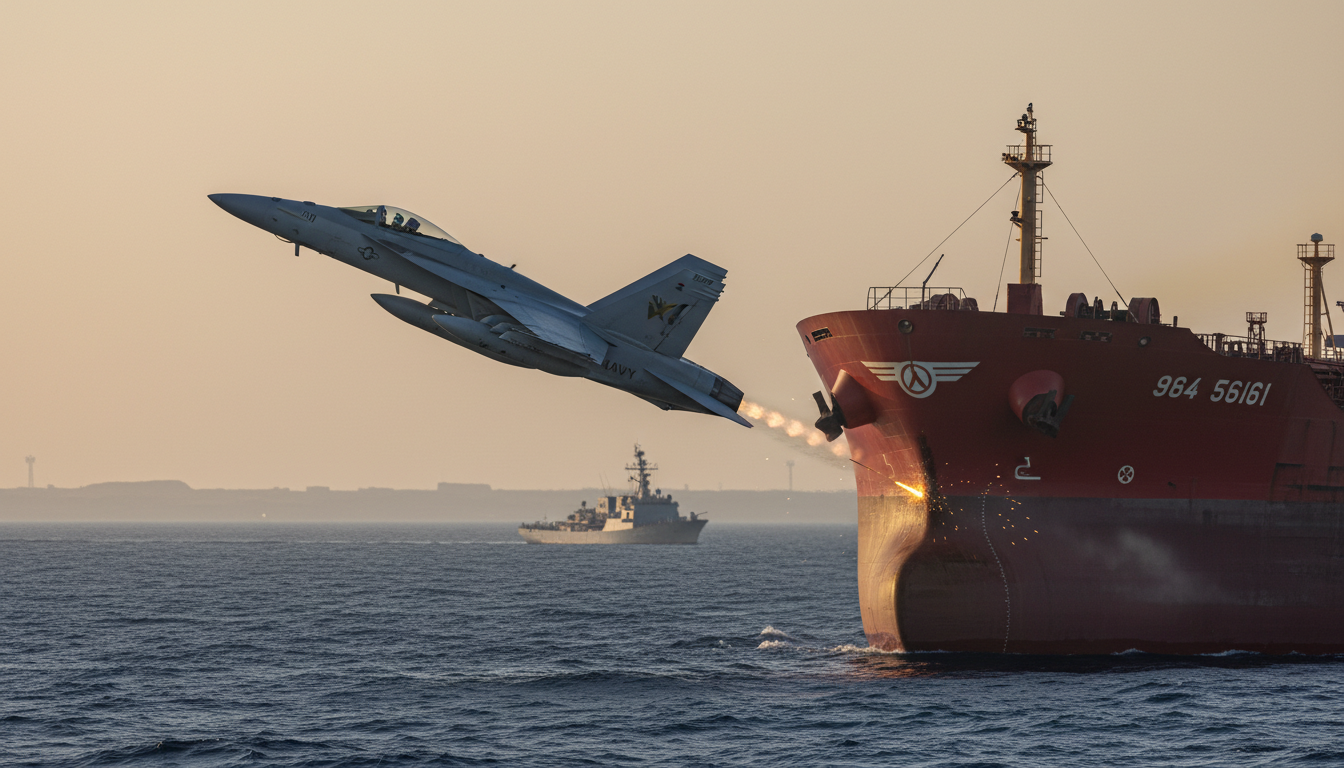
US fighter fires on Iranian oil tanker in Gulf of Oman, disabling the rudder of M/T Hasna on May 6, 2026 after repeated warnings amid a US maritime blockade.
The United States military said a U.S. fighter jet fired on an Iranian-flagged oil tanker in the Gulf of Oman on Wednesday, disabling the vessel’s rudder after the ship allegedly ignored multiple warnings while attempting to reach an Iranian port. (centcom.mil)
Incident in the Gulf of Oman
On the morning of May 6, U.S. forces observed the unladen oil tanker M/T Hasna transiting international waters en route to an Iranian port and determined it was attempting to breach a U.S.-declared maritime blockade. The Central Command said the tanker did not heed repeated orders to stop, prompting kinetic action to halt its transit. (centcom.mil)
The action involved rounds fired at the vessel’s rudder, rendering it unable to steer and stopping its approach to Iranian waters. U.S. officials described the measure as a targeted disabling of the ship rather than an attempt to sink or board it. (maritime-executive.com)
CENTCOM statement and public posts
U.S. Central Command posted details of the engagement on its social media channel, saying forces issued several warnings before taking action against the tanker for violating blockade measures. The statement framed the action as an enforcement step intended to maintain compliance with the interdiction campaign. (centcom.mil)
CENTCOM emphasized that personnel acted deliberately and professionally, and that the blockade of ships entering or departing Iranian ports remains in force as part of broader maritime operations. The command also said the tanker was unladen when observed transiting toward Iran. (centcom.mil)
Assets and tactics used in the operation
U.S. forces deployed an F/A-18 Super Hornet, launched from the aircraft carrier USS Abraham Lincoln, which fired several 20mm cannon rounds to disable the Hasna’s rudder, according to military accounts. The use of aircraft cannons rather than larger munitions was described as a calibrated measure to end the transit while limiting damage. (stripes.com)
Officials said the tactic allowed CENTCOM to enforce the blockade without diverting surface warships for a boarding or seizure, illustrating a preference for precision interdiction methods in contested maritime environments. The operation reflects evolving rules of engagement in ongoing regional operations. (navytimes.com)
Blockade enforcement and timeline
The U.S. maritime interdiction campaign was announced earlier this month as part of efforts to restrict Iranian port access, and U.S. forces have since moved to prevent vessels from entering or leaving Iranian harbors. CENTCOM has described the effort as necessary to limit materiel flows tied to wider regional hostilities. (navytimes.com)
The Hasna interception is the latest in a series of maritime enforcement actions and confrontations in the Strait of Hormuz and Gulf of Oman, where both states and non-state actors have carried out strikes, seizures and interdictions in recent weeks. Officials note that enforcing the blockade has required a combination of surface, air and intelligence assets. (apnews.com)
Regional security and diplomatic fallout
Regional governments and commercial shipping stakeholders are closely monitoring the incident for signs of escalation, as repeated interdictions risk heightening tensions at sea and disrupting vital energy and trade routes. Analysts warn that actions perceived as aggressive could complicate ongoing diplomatic efforts. (apnews.com)
Diplomatic channels in the Gulf and beyond have been active since the start of the broader conflict, with neighboring states and international actors urging restraint while also urging safe passage for civilian and commercial vessels. Authorities continue to stress the need to protect merchant shipping amid competing military objectives. (apnews.com)
Implications for global shipping and energy markets
Maritime insurers, shipping firms and energy markets have reacted to successive incidents by recalibrating risk assessments for transit through the Strait of Hormuz and adjacent waters. The disabling of an oil tanker, even one reported as unladen, underscores the vulnerability of commercial seaways to military enforcement actions. (maritime-executive.com)
Market and logistics watchers say continued interdictions could increase insurance premiums, reroute shipments and place additional strain on global supply chains that rely on steady flows of crude and refined products through the region. Nations with economic exposure to Gulf shipping are weighing measures to limit economic damage while seeking diplomatic solutions. (apnews.com)
The United States said it will maintain the blockade and continue enforcement actions to ensure compliance, while regional and international diplomatic actors urge de-escalation and protection of civilian maritime traffic. The Hasna incident marks a notable escalation in maritime enforcement tactics that will be watched closely by governments and commercial interests alike. (centcom.mil)
