
China Exports Its Surveillance State, Selling AI Policing Tools to Vulnerable Nations
China exports its surveillance state: Beijing’s policing model and AI-enabled tools spread across developing countries, sparking debate and local pushback.
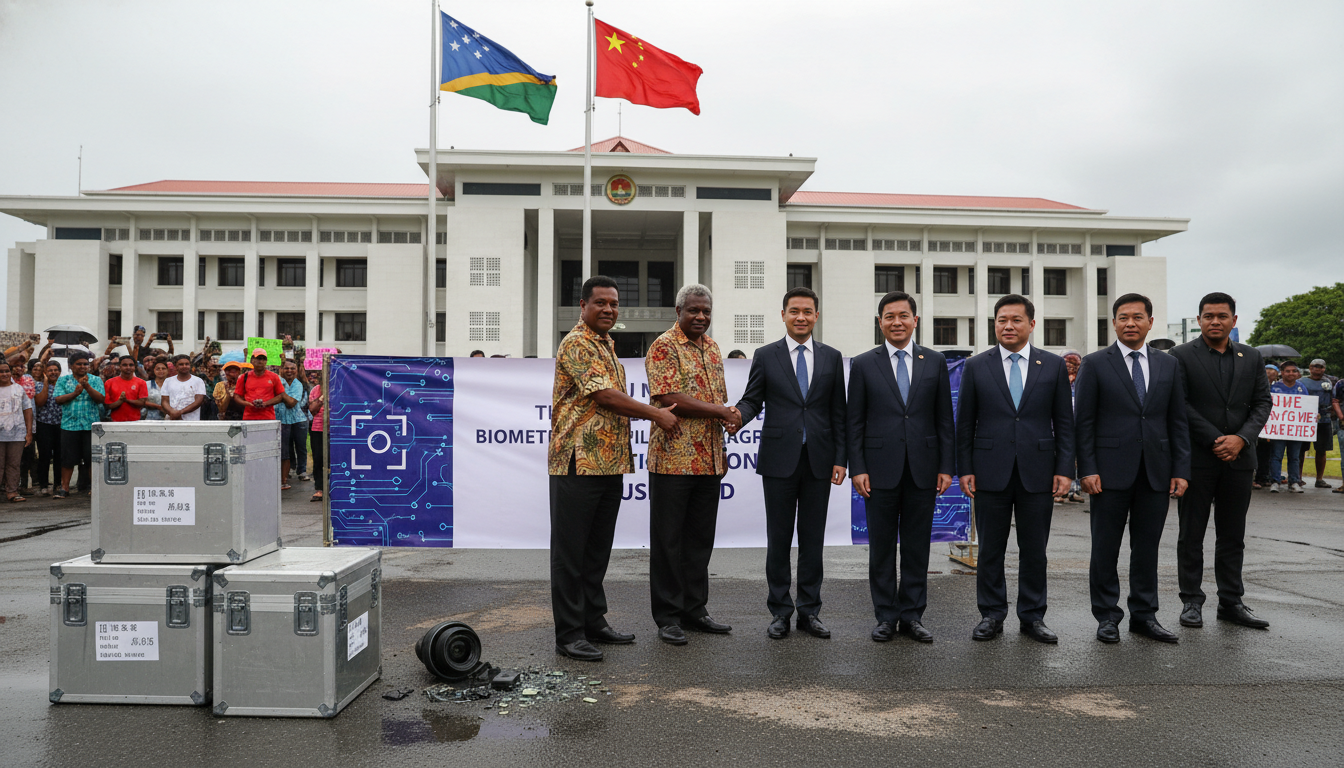
China’s model of state surveillance — now augmented by artificial intelligence and biometric systems — is being offered beyond its borders, prompting alarm among rights advocates and political leaders in several partner countries. The Solomon Islands recently became a flashpoint after Chinese police advisers proposed a pilot to register fingerprints and palm prints of villagers and map household data, a plan that was suspended amid public outcry. Observers say the export of Beijing’s policing practices combines training, hardware and an ideological framework that binds security to social control.
Beijing’s blueprint for domestic control
China has spent decades building a dense security architecture at home that combines cameras, biometric databases and community policing. Under initiatives promoted by central authorities, local officials are encouraged to integrate party oversight into everyday life and to use technology to monitor movement and behavior. Critics point to mass biometric collection and intensive monitoring of minority regions as examples of how these systems can be used to suppress dissent while being presented as crime-fighting measures.
This domestic experience has evolved to include AI tools that can perform facial recognition, gait analysis and pattern detection, increasing the speed and scope of surveillance. The same toolkit that authorities describe as improving public safety has also been associated with restrictions on free expression and enhanced powers of social control, experts say.
Security pact and the Solomon Islands pilot
In 2022 the Solomon Islands signed a security pact with Beijing that opened channels for Chinese police cooperation, training and equipment donations. Local authorities say the pact was intended to bolster law enforcement capacity after episodes of unrest that targeted certain communities and businesses. Chinese advisers later proposed a village-level pilot that would collect biometric identifiers and household registries as part of a community surveillance approach.
The proposal touched off a political backlash when prominent local figures and civil society questioned both the legality and cultural appropriateness of broad biometric registration and neighbor-led monitoring. The pilot was suspended before any biometric data were gathered, and government officials subsequently indicated they would reassess how external assistance is applied on the ground.
How China exports policing: training and equipment
Beijing’s overseas security engagement is multifaceted, combining formal training programs, donated hardware and embedded advisory teams. Over the past two decades China has increased police-to-police exchanges and provided surveillance systems, riot gear and technical support to a wide range of states. In some cases governments have publicly showcased Chinese advisers in community events and joint demonstrations to emphasize cooperation and capability-building.
Such assistance can include everything from drone displays and crowd-control equipment to camera networks integrated with central monitoring centers. Analysts warn that the transfer of hardware and tactics often carries with it operational doctrines and approaches to governance that reflect China’s own domestic priorities.
Local backlash and legal concerns
The prospect of dense neighborhood surveillance and mandatory biometric registries has raised legal and ethical questions in partner countries. Critics argue that programs modeled on community reporting and surveillance undermine traditional dispute-resolution customs and can erode privacy protections. Local leaders in affected communities have described the proposals as inconsistent with local norms and as a potential source of social tension.
Public commentary and grassroots opposition played a decisive role in the Solomon Islands case, where commentators argued that police lacked the mandate to collect sweeping personal data. That response demonstrates how local politics and civil-society pressure can stall or reshape externally driven security initiatives.
Regional responses and geopolitical stakes
Beijing pitches its security assistance as a ready-made solution for governments facing crime, unrest or weak institutional capacity, and some leaders have embraced the support as practical and immediate. Yet security cooperation also carries geopolitical implications, as states weigh the trade-offs between capacity-building and potential dependency or influence. In the Solomon Islands the agreement followed a diplomatic realignment and became entangled with broader tensions over foreign presence and domestic governance.
Across Africa, Southeast Asia and the Pacific, officials have responded with a mixture of receptiveness and caution, sometimes accepting equipment and training while seeking limits or safeguards. The divergent reactions reflect differing domestic politics and the competing demands of sovereignty, stability and human-rights obligations.
Questions for global governance and human rights
Human-rights groups and some scholars urge stronger international norms and oversight to govern cross-border transfers of surveillance technology and policing methods. They argue that donor transparency, judicial safeguards and clear limits on data collection should accompany any technical assistance. Others say recipient states must balance security needs with accountability mechanisms that protect citizens’ rights.
Experts who have studied China’s international training programs caution that exporting a model framed as public-safety success can obscure its political uses. Renewed attention to procurement practices, contractual terms and the role of local institutions will likely shape how — and whether — such programs expand in coming years.
The Solomon Islands episode illustrates how imported policing models can collide with local expectations and law, producing political pushback and policy reversals. As more countries consider offers of technology and training, governments and watchdogs will face pressing choices about oversight, consent and the long-term consequences of adopting surveillance-centered security frameworks.
