
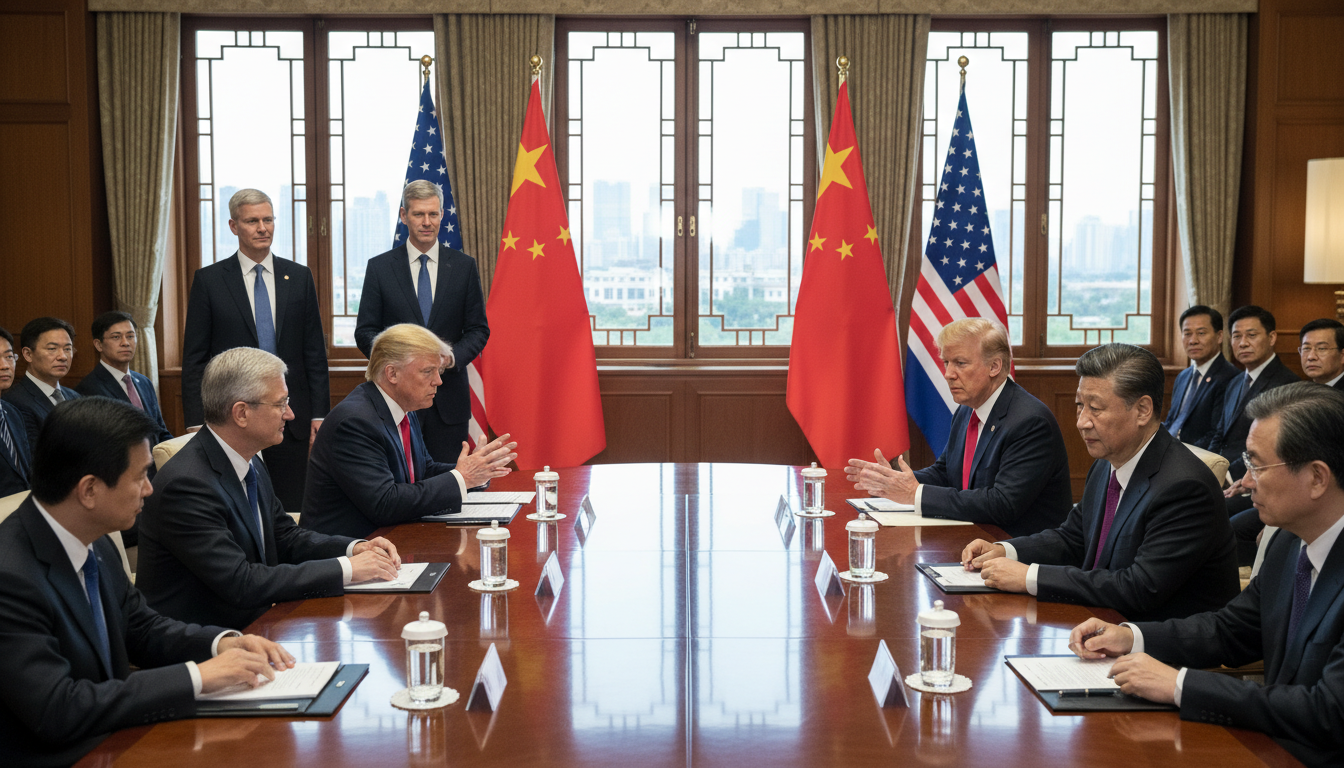
Trump China visit: President urges Xi to open markets to foreign firms as US tech chiefs accompany him
On his China visit, President Trump urged Xi Jinping to open markets to foreign firms, bringing US tech leaders to Beijing for trade and regional security talks.
President Trump arrived in Beijing this week for high-stakes talks with President Xi Jinping in which he pledged to press for greater market access for foreign companies. The Trump China visit is being framed largely as an economic mission, but officials say discussions will also touch on regional security, including tensions involving Iran and Taiwan. A delegation of top U.S. executives accompanied the president, underscoring the commercial emphasis of the trip.
Trump Asks Xi to Open China to Foreign Companies
Trump told reporters and posted on social media that he would ask Xi to “open” China so foreign firms can compete and innovate on a more level playing field. The request signals an effort to reset elements of U.S.-China commercial engagement after years of tariffs, restrictions and technology competition.
Government spokespeople on both sides described the visit as an opportunity to expand cooperation while managing disagreements, with Beijing publicly welcoming the delegation and offering to engage on trade and investment matters.
Prominent US CEOs Join Presidential Delegation
A high-profile group of U.S. technology leaders joined the president on the trip, including the chief executives of Nvidia, Tesla/SpaceX and Apple. Sources on the presidential plane said they made a stopover in Alaska where some executives boarded, highlighting the commercial stakes attached to the visit.
The presence of these executives is intended to signal to Beijing the economic benefits of deeper market access and cooperation, and to give U.S. companies a platform to press for regulatory and investment changes.
Trade Agenda and Economic Stakes
The trade agenda centers on concessions the U.S. seeks to lower barriers, protect intellectual property and open sectors where foreign firms now face restrictions. Trump’s message emphasizes jobs and commercial opportunity while framing access as reciprocal market opening rather than unilateral advantage.
Economic analysts note that any substantive commitments will require follow-up mechanisms and likely lengthy negotiations; the visit is positioned as the start of a renewed dialogue rather than the point of final agreement.
Security Issues: Iran and Taiwan on the Table
Beyond commerce, both leaders are expected to address regional security concerns, including the conflict involving Iran that previously delayed the trip from its original March schedule. U.S. officials have said they will raise concerns over regional stability and seek China’s cooperation on de-escalation efforts.
Taiwan remains another friction point, with Washington and Beijing holding divergent views on sovereignty and military posture. Observers say the leaders’ discussions will test whether economic pragmatism can be coupled with candid strategic dialogue.
Ceremonial Reception and Diplomatic Framing
The president received a ceremonial reception that reflected Beijing’s desire to manage optics and present the visit as constructive engagement. Chinese foreign ministry briefings emphasized willingness to expand cooperation and handle differences through diplomacy and dialogue.
State-level ceremonial elements coexist with private talks and working sessions, where negotiators and technical teams are planned to pursue detailed discussions on trade, tech cooperation and regulatory issues.
Implications for US-China Business Relations
Business groups from both countries are watching closely for signals on tariffs, market access and investment rules that could alter planning for supply chains and technology partnerships. The presence of leading technology firms underscores how integral commercial ties are to the broader bilateral relationship.
Industry leaders say any concrete policy shifts will be incremental, and that the value of the visit lies in re-establishing direct lines of communication at the highest level to address long-standing business frictions.
The Trump China visit marks a diplomatic and commercial push to recalibrate a complex relationship where economic interdependence collides with strategic rivalry, and where short-term gestures must be followed by sustained negotiation to produce lasting change.
