
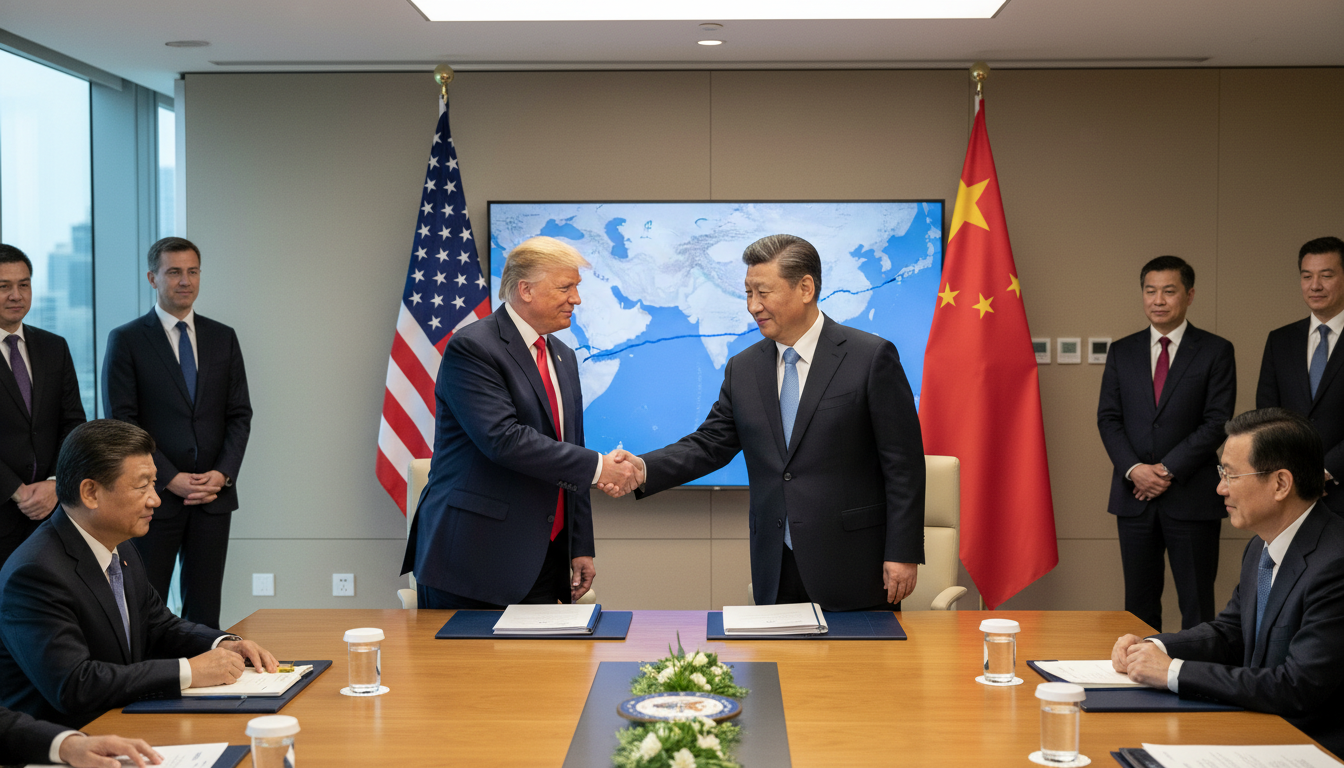
Trump-Xi meeting in Beijing called “very positive” as leaders agree to keep Strait of Hormuz open
Trump calls Beijing talks with Xi ‘very positive’ and invites Xi to the White House Sept 24; leaders agreed to keep the Strait of Hormuz open for energy flows.
President Donald Trump described the Trump-Xi meeting held in Beijing as “very positive” on the opening day of the summit, saying talks and working sessions with President Xi Jinping yielded productive outcomes. The White House confirmed that Mr. Trump invited President Xi to visit Washington on 24 September, and senior officials said both leaders discussed regional security and deepening economic ties. The administration said the two agreed on measures to maintain the free flow of energy through the Strait of Hormuz, a vital maritime chokepoint.
Trump frames summit tone and outcomes
Mr. Trump told guests at a state dinner that conversations with the Chinese delegation were fruitful and constructive, framing the encounter as a forward-looking step in US-China relations. He emphasized personal rapport with President Xi and highlighted the intention to expand bilateral cooperation across multiple areas. White House officials characterized the session as substantive, noting follow-up talks would continue at ministerial levels.
White House announces September 24 invitation
The White House issued a statement confirming an invitation extended by Mr. Trump for President Xi to visit Washington on 24 September, describing the gesture as part of efforts to institutionalize high-level engagement. Officials said scheduling aims to provide a platform for follow-up on the priorities raised in Beijing and to pursue concrete economic and security arrangements. No year was specified in the initial White House summary, but aides described the invitation as a near-term diplomatic step.
Agreement reached on keeping the Strait of Hormuz open
Both leaders agreed on the importance of keeping the Strait of Hormuz open to support the uninterrupted flow of energy supplies, according to the White House account of the meeting. President Xi reportedly voiced opposition to any militarization of the strait or the imposition of transit fees, reflecting Beijing’s long-standing position in favor of freedom of navigation. The commitment signals a shared interest in preventing disruptions to global energy markets that could arise from heightened tensions in the Gulf region.
Oil purchase discussions highlighted by U.S. but omitted in Chinese summaries
The White House said President Xi expressed interest in purchasing more U.S. oil as a way to diversify and reduce Beijing’s dependence on imports routed through the Strait of Hormuz. However, official Chinese summaries of the talks published by state media did not mention oil procurement, creating a divergence in the two governments’ public narratives about the commercial aspects of the meeting. Analysts noted that such differences in emphasis are common in diplomatic exchanges, where each side frames outcomes for its domestic audience.
Leaders exchanged views on major regional and global crises
According to U.S. officials, Mr. Trump and President Xi discussed a range of international and regional issues, including developments in the Middle East, the conflict in Ukraine, and security concerns on the Korean Peninsula. The White House said the leaders exchanged candid assessments and explored avenues for cooperation, though it provided no detailed account of any specific agreements on those crises. Both sides indicated an interest in coordinating where possible to reduce escalatory risks and maintain lines of communication.
Economic cooperation and next steps after Beijing talks
Economic cooperation formed a significant part of the agenda, with the two presidents taking time to consider measures to enhance trade and investment ties between the United States and China. Officials described discussions on tariffs, market access, and potential commercial arrangements as underway, and they said technical teams would meet to translate high-level pledges into actionable plans. The White House emphasized that future consultations at the ministerial level will follow to monitor progress and resolve outstanding issues.
The Trump-Xi meeting in Beijing marked a deliberate effort to stabilize an often-fractious bilateral relationship by combining strategic dialogue with concrete economic conversations. Both capitals presented elements of agreement while also managing domestic expectations through differing public summaries. Observers say the September 24 invitation and follow-on ministerial talks will be watched closely for signs that the two sides can convert positive rhetoric into measurable cooperation on energy, trade and regional security.
