
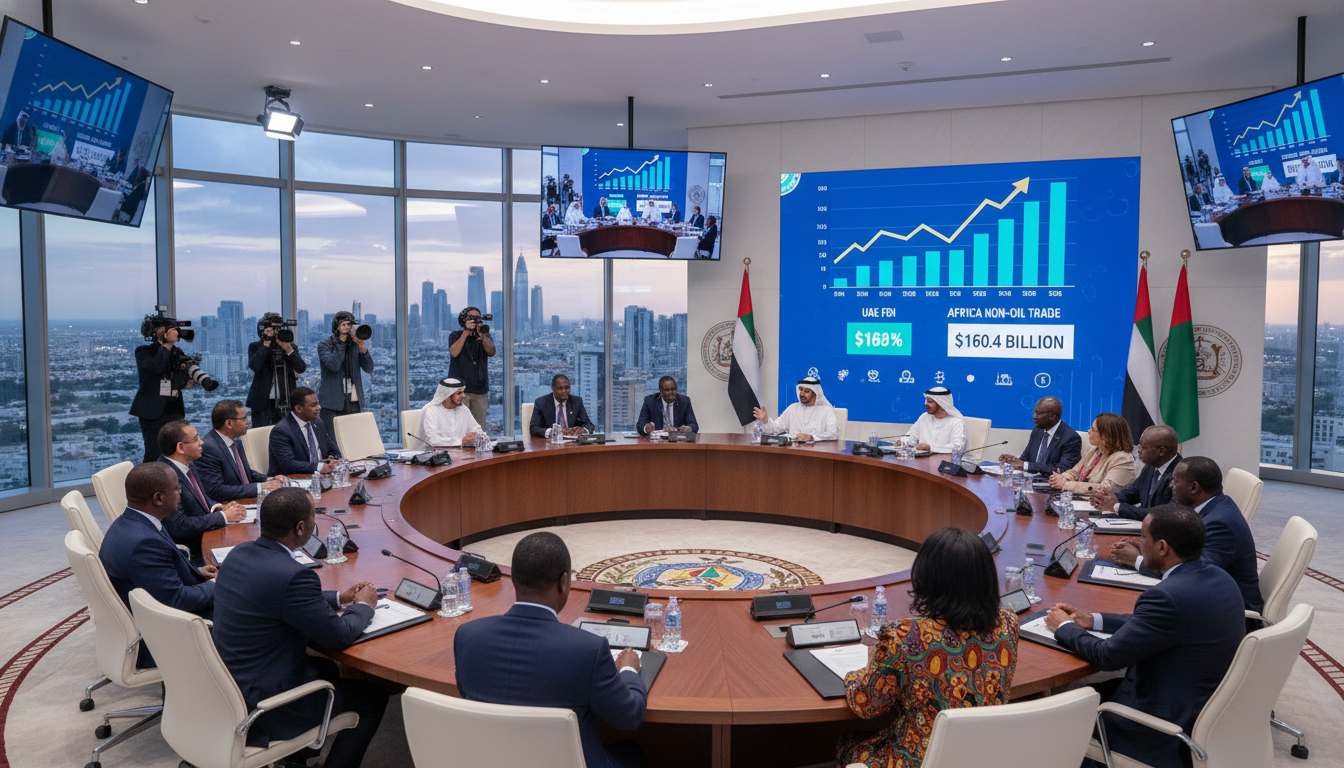
UAE-Africa trade surges to $160.4bn in 2025 as Abu Dhabi pushes investments and logistics ties
UAE-Africa trade reached $160.4bn in 2025, driven by expanding UAE investments, port and logistics projects, and a renewed push for sustainable industrial partnerships.
The United Arab Emirates reaffirmed its expanding economic partnership with Africa at the African CEOs Forum 2026 in Kigali, where Dr. Thani bin Ahmed Al Zeyoudi led an Emirati delegation on behalf of President Sheikh Mohamed bin Zayed Al Nahyan. UAE-Africa trade — measured as non-oil bilateral commerce — exceeded $160.4 billion in 2025, a 43.6% increase from 2024 and roughly double the level recorded in 2023. The forum provided the platform for Abu Dhabi and Dubai-based firms to outline investment pipelines and coordinate on infrastructure, energy and manufacturing projects across the continent.
UAE-Africa trade reaches $160.4 billion in 2025
The jump to $160.4 billion marks a sharp acceleration in non-oil commerce between the UAE and African countries, reflecting stronger goods flows, services exchanges and new commercial agreements. Officials noted the 43.6% year-on-year rise for 2025 compared with 2024, and the figure was described as nearly twice the 2023 value, underscoring rapid momentum in two consecutive years.
Sectoral drivers include increased re-exports, growth in commodity and manufactured goods shipments, and rising trade in digital and logistics services. Observers at the forum highlighted that trade growth has been supported by enhanced connectivity through ports, air links and expanded free zone cooperation.
UAE becomes top source of new FDI in Africa since 2019
Since 2019 the UAE has emerged as the largest single source of new foreign direct investment flows into Africa, with cumulative commitments surpassing $110 billion. That investment total spans greenfield projects, acquisitions and strategic partnerships in sectors from energy and transport to technology and agro-processing.
Analysts at the forum said Emirati capital has targeted projects that underpin long-term value chains rather than short-term commodity plays. The flow of FDI is concentrated in logistics hubs, renewable energy, industrial parks and finance, positioning the UAE as a strategic investor in Africa’s industrialisation agendas.
Minister Al Zeyoudi reiterates commitment to sustainable growth
In his keynote at the Kigali forum, Dr. Al Zeyoudi emphasized the UAE’s commitment to stimulating sustainable economic growth across African markets. He framed the relationship as mutually beneficial, noting the continent’s abundant resources and demographic potential alongside the UAE’s finance, logistics and project development capabilities.
The minister underscored that UAE-backed projects focus on strengthening logistics capacity, digital infrastructure and manufacturing, with the aim of enabling African producers and exporters to access global markets. He also highlighted that sustainable investment — including renewable energy and climate-resilient infrastructure — is central to the UAE’s engagement strategy.
High-level meetings shape development and investment plans
During the forum Dr. Al Zeyoudi held a series of bilateral talks with African ministers, global institutional leaders and chief executives from major companies. These meetings were used to fine-tune investment roadmaps, discuss regulatory barriers and explore joint ventures in priority sectors such as ports, energy and industrial zones.
Delegation members took part in a strategic panel with leading African business figures to discuss measurable development targets for the continent. Participants said the dialogue aimed to align private capital deployment with national development plans across several African states, improving the prospects for scaled and sustainable projects.
DP World spotlights Africa’s role in global supply chains
On the sidelines of the forum, DP World organised an event focused on Africa’s expanding role in international supply chains and logistics networks. The session highlighted ongoing UAE support for port upgrades, freight corridors and logistics hubs intended to reduce transit times and lower costs for African exporters.
Dr. Al Zeyoudi used the DP World platform to reiterate the UAE’s push to expand port capacity, accelerate renewable energy production and develop free zones in multiple African countries. Business leaders at the event stressed that improved ports and logistics infrastructure will be critical to unlocking further trade growth and attracting more value-added manufacturing to the continent.
Next steps: infrastructure, digital and manufacturing projects
Officials said follow-up measures will prioritise projects that build regional value chains, including investments in manufacturing clusters, digital connectivity and renewable power plants. These initiatives seek to move trade beyond raw commodities toward higher-margin goods and services that can support job creation and skill transfer locally.
UAE stakeholders signalled plans for coordinated technical assistance, public-private partnerships and financing mechanisms that lower entry barriers for African firms. The stated goal is to ensure that expanded trade and investment translate into durable economic benefits for both Emirati and African partners.
The outcomes in Kigali reflect a broader strategic pivot by the UAE to deepen ties with African economies through targeted investments, upgraded logistics and sustained diplomatic engagement. As UAE-Africa trade and investment totals continue to climb, officials on both sides said the emphasis will remain on projects that deliver long-term, inclusive growth and improved market access for African businesses.
