
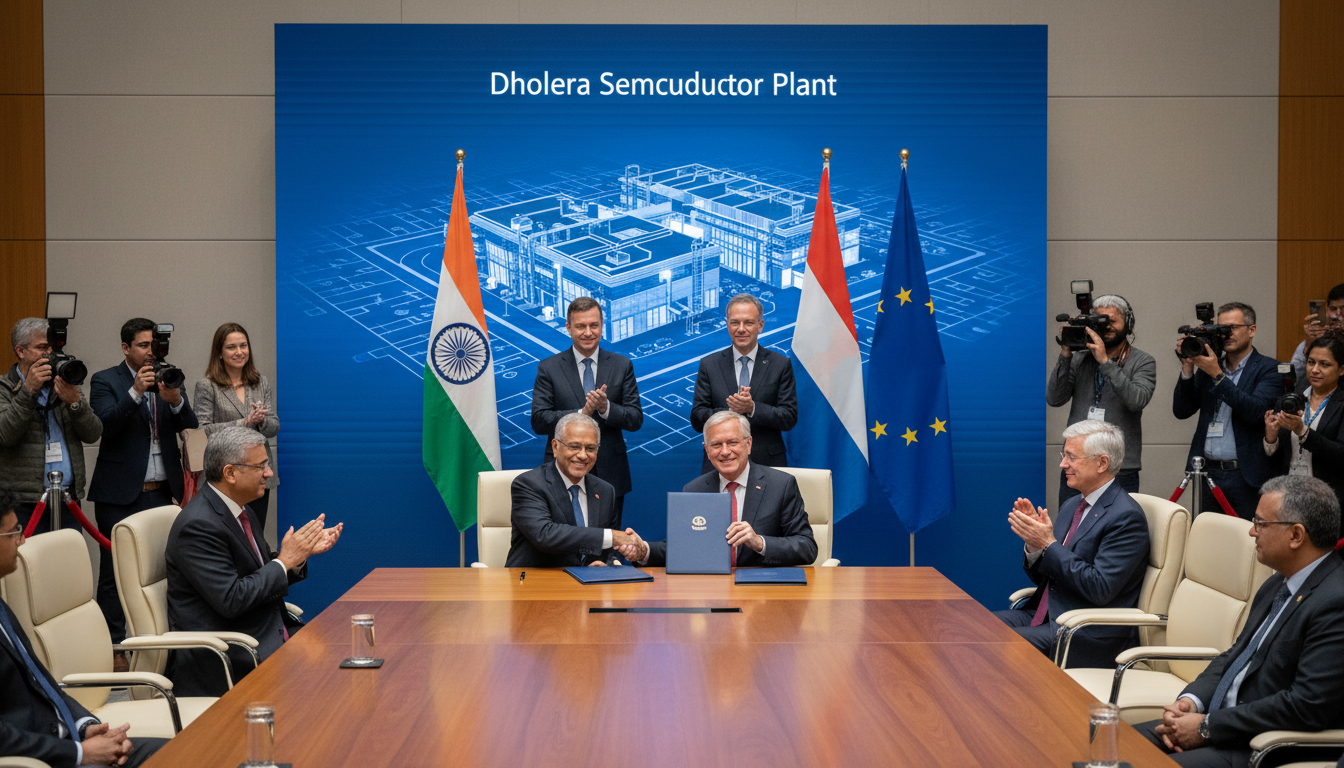
Tata Electronics and ASML to build $11bn semiconductor plant in Dholera, Gujarat
Tata Electronics signs deal with ASML to supply advanced lithography equipment for an $11bn semiconductor plant in Dholera, boosting India’s chip manufacturing capacity and ties with the Netherlands.
India’s Tata Electronics has signed a landmark agreement with Dutch chip-equipment leader ASML to support construction and ramp-up of a major semiconductor plant in Dholera, Gujarat. The Tata Electronics-ASML semiconductor plant deal, announced during Prime Minister Narendra Modi’s visit to the Netherlands, aims to produce chips for AI, automotive and industrial applications. The pact is a central part of broader India-Netherlands cooperation discussed during Modi’s meetings in The Hague and signals a push to deepen high-tech manufacturing in India.
Deal details and investment
Tata Electronics will invest approximately $11 billion in the Dholera facility, which company statements say will focus on high-value semiconductors used in artificial intelligence systems, electric and autonomous vehicles, and other advanced electronics. ASML will supply its cutting-edge lithography machines and technical support to establish production capacity and accelerate the plant’s ramp-up. Company officials described the agreement as a multi-year collaboration that includes machine delivery, training and local ecosystem development.
ASML’s role and technology transfer
ASML, Europe’s most valuable technology company and a leading supplier of extreme ultraviolet and deep ultraviolet lithography systems, said it will help “establish and ramp up” production at the Dholera site. The Dutch firm emphasized long-term partnerships and technical assistance rather than outright transfer of all manufacturing processes. ASML chief executive Christophe Fouquet noted the large market opportunity in India and framed the deal as part of a broader strategy to support new semiconductor hubs outside traditional centres.
Economic and regional impact in Gujarat
The Dholera plant is being built in Gujarat, Prime Minister Modi’s home state, and is expected to create thousands of direct and indirect jobs across manufacturing, logistics and services. Officials in New Delhi have framed the project as a cornerstone of efforts to attract high-end technology investment and to reduce reliance on overseas chip supply chains. Local authorities and industry bodies say the facility could stimulate suppliers, testing and packaging units, and help develop a domestic chip ecosystem over the coming years.
Strategic ties between India and the Netherlands
The agreement comes amid an intensifying economic dialogue between India and the Netherlands, with both governments signalling interest in expanding cooperation in science, technology and trade. Modi’s meetings with Dutch Prime Minister Rob Jetten and King Willem-Alexander covered a range of topics, including defence, space and maritime systems. Indian officials described the semiconductor deal as emblematic of the Netherlands’ growing role as a partner in technology transfer and industrial cooperation.
Defence and security cooperation discussed
Alongside commercial agreements, Modi and Dutch leaders raised the prospect of deeper defence and security collaboration, including a potential action plan for the defence industry. Modi posted on X that discussions covered defence, space travel and maritime security, suggesting governments will explore joint projects and technology-sharing arrangements. Observers say such security-focused dialogue could create parallel pathways for sensitive technologies while requiring careful export-control coordination.
Education, visas and talent mobility
Indian and Dutch officials are also negotiating more flexible visa arrangements aimed at students and skilled workers, a move industry groups say is essential to support the semiconductor workforce. The Dholera facility will need engineers, technicians and research staff, prompting calls for streamlined mobility measures and training partnerships with universities. Both sides indicated interest in academic exchanges and vocational training programmes to build local capability and sustain long-term operations.
The plant aligns with broader European interest in India as a long-term market and manufacturing partner, with the European Union increasingly viewing India as a strategic economic partner. Analysts note that bringing companies like ASML into Indian projects can accelerate technical learning, but full supply-chain resilience will require investments across design, materials and backend services. For now, the Tata Electronics-ASML semiconductor plant deal marks a significant step in India’s bid to become a major chip producer while strengthening bilateral ties with the Netherlands.
