
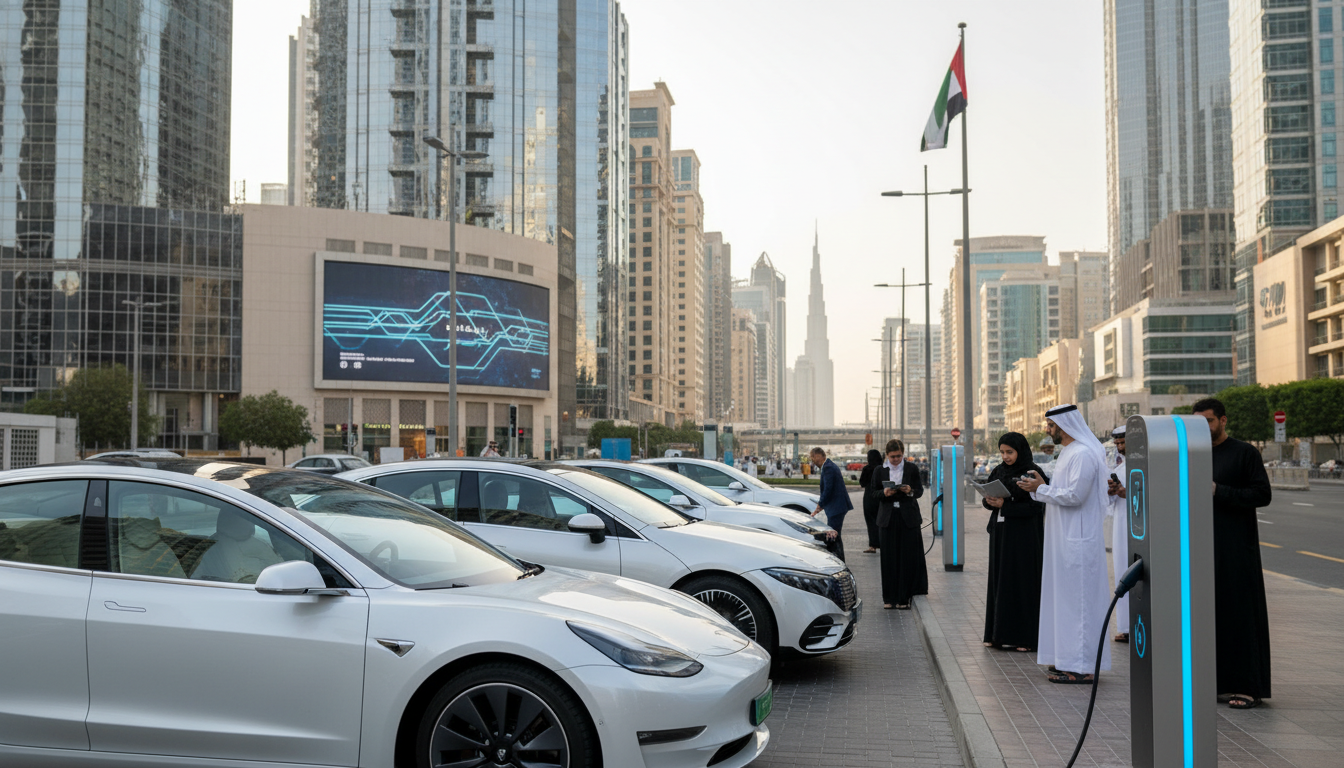
UAE Leads Middle East in Electric Vehicle Sales for Second Consecutive Year, IEA Says
IEA Global EV Outlook 2026: UAE claims roughly 50% of Middle East electric vehicle sales, propelled by the 2023 national EV policy and charging network.
The UAE has emerged as the clear regional leader in electric vehicle sales, capturing about half of all EV purchases in the Middle East, according to the International Energy Agency’s Global EV Outlook 2026. This surge in electric vehicle sales reflects rapid market uptake and government-led initiatives to scale charging infrastructure and attract manufacturers. The ministry’s national EV policy, launched in 2023, is credited with accelerating adoption and positioning the country as a regional hub for sustainable mobility.
IEA report underlines UAE dominance in regional EV market
The IEA’s Global EV Outlook 2026 identifies the UAE as the top performer in the region for the second straight year, reporting that the country accounted for approximately 50 percent of the region’s electric vehicle sales. The figure underscores a concentrated market shift toward zero-emission cars and SUVs across the Emirates. Analysts say the pace of sales has outstripped neighboring markets, driven by policy incentives and consumer interest in lower-emission transport.
The report’s assessment places the UAE ahead of peers on adoption metrics and market penetration, a development that international observers link to coordinated public and private action. The finding has also drawn attention from global manufacturers evaluating Middle Eastern expansion strategies.
2023 national EV policy cited as key driver
Officials point to the UAE’s national policy on electric vehicles, introduced by the Ministry of Energy and Infrastructure in 2023, as a pivotal catalyst for growth in electric vehicle sales. The policy set out targets to increase EV uptake, expand charging infrastructure, and encourage investment in clean mobility technologies. According to ministry statements, these measures created clearer market signals for both consumers and industry stakeholders.
The ministry’s Undersecretary for Energy and Petroleum, Eng. Sharif Al-Olama, said the policy reflects a proactive vision by the leadership to embed sustainability within transport planning. He noted that a stronger regulatory framework and targeted incentives have encouraged manufacturers to broaden their presence in the UAE market.
Expansion of charging infrastructure gains momentum
A rapid rollout of public and private charging stations is helping to remove a key barrier to electric vehicle sales: range anxiety. Authorities and industry partners are accelerating the deployment of fast chargers across urban corridors, residential developments, and major highways. The ministry and its partners have highlighted investment programs and permitting reforms designed to speed station installation.
The recent establishment of a national company dedicated to electric vehicle charging stations represents a strategic step to coordinate a unified network. Officials say the new entity will help standardize services, improve interoperability, and scale capacity to meet rising demand as EV ownership expands.
Manufacturers and investors increase regional activity
Automakers and mobility firms are responding to stronger electric vehicle sales in the UAE by expanding product offerings and local operations. Market entrants and established brands have increased model availability, promotional financing, and after-sales support for EV customers. The more competitive market has also spurred partnerships on battery services and vehicle-to-grid technologies.
Private investment flows into charging infrastructure, fleet electrification, and related services have accelerated, with both domestic entrepreneurs and international firms seeking footholds. Industry sources indicate that market confidence is rising as regulatory clarity and infrastructure commitments reduce deployment risks.
Alignment with UAE’s energy and climate strategies
The EV momentum dovetails with the UAE’s broader strategies on energy efficiency and climate neutrality, including national targets under the UAE Energy Strategy 2050 and the Net Zero by 2050 commitments. Government officials say expanding electric vehicle sales contributes to lower transport emissions and improved urban air quality while supporting energy system optimization. The transition is also positioned as an economic opportunity to cultivate high-tech industries and green jobs.
Policy architects emphasize that EV adoption is one component of a multi-pronged approach that includes renewable energy expansion, smarter grids, and incentives for low-carbon transport solutions. Coordination across ministries and with the private sector remains central to scaling the impact of those measures.
Challenges and next steps for sustaining growth
Despite strong gains, experts caution that sustaining rapid growth in electric vehicle sales will require continued focus on affordability, charging access, and supply-chain resilience. Ensuring that lower-income and fleet segments gain access to EV options is seen as critical for broader decarbonization goals. Policymakers are also monitoring grid impacts and considering measures to manage peak electricity demand as EV uptake rises.
Officials say the next phase will emphasize incentives for commercial fleets, expanded public charging in peri-urban areas, and incentives for local assembly and component manufacturing. Continued alignment with international standards and collaboration with private investors are expected to remain priorities.
The IEA’s Global EV Outlook 2026 has put the UAE’s progress on the global and regional map, showing how targeted policy and infrastructure investment can accelerate the shift to electric mobility. As the country seeks to translate early leadership into a long-term competitive advantage, stakeholders across government and industry are preparing to scale the systems that underpin a cleaner transport future.
