
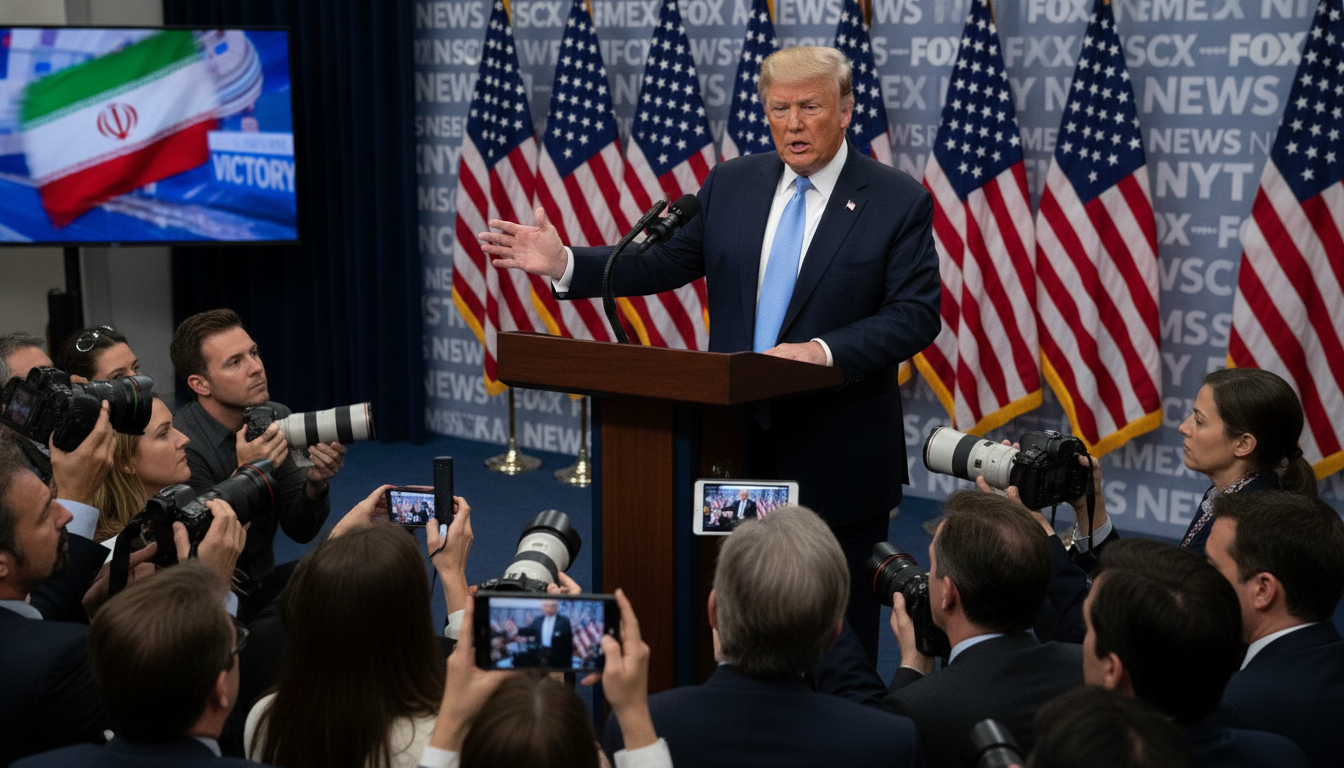
Trump Attacks US Media Over Iran Coverage, Says Outlets Would Call Surrender an “Iranian Victory”
Trump attacks US media over Iran coverage, claiming outlets would call even a full Iranian surrender an “Iranian victory,” naming NYT, WSJ and CNN today.
Former President Donald Trump launched a sharp attack on major US news organisations, accusing them of bias in how they would portray any military or diplomatic outcome involving Iran. Trump attacks US media over Iran coverage was the central claim he posted on his Truth Social platform, where he argued that the outlets would portray even a complete Iranian surrender as a victory. The remark singled out the New York Times, the Wall Street Journal and CNN as examples of what he called “fake media.”
Post on Truth Social and the central claim
On his Truth Social account, Trump set out a hypothetical in which Iran surrenders fully and its forces leave Tehran with hands raised. He wrote that, in that scenario, the major US outlets would still run headlines framing the outcome as a resounding Iranian victory. The post reiterated longstanding grievances Trump has expressed toward media coverage of foreign policy issues.
This latest message continued a familiar line of attack from Trump, who has long criticised news organisations for what he describes as unfair reporting. By framing the possibility of surrender as a media-driven narrative, he sought to underline his broader argument that coverage often reflects partisan bias rather than objective analysis.
Named outlets and the “fake media” label
Trump specifically named the New York Times, the Wall Street Journal and CNN in his post, calling them “fake media” and accusing them of predisposition against his perspective. Those outlets have been among the most frequent targets of his attacks during and after his presidency. Media organisations named in his comments did not issue immediate, unified responses to the post.
Analysts say naming prominent outlets helps rally his political base while amplifying his critique of mainstream journalism. The tactic also feeds into ongoing public debates in the United States about the role of media in shaping public perceptions of national security and foreign policy.
Political framing and criticism of Democrats
In the same message, Trump broadened his criticism to include US Democrats, saying they had “lost their way” on issues related to Iran and national security. He positioned his comments as a rebuttal to what he described as a media-Democrat alliance that would skew coverage regardless of the facts on the ground. That political framing aligns with Trump’s wider strategy of contesting institutional narratives and appealing to voters who distrust traditional news sources.
Observers note that attacks on both media and political opponents can serve to consolidate support among followers who view mainstream outlets and centrist politicians with scepticism. The interplay between media criticism and partisan messaging remains a central element of current US political communication.
Context: US-Iran tension and media scrutiny
The comments arrive against a backdrop of longstanding tensions between the United States and Iran, where any military or diplomatic development is intensely scrutinised. Media coverage of the region has frequently been contested, with competing narratives emerging from different outlets and political camps. In that environment, claims about how the media would report an outcome are likely to resonate with audiences already attuned to narrative battles.
Experts say scrutiny of coverage is heightened when the subject involves potential conflict, because framing, sourcing and headline choices can shape public understanding quickly. The accusation that outlets would portray a defeat as a victory underscores the broader anxieties about information, interpretation and public trust.
Potential reactions and implications for media trust
The immediate political fallout from the post is likely to be limited to further polarisation between Trump supporters and critics, but it could also prompt renewed discussion within newsrooms about language and emphasis when reporting on international crises. News organisations often defend their editorial decisions as attempts to balance accuracy with context, while critics argue that selection and framing can produce misleading impressions. How outlets respond to public charges of bias can influence perceptions of credibility across different audience segments.
Media scholars warn that repeated attacks on journalism can erode institutional trust over time, creating an environment in which facts are contested and consensus becomes harder to achieve. The debate over coverage of Iran may therefore have implications beyond a single post, affecting long-term public confidence in news reporting.
Trump attacks US media over Iran coverage remains a touchpoint in a broader contest over information and narrative control, as political leaders and news organisations continue to spar over how events are portrayed. The exchange highlights enduring tensions between elected figures and the press, especially when national security and foreign policy are at stake.
The coming days may bring responses from the outlets named and commentary from political figures across the spectrum, but the post itself underscores how quickly media criticism becomes a central element of political discourse in the United States.
