
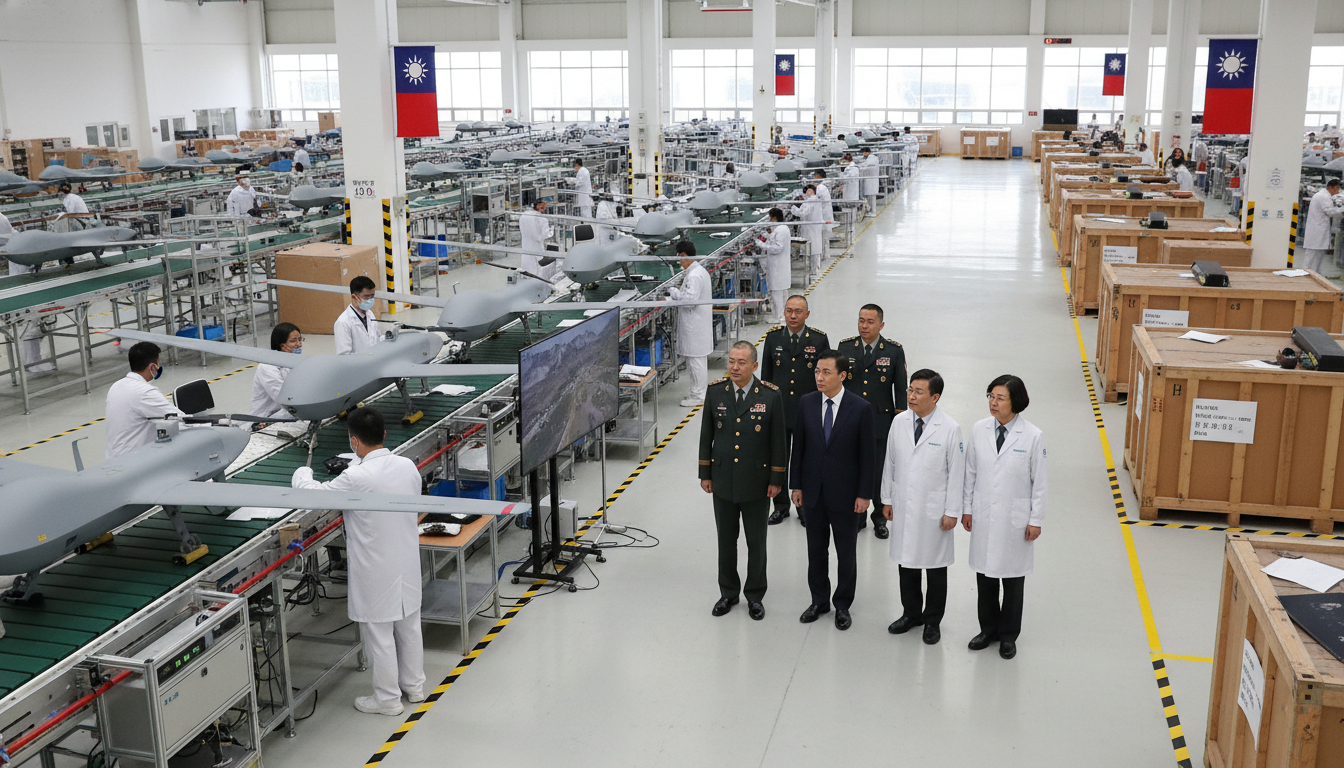
Taiwan drone exports surge as firms rush to meet wartime demand
Taiwan drone exports have surged after the Ukraine war, with Taipei manufacturers reporting a sharp rise in shipments to European buyers while facing funding and competition hurdles.
Strong sales driven by Ukraine conflict
Taiwanese manufacturers have seen a rapid increase in demand for drones since Russia’s invasion of Ukraine, industry sources say. Exports jumped to about 181,000 units in January–April 2026, roughly twenty times the volume in the same period of 2025, according to official trade data.
Analysts link the spike to widespread battlefield use of low-cost reconnaissance and attack drones and to restrictions on Chinese drone exports that opened market space. Taiwanese firms, which had previously struggled to find sufficient domestic orders, moved quickly to supply European channels and intermediaries.
Primary destinations and supply routes
The vast majority of the new shipments were routed to the Czech Republic, followed by Poland, where buyers and donors are active in reallocating equipment to Ukraine. Researchers at a Taipei-backed democracy and technology institute estimate that many of the units were purchased or financed by non-governmental organisations and later donated to Ukrainian forces.
Export figures reflect a mix of commercial and humanitarian channels rather than direct state-to-state military sales, officials and industry insiders say. That distribution pattern has allowed Taiwanese producers to scale orders rapidly without formal government-to-government procurement processes.
Manufacturing ambitions and capacity targets
Taipei aims to turn its existing strengths in semiconductors and artificial intelligence into a competitive drone manufacturing base. Government and industry roadmaps now target a monthly production capacity of 100,000 drones by 2030, a marked increase from an earlier goal of 15,000 units by 2028.
Officials frame the effort as both a national security priority and an export opportunity, with an emphasis on building supply chains that avoid reliance on Chinese components. The longer-term strategy is to integrate Taiwanese drone output into global logistics networks, mirroring the island’s role in chip manufacturing.
Budget shortfalls and parliamentary resistance
Despite clear export momentum, Taiwanese producers say their domestic market remains weak and that limited government procurement has constrained long-term planning. Max Lu, chief executive of a dual-use drone manufacturer, told industry contacts that without steady local orders or budgetary backing it is difficult to sustain production lines and workforce investments.
A proposed defence package that included the domestic purchase of more than 200,000 locally made drones as part of a near-$40 billion spending plan did not win parliamentary approval. Opposition in the legislature has left companies reliant on foreign buyers and ad hoc contracts to maintain output and finance expansion.
Competitive pressures from China and battlefield effectiveness
China’s DJI remains the dominant global drone manufacturer, benefiting from scale and established supply networks, and Chinese products are typically far cheaper. Market estimates indicate some Taiwanese models may sell for as much as three times the price of comparable Chinese kits, prompting questions about competitiveness on cost-sensitive battlefields.
Industry experts also caution that industrial know-how does not automatically translate into battlefield performance. Regional security analysts stress that effectiveness under combat conditions — from durability to software resilience — will be the decisive factor in whether Taiwanese drones gain a durable foothold in military markets.
Operational concerns and the Ukrainian market outlook
Some observers warn that Ukraine, which has developed significant domestic drone manufacturing during the conflict, could saturate the market with locally produced systems once wartime demand eases. That potential oversupply could limit long-term opportunities for foreign suppliers regardless of origin.
Security-policy specialists also question how many of the exported units are truly non‑military, noting that dual‑use capabilities blur the lines between civilian and combat applications. Taipei officials maintain that most exports are for civilian uses, but several industry insiders suspect a sizable share will find military employment.
Taiwan’s rush into drone exports reflects both a business response to immediate wartime demand and a broader strategic push to convert technological strengths into a new manufacturing niche. Whether Taipei’s firms can translate the current sales boom into sustained, competitive industry growth will depend on securing stable financing, improving battlefield-proven performance, and finding cost and capability advantages over established competitors.
