
Russian strike on Kyiv kills at least 16 as hundreds of drones and missiles rain down
Russia launched a massive strike on Kyiv and other Ukrainian cities with hundreds of drones and missiles; at least 16 dead and widespread damage reported.
The Russian strike on Kyiv early on Tuesday sent hundreds of drones and scores of missiles across Ukrainian skies, killing at least 16 people and setting buildings ablaze in multiple cities. Ukrainian authorities said the bombardment included hypersonic cruise missiles and represented one of the largest coordinated aerial attacks in recent weeks. The wave of strikes followed Russian warnings more than a week earlier that diplomats and foreigners should evacuate and that Moscow intended to target “decision-making centers.”
Massive overnight bombardment launched
Ukraine’s Air Force reported that the assault comprised 656 drones and 73 missiles, with 33 missiles striking their intended targets, according to official tallies. Russian authorities framed the operation as a response to what they described as “terrorist acts” inside Russia, while Ukrainian officials rejected parts of Moscow’s claims as misinformation. The scale of the strike echoed earlier high-casualty bombardments this month that used unprecedented numbers of unmanned aircraft and ballistic weapons.
The attack included a record deployment of Zirkon hypersonic cruise missiles, state and local officials said, with multiple launches occurring during the night and again in the early morning. Explosions shook neighbourhoods as air-raid warnings sounded, compounding weeks of rising unease over sustained, high-volume strikes on urban areas.
Casualties and structural damage in Kyiv and Dnipro
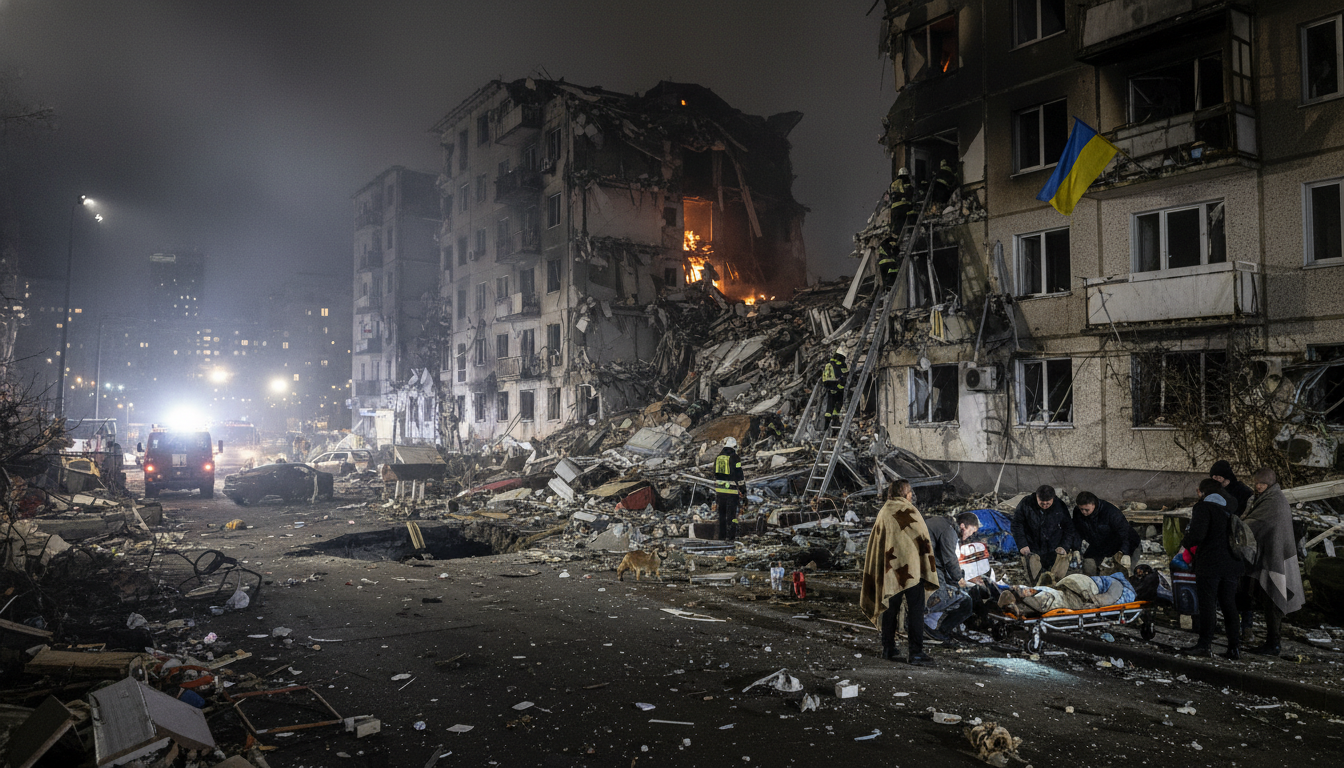
Kyiv officials reported at least five fatalities in the capital and 65 people wounded, Mayor Vitali Klitschko said, with three children among the injured. A nine-storey apartment block in the Podilskyi district partially collapsed and several sites were burning through the morning as emergency crews searched for survivors. Streets near the blast sites were littered with debris and emergency services moved to clear access for rescue operations.
In the central city of Dnipro, local authorities reported 11 dead, including two children, and dozens more injured after overnight strikes hit residential areas and infrastructure. Across other regions, officials documented additional damage to civilian buildings and utilities, exacerbating an already acute humanitarian strain in parts of the country.
Civilian sheltering and psychological toll
The weeks of threatening rhetoric preceding the attack took a palpable psychological toll on Kyiv residents, officials said, as repeated false alarms and preparatory flight activity left people exhausted. Many spent multiple nights in subway stations and improvised shelters; on the night of the assault subway platforms and station floors were crowded with tents, mats and families seeking safety. Children and pets struggled to rest amid constant alarms, and those who left shelters at dawn found smoke hanging over parts of the city.
When air-raid alerts briefly lifted, some residents began returning home, only to face fresh strikes shortly afterwards, limiting the time available to seek shelter. Local authorities warned that the unpredictability of the strikes and the use of high-speed ballistic weapons further complicate civilian protection and emergency response.
Scale and types of weapons deployed
Analysts and Ukrainian officials highlighted the variety of munitions used in the operation, which combined cheap, swarming drones with more costly ballistic and cruise missiles. The mix is designed to overwhelm layered air-defence systems and to force defenders to expend costly interceptor missiles. Kyiv reported that only a fraction of incoming missiles were intercepted, with some ballistic rounds reaching urban targets.
The inclusion of Zirkon hypersonic missiles — capable of very high speed and maneuverability — raised concern among military analysts about both the weapon’s operational use and the pressure it places on existing defence networks. Russia’s overnight launches marked one of the largest simultaneous uses of such systems in the conflict to date.
Pressure on Ukraine’s air-defence inventory
Ukraine’s limited stock of Patriot interceptors remains a focal point for military planners and international supporters, officials said, as the country attempts to blunt increasingly frequent ballistic missile strikes. Ukrainian authorities have warned in recent weeks that supplies of Patriot interceptors are depleted with demand outpacing deliveries, a problem compounded by global demand for advanced systems. Officials noted that Ukraine has been able to intercept roughly one in three ballistic missiles this year, but that rate may not be sustainable if attacks continue at the current tempo.
Western envoys in Kyiv publicly pledged solidarity and refused calls to evacuate following Russia’s earlier threats, but have also signalled that supporting Ukraine’s air-defence capacity will be essential to protect civilians and critical infrastructure. Supply constraints, production bottlenecks and competing global needs for advanced interceptors have made rapid replenishment difficult.
Diplomatic reaction and strategic implications
The bombardment prompted renewed international concern over escalation and the humanitarian cost of intensified strikes on urban centres. Kyiv officials characterised Russia’s warnings and the subsequent assault as an attempt to intimidate both local populations and diplomatic communities, while Moscow framed the operation as retaliation. The exchange has underscored the broader stalemate on the front lines even as both sides deploy increasingly long-range capabilities.
Military analysts said the campaign appears intended to both inflict damage and to deplete Ukraine’s expensive interceptors, altering calculations on the battlefield and in diplomatic capitals. The strikes also complicate efforts to stabilise front-line gains and could affect forthcoming decisions by partner states on further military assistance.
As emergency teams continue rescue and recovery operations, civilians and officials in affected cities face the immediate task of accounting for the dead and injured and repairing essential services disrupted by the assault. The scale of the attack and the strain it places on defences underline persistent vulnerabilities as the conflict persists.
