
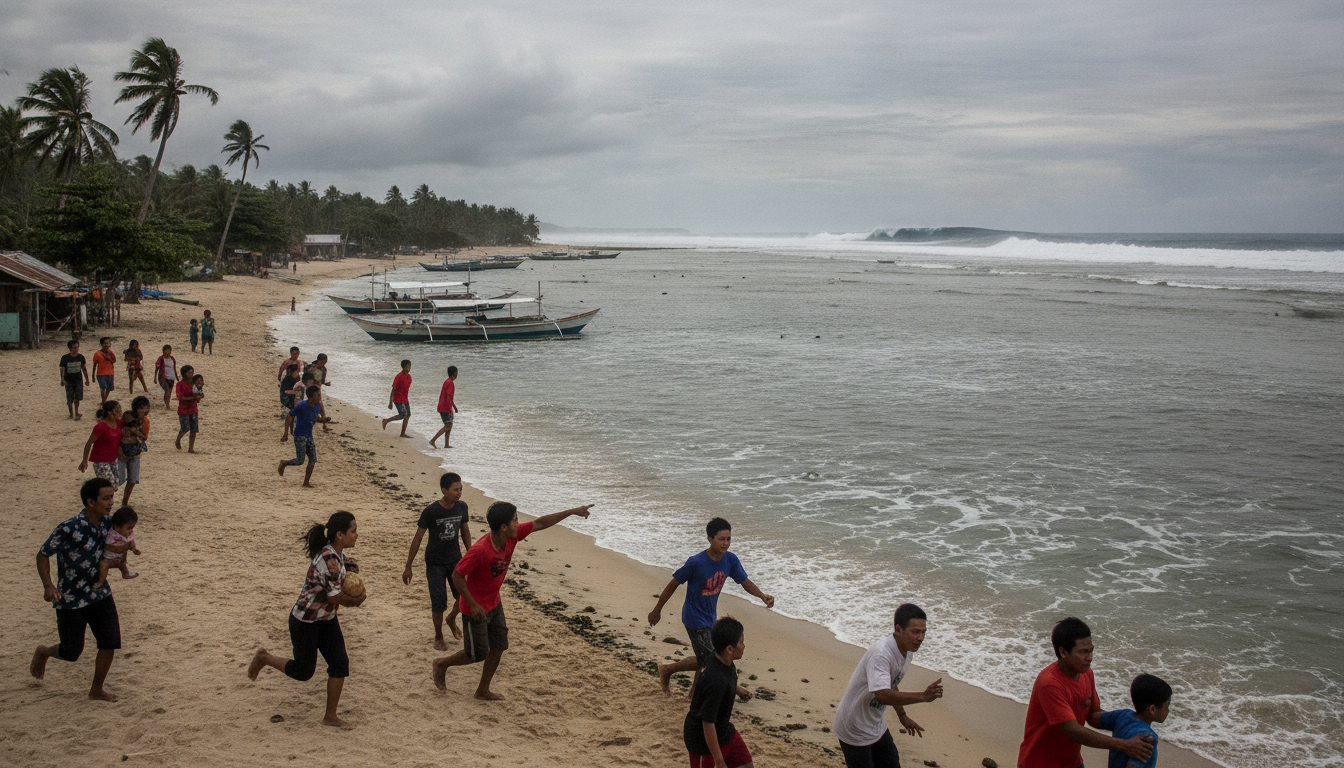
7.8-magnitude earthquake in Celebes Sea prompts tsunami advisories for Philippines and Guam
A 7.8-magnitude earthquake struck the Celebes Sea near the Philippines on Monday, June 8, 2026, prompting tsunami advisories for Philippine coastlines and Guam. The U.S. Geological Survey reported the temblor at 7:37 a.m. Philippine time with an epicentre about 15 miles southwest of Burias. Officials warned coastal communities to remain alert as aftershocks were recorded and monitoring continued.
7.8-magnitude quake strikes Celebes Sea
A powerful earthquake measuring 7.8 on the moment magnitude scale hit the Celebes Sea early on June 8, 2026, according to U.S. monitoring agencies. The quake’s reported strength and proximity to shallow coastal waters raised immediate concerns about tsunami generation for nearby shorelines. Emergency services and meteorological authorities issued advisories and urged residents in affected zones to follow guidance from local officials.
Tsunami advisories issued for Philippines and Guam
Tsunami advisories were posted for multiple Philippine coastlines and for Guam by the U.S. Tsunami Warning System shortly after the quake. The advisory signalled the possibility of dangerous sea-level changes and strong currents rather than a guaranteed large tsunami. The agency specified there was no threat to the Pacific coastlines of the United States and Canada at the time of the advisory.
Epicentre, timing and reported location
The U.S. Geological Survey located the epicentre about 15 miles (roughly 24 kilometres) southwest of Burias, Philippines, with the main shock recorded at 7:37 a.m. Philippine time. That timing corresponds to early hours in other time zones; shake data and subsequent updates were timestamped in U.S. Eastern Time as agencies processed incoming observations. Officials cautioned that magnitude and location details can be revised as seismologists analyse additional data.
Aftershocks detected across the same area
Multiple subsequent quakes were reported in the same general area, which seismologists characterize as aftershocks from the main rupture. Aftershocks can continue for days, weeks or longer, and in some instances may be nearly as strong as the initial event. Authorities emphasised that communities already impacted by ground shaking should be prepared for further jolts and potential damage to vulnerable structures.
How tsunamis form and warning signs for the public
Tsunamis are created when a large earthquake causes a sudden displacement of the ocean floor, sending long waves radiating outward from the epicentre. Experts remind the public that a natural warning sign can include the unusual receding of water from the shoreline before waves arrive. Residents in coastal areas were advised to move to higher ground or follow evacuation orders rather than approach exposed beaches to observe the sea.
Monitoring, data updates and next steps
Seismological and tsunami-monitoring organisations said they would update alerts as new information became available and as sea-level sensors reported any anomalies. The U.S. Geological Survey noted that additional analysis can lead to revisions of the quake’s reported magnitude or shake-severity mapping. Local emergency agencies in the Philippines and in Guam were coordinating public messages and readiness measures while assessing coastal impacts.
Regional authorities and relief organisations urged residents to stay tuned to official channels for instructions and to avoid spreading unverified information. Emergency teams were put on alert to assess coastal areas if sea-level changes or flooding occurred, and communications lines remained open for rapid dissemination of any revised advisories.
Communities near the epicentre and along vulnerable coastlines were reminded to treat tsunami advisories seriously and to follow evacuation routes and orders issued by local authorities. The situation remained under close observation by international and regional agencies as sensors and field reports continued to be collected.
