
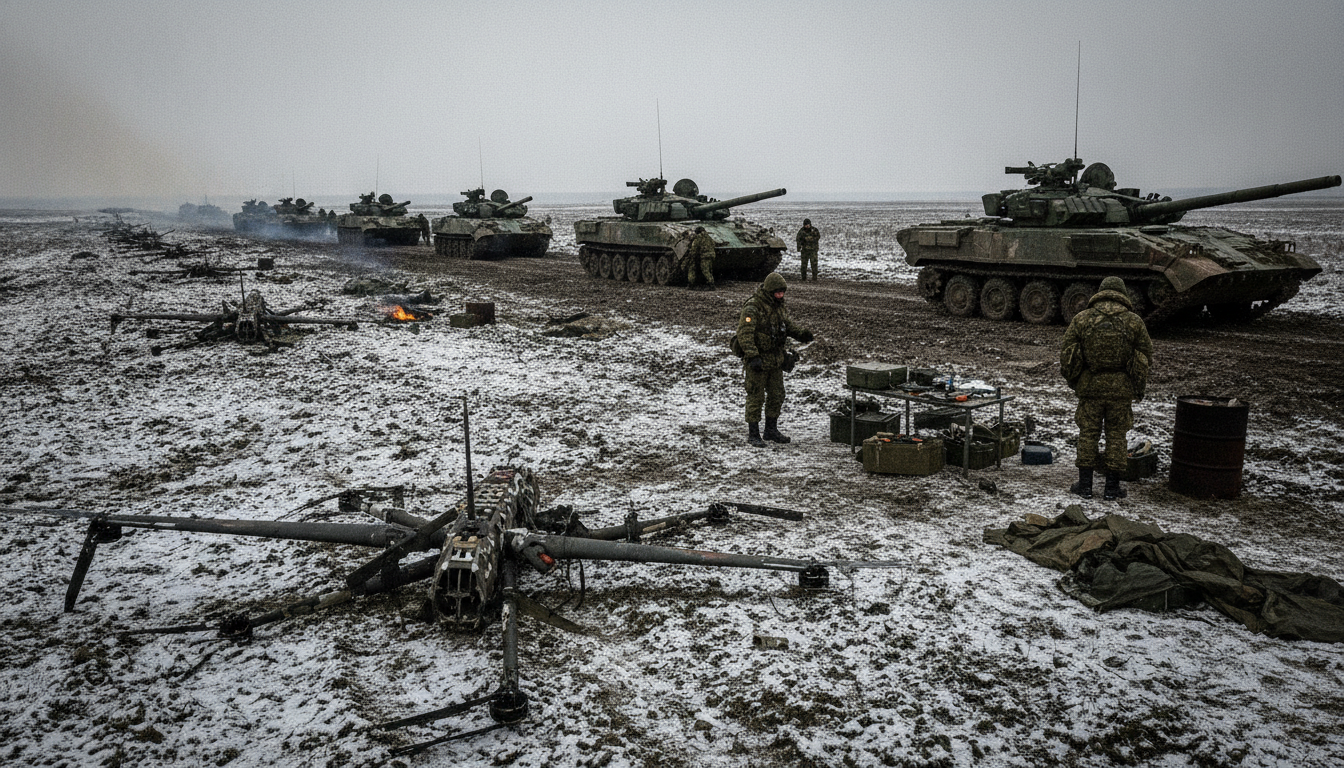
Russia’s drone onslaught continues as analysts point to growing strain on Russian forces in Ukraine war
Russia’s sustained drone and missile campaign is inflicting daily damage on Ukrainian cities and infrastructure, even as analysts say signs of strain in the Russian military are appearing after more than four years of fighting in the Ukraine war. Kyiv has mounted limited local counterattacks and long-range strikes inside Russia, while international monitors warn the conflict is widening beyond frontlines. (investing.com)
Heavy aerial campaign batters Ukrainian cities
Russian forces have launched repeated waves of Shahed-style and other strike drones alongside ballistic and cruise missiles, mounting some of the largest aerial barrages since the full-scale invasion began. These attacks have targeted power grids, industrial sites and urban areas, causing civilian casualties and widespread outages. (investing.com)
Ukrainian air defences regularly intercept many incoming drones, but the sheer volume of launches — measured in the hundreds during major strikes — has overwhelmed some protective systems and left critical infrastructure vulnerable. The strikes have also been described by Kyiv as an effort to erode Ukraine’s ability to sustain broader offensive operations. (aljazeera.com)
Limited Ukrainian recoveries point to tactical opportunities
Western analysts and think tanks note that Ukrainian forces have made small but notable recoveries of terrain in recent weeks, reclaiming pockets of ground that Russian forces had held. These gains are limited in scope and do not yet alter the strategic balance, but they are significant as indicators of Ukrainian operational resilience. (understandingwar.org)
Ukrainian commanders and defence officials frame such advances as part of a wider strategy to impose costs on Russian formations and to set conditions for future negotiations, rather than as a preparatory phase for a large-scale offensive without additional resources. Kyiv stresses that success depends on continued Western support for weapons, ammunition and logistics. (understandingwar.org)
Attrition and tactics: small-unit infiltrations and frontline ‘dead zones’
Both sides increasingly rely on drones, long-range fires and small-unit actions, a dynamic that has produced kilometres-long contested areas where neither side can safely maneuver. Analysts describe repeated drone surveillance and strike cycles that make gains costly and expose attacking units to persistent aerial threat. (investing.com)
Moscow has also used infiltration by small groups and focused ground probes to seize limited ground, an approach that can yield tactical gains but is slow and manpower-intensive. Observers warn that this method prolongs grinding combat and raises the human and materiel cost for any incremental territorial advance. (russiamatters.org)
Narrowing political aims in Moscow and Kyiv
Officials in both capitals have signalled a recalibration of publicly stated goals. Moscow’s rhetoric has increasingly emphasised control of the Donbas and key eastern industrial areas, while Kyiv’s leaders have moderated expectations for full territorial restoration and instead focus on securing favourable conditions for negotiations. These shifts reflect battlefield realities and the limits of sustained offensive operations. (aljazeera.com)
Kyiv’s top intelligence official recently described a settlement before winter as a “realistic” outcome if diplomatic windows are seized, underlining that Ukraine’s immediate aim is to push Russia into a position where a negotiated halt becomes viable. The comment came amid continued long-range Ukrainian strikes against Russian logistics and energy nodes intended to raise the costs of Moscow’s campaign. (investing.com)
International concern: conflict widening beyond the frontlines
United Nations briefings and rights monitors have warned that the escalation of long-range attacks is expanding the battlefield well beyond direct frontline combat, heightening civilian risk and regional instability. UN officials say the intensification of strikes on energy and transport infrastructure is amplifying humanitarian needs and cross-border spillovers. (dppa.dfs.un.org)
The expansion of targets inside Russia and in occupied areas of Ukraine, combined with regular strikes on civilian installations, has prompted renewed diplomatic alarms about escalation and the difficulty of protecting non-combatants amid protracted high-intensity operations. International agencies are urging restraint and expanded humanitarian access. (dppa.dfs.un.org)
The Ukraine war has settled into a grinding, attritional phase in which powerful aerial strike campaigns coexist with limited ground gains and complex political signalling. While drones and precision fires shape day-to-day operations, analysts say the conflict’s trajectory will hinge on the flow of materiel, the endurance of forces on both sides, and the success of diplomatic efforts to convert battlefield pressures into negotiated steps to reduce violence. (investing.com)
