
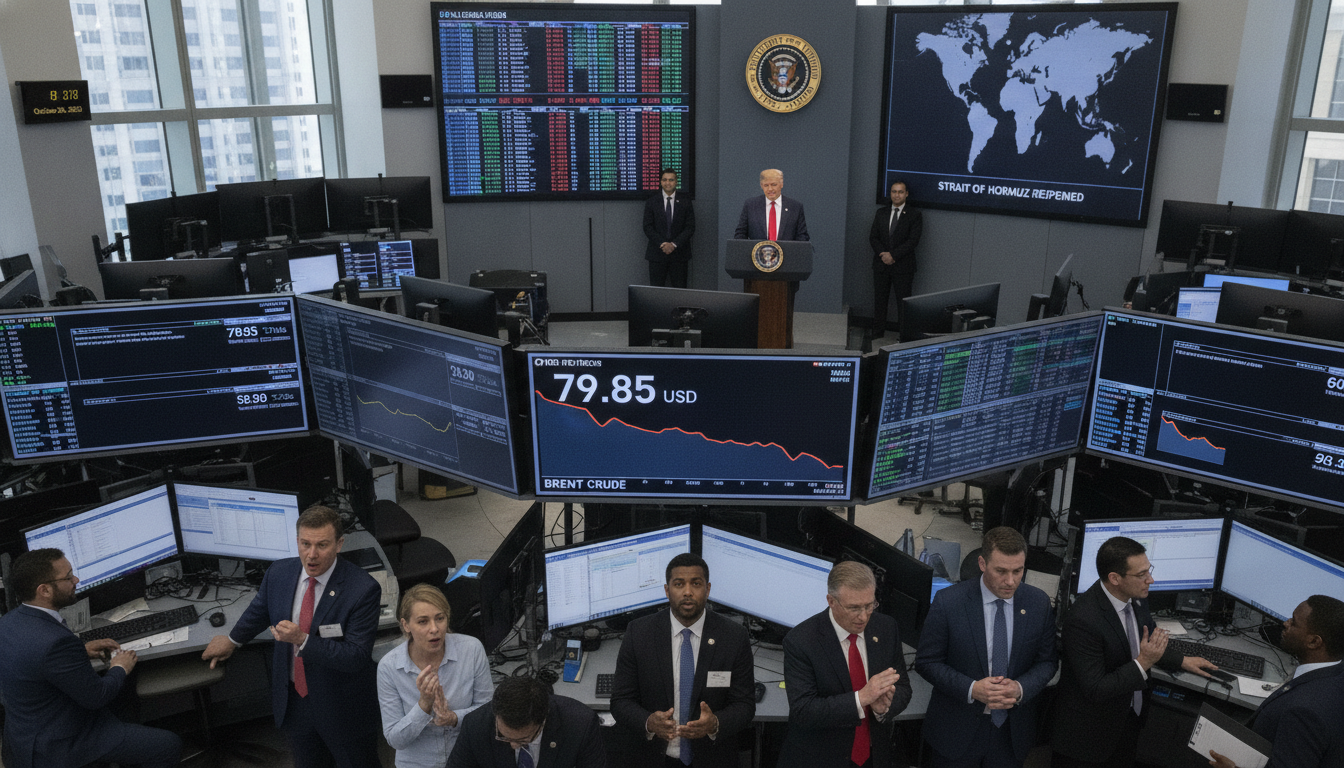
Brent crude slips below $80 as Trump says Strait of Hormuz to reopen after US‑Iran agreement
Brent crude fell under $80 as oil prices dropped following U.S. President Donald Trump’s announcement that the Strait of Hormuz will reopen after a Washington‑Tehran agreement.
Brent crude retreats below $80
Brent crude for August delivery closed sharply lower, falling to about $80.08 a barrel, a near 3.7% decline on the trading day. The slide marked the first time Brent traded below the $80 threshold since early March, according to market quotes.
Oil prices were driven primarily by a sudden shift in geopolitical risk sentiment after the U.S. presidential statement. Traders adjusted positions rapidly, unwinding risk premia that had supported higher crude benchmarks in recent months.
U.S. benchmark WTI posts larger percentage drop
West Texas Intermediate, the U.S. benchmark, registered an even steeper fall, slipping roughly 4.5% to about $77.16 per barrel. The larger percentage move in WTI reflected the broader selloff across crude futures and the sensitivity of U.S. contracts to rapid sentiment changes.
Futures volumes and volatility spiked as market participants recalibrated inventory, shipping and refinery expectations. The move highlighted how geopolitical developments can quickly translate into price swings across both international and regional benchmarks.
Trump announcement and the Strait of Hormuz timeline
President Donald Trump said on Monday that the Strait of Hormuz would be reopened in full on Friday, following a signing ceremony for an agreement between Washington and Tehran. The statement appeared to remove some of the premium that had been attached to crude prices amid earlier navigational and security concerns.
Market actors interpreted the news as a possible restoration of secure transit through one of the world’s most important oil chokepoints. That assessment prompted many traders to pare back positions that had priced in tighter supply or heightened disruption risk.
Market drivers beyond geopolitics
While the U.S. announcement was the immediate catalyst, other factors contributed to the downward pressure on oil. Global demand forecasts, inventory reports and refinery maintenance schedules also influenced pricing, according to traders following the session.
Analysts noted that when geopolitical risk falls, latent bearish factors such as ample floating storage or weaker industrial activity can reassert themselves. The interplay of supply expectations and macroeconomic indicators has kept the market sensitive to single‑day catalysts.
Implications for Gulf oil producers and shipping
Lower crude prices reduce near‑term revenues for Gulf producers that depend heavily on oil exports, though the effect depends on contract structures and hedging programs. A reopening of the Strait of Hormuz would restore a primary shipping route for oil bound for Europe and Asia, shortening transit times and cutting some logistical costs.
Shipping insurers and energy traders will still monitor security assurances and operational details tied to the reopening timetable. Even with a formal reopening, layers of verification and confidence building will be needed before the market fully prices out disruption risks.
Investor and refinery reactions
Refiners typically welcome improved shipping access, as it eases crude procurement and can reduce sourcing premiums. Investment flows into oil‑linked instruments shifted during the session, with some funds trimming exposure and others seeking to lock in short‑term gains from the rally’s reversal.
Hedging desks at producing companies may accelerate adjustments to protect fiscal plans, while sovereign wealth managers and national budgets that assume higher oil prices could face fresh review. Market participants emphasized that rapid announcements of geopolitical change can force quick rebalancing across both physical and financial markets.
Outlook and near‑term risks to oil prices
Analysts cautioned that the relief rally for crude may be fragile if the Washington‑Tehran agreement requires time to implement or if follow‑up statements create ambiguity. The timing and substance of any formal implementation steps will be watched closely by traders and policy makers alike.
Risk premiums could reappear in prices if subsequent developments raise doubts about the agreement’s durability or if other global supply disruptions emerge. For now, the market has reacted to the prospect of restored transit through the Strait of Hormuz by trimming an important element of geopolitical risk.
The developments underscore how geopolitical headlines remain a primary driver for oil prices, capable of reversing months‑long trends in a single session. Market observers said that liquidity, physical cargo flows and scheduled economic data releases will help determine whether Brent crude stabilizes above current levels or sees further downside in the coming weeks.
