
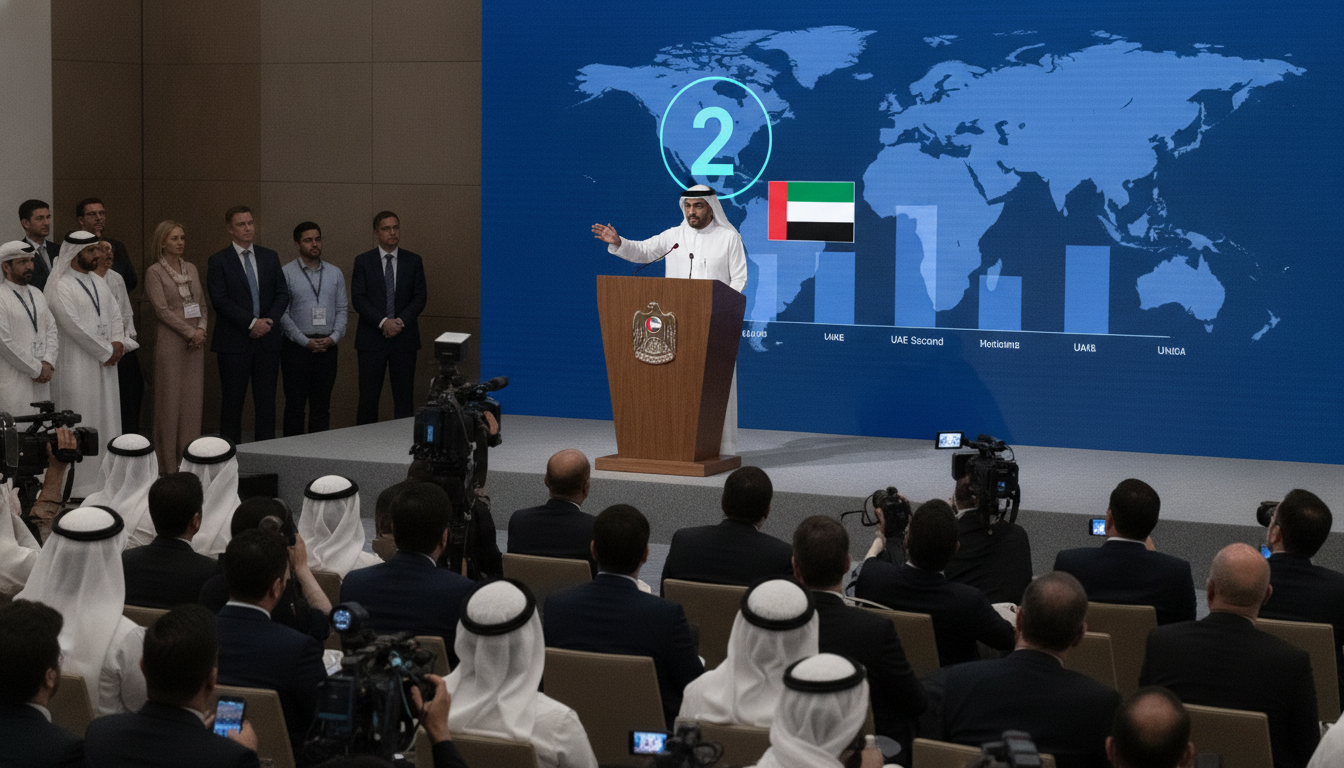
UAE ranks second in Merchandise Trade Index 2026, reinforcing its role as a global trade hub
UAE ranked second in the Merchandise Trade Index 2026, underscoring its logistics edge, competitive corporate tax regime and rising foreign direct investment.
The United Arab Emirates has climbed to second place globally in the Merchandise Trade Index 2026, according to a new report from the Dubai Multi Commodities Centre (DMCC). The index places the UAE behind only the United States and highlights the country’s role as a strategic connector for global commodity flows. The report, released at a high-level event in Dubai, points to competitive corporate taxation, advanced logistics and robust institutional frameworks as key drivers of the ranking.
DMCC report places UAE among top global commodity centres
The DMCC’s Future of Trade 2026 report, titled “Rebuilding Through Radical Transformation,” ranks the UAE second on the Merchandise Trade Index among the world’s leading commodity hubs. The analysis assessed ten major centres and measured factors that now determine where commodity trade is conducted. The ranking reflects a combination of regulatory quality, commodity resource access and trade facilitation performance.
The report notes that the UAE’s performance persisted despite mounting pressure on global energy and shipping routes, underscoring the resilience of the country’s trade ecosystem. Analysts attributed the standing to a deliberate blend of policy reforms, infrastructure investment and market-facing incentives that attract traders and producers alike.
Competitive tax landscape and institutional strengths
Among the 10 centres evaluated, the UAE was identified as offering one of the most competitive corporate tax systems, a factor that continues to influence where multinational commodity firms locate operations. The report credits that tax competitiveness with bolstering the UAE’s appeal to global capital and trade intermediaries. Beyond taxation, institutional metrics such as regulatory clarity, customs efficiency and trade facilitation scored strongly for the country.
These institutional strengths, the report argues, are increasingly decisive as firms reconfigure supply chains and seek jurisdictions that combine predictability with operational scale. The UAE’s legal and regulatory frameworks, alongside streamlined customs processes, were cited as enablers for commodity-intensive businesses to scale and diversify.
Strategic geography and logistics capacity
The index highlights the UAE’s strategic geographic position linking the Middle East with Asia, Africa and Latin America, a configuration that is shifting more trade flows toward transregional corridors. State-of-the-art port and airport infrastructure, integrated free zones and multimodal logistics capacity were central to the UAE’s high score. Logistics reliability and energy security, the report says, have become critical competitive differentiators as businesses face rising geopolitical and maritime volatility.
DMCC and private-sector operators have invested heavily in modern warehousing, cold-chain solutions and digital trade platforms, which together reduce friction for commodity transactions. This physical and digital connectivity supports faster market access for exporters and importers across multiple continents.
Capital inflows signal growing investor confidence
The Future of Trade 2026 report points to tangible capital flows as evidence that companies and investors are backing the UAE’s trade strategy. The country ranked among the top five destinations for new foreign direct investment in 2024, reflecting a shift of investment toward economies that can credibly bridge economic blocs. The flow of capital into infrastructure, commodity trading firms and logistics ventures underpins expectations for continued expansion of the UAE’s role as a trading platform.
Experts say the pattern of investment indicates that global firms now prioritize jurisdictions offering stability, market access and flexible operating environments. The UAE’s combination of policy incentives and connectivity appears to meet those investor criteria, the report concludes.
Government strategy and official perspectives
UAE officials framed the ranking as validation of long-term policy choices focused on openness, connectivity and economic diversification. Dr. Thani bin Ahmed Al Zeyoudi, Minister of State for Foreign Trade, emphasized that companies are increasingly seeking trustworthy, interconnected economies that enable resilience and access to high-growth markets. He pointed to the UAE’s long-term strategy of liberalization, infrastructure investment and expanded trade agreements as preparatory steps that positioned the country to capture new trade corridors.
Ahmed bin Sulayem, DMCC’s chief executive, said the report reflects a re-drawing of global trade maps, with growth shifting toward corridors linking the Middle East, Asia, Africa and Latin America. He noted that the UAE has spent decades building a business environment combining world-class infrastructure, capital access and deep commercial links with dynamic economies.
Implications for businesses and regional trade dynamics
The report forecasts that the UAE’s role as a trade, capital and infrastructure platform will become more pronounced as companies pursue resilience and new market entry. Firms seeking to manage disruption, tap high-growth markets and build operational redundancy are likely to increase their presence in economies that can operate across different trade systems. The DMCC analysis suggests that the UAE’s integrated model will be particularly attractive to commodity traders, logistics providers and investors focused on transregional supply chains.
As trade patterns evolve, the UAE’s ability to maintain regulatory clarity, invest in logistics and expand market access through strategic agreements will determine whether it consolidates or advances its position among global commodity centres. The report also indicates that, while global trade will remain resilient over the next two years, it will operate under a materially different model that rewards connectivity and reliability.
The Merchandise Trade Index 2026 ranking marks a strategic moment for the UAE as it seeks to translate policy gains into sustained trade and investment growth, while positioning the country at the centre of newly emergent global trade corridors.
