
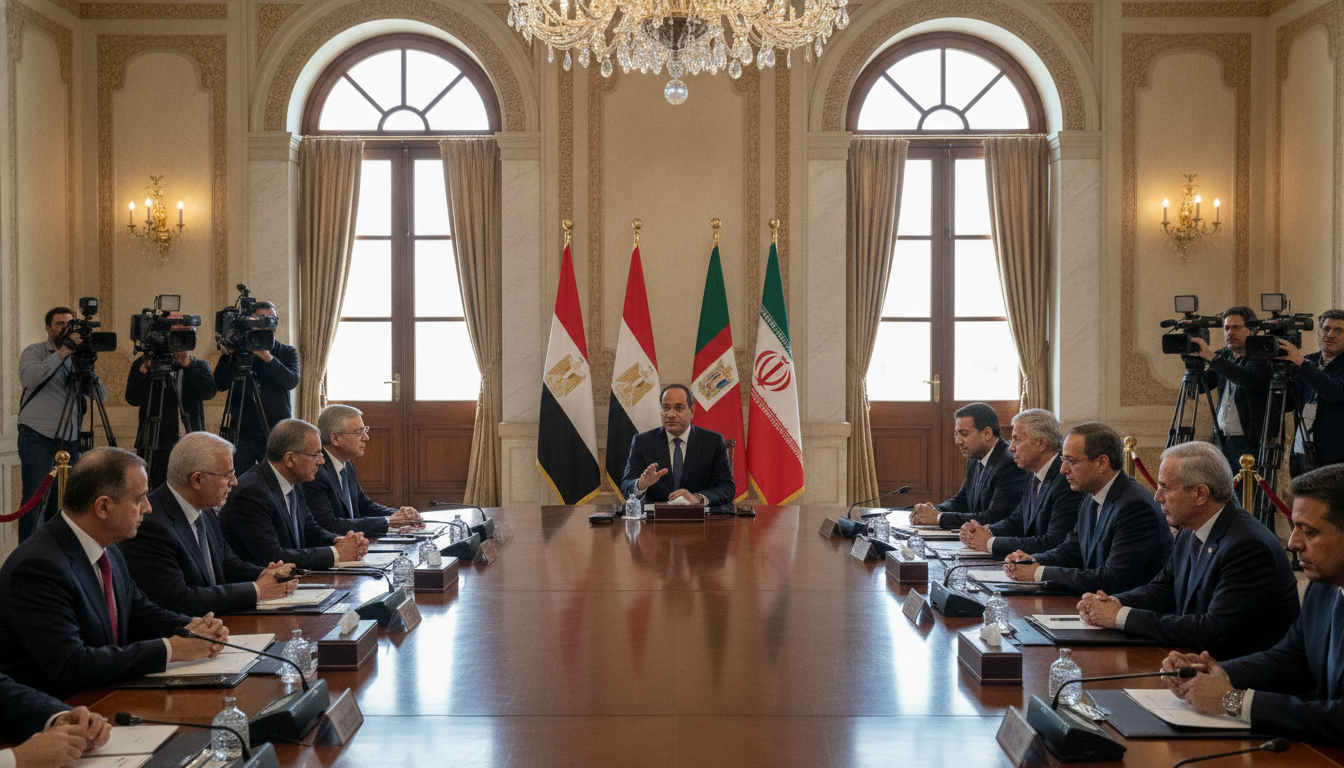
Sisi says final US-Iran memorandum must guarantee GCC security as Cairo quartet meets
Sisi says final US-Iran memorandum must guarantee GCC security and respect Arab sovereignty; Cairo quartet ministers urge institutionalised coordination.
Egyptian President Abdel Fattah al‑Sisi on Sunday urged that any final US‑Iran memorandum must explicitly guarantee the security of Gulf Cooperation Council states and other Arab countries.
He made the comments as Cairo hosted the fourth meeting of foreign ministers from the quartet comprising Egypt, Saudi Arabia, Pakistan and Turkey.
A presidential spokesman said the gathering underscored the quartet’s role as a stabilising force amid recent regional developments.
Sisi stresses Gulf security and territorial integrity
President Sisi told visiting ministers that a conclusive US‑Iran agreement must take into account the security concerns and sovereign rights of GCC members and neighbouring Arab states.
He emphasised the importance of clear safeguards for territorial integrity and the need for assurances that the deal will not undermine regional stability.
The presidency framed the request as essential to ensuring that diplomatic progress between Washington and Tehran benefits, rather than threatens, Gulf security.
Quartet ministers welcome Cairo meeting and coordination
Foreign ministers from Egypt, Saudi Arabia, Pakistan and Turkey described their fourth meeting in Cairo as constructive and timely.
They expressed appreciation for President Sisi’s reception and affirmed their shared view that the quartet should deepen consultation on regional crises.
Ministers agreed that the existing coordination should evolve into a more formal institutional framework capable of producing durable policy responses.
Egypt highlights Pakistan’s mediation role
The presidential statement singled out Pakistan for its active role in narrowing differences and facilitating dialogue between the United States and Iran.
Egypt welcomed Islamabad’s mediation efforts as a positive contribution to the negotiation track and urged continued support for bridging remaining gaps.
Sisi reiterated that sustained, multilateral engagement will be necessary to shepherd talks from memorandum to final comprehensive agreement.
Palestinian issue linked to wider regional stability
President Sisi reiterated that a just and comprehensive solution to the Palestinian question remains a central condition for achieving lasting stability across the Middle East.
He said progress on the Palestinian file is inseparable from broader regional security, and urged international partners to prioritise steps that advance a viable political settlement.
The ministers echoed this stance, stressing that efforts to normalise relations or resolve wider tensions should not sideline the Palestinian cause.
Path to implementation and institutional development
Officials at the meeting agreed on the need to move from ad hoc coordination toward an institutionalised quartet mechanism with clear mandates and follow‑up systems.
They discussed practical measures to support implementation of the US‑Iran memorandum, monitor its effects on Gulf security, and coordinate diplomatic responses if issues arise.
Egypt signalled its readiness to continue working closely with Saudi Arabia, Pakistan, Turkey and other regional partners to ensure the memorandum’s commitments are realised in ways that protect Arab interests.
The ministers also committed to maintaining regular consultations and to convening additional meetings as the US‑Iran negotiation process advances.
Sisi called for persistence in diplomatic efforts aimed at translating the current memorandum into a final, sustainable agreement that addresses proliferation risks, regional proxies, and maritime security.
The Cairo meeting concluded with renewed pledges to synchronise positions and to intensify cooperation on the political and security dimensions tied to any US‑Iran accord.
