
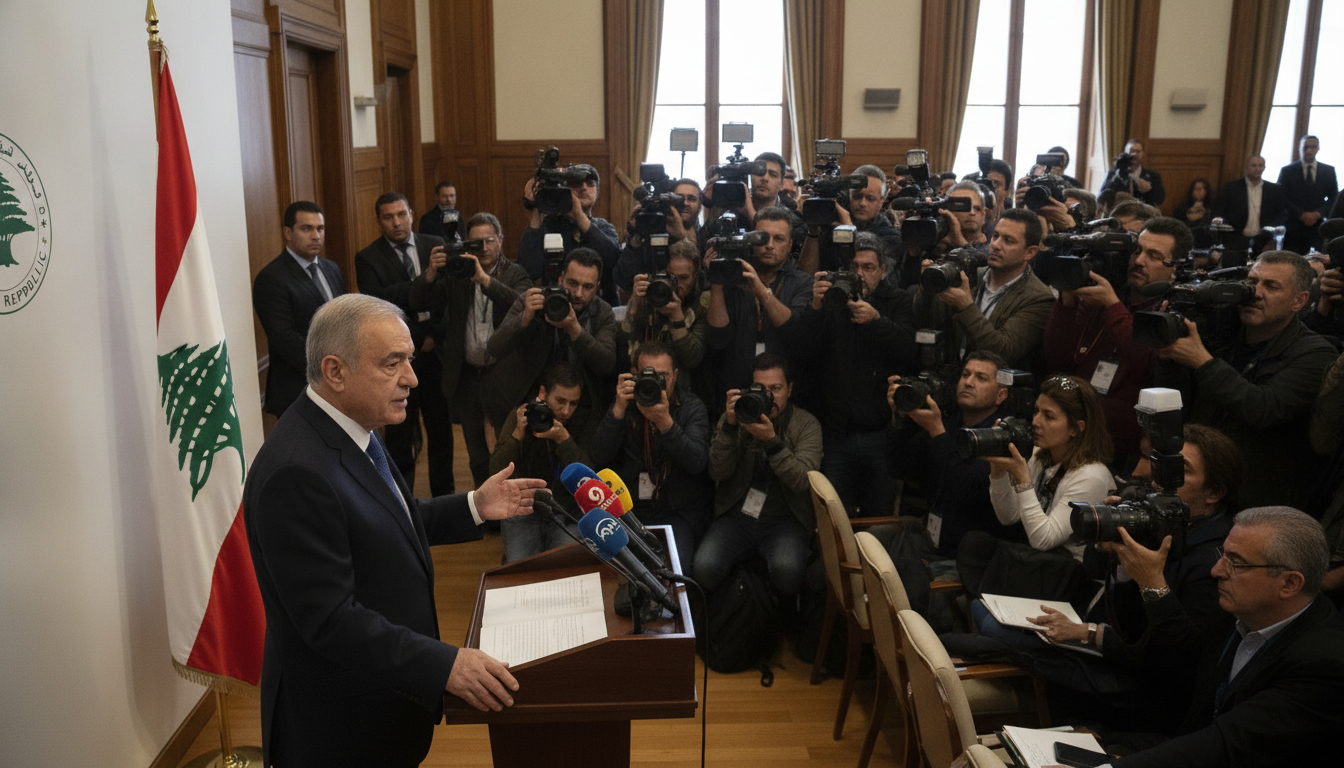
President Aoun urges critics to propose alternatives to Lebanon-Israel framework agreement
Aoun urges critics to offer alternatives to the Lebanon-Israel framework agreement, defends Lebanon’s sovereignty and calls for institutional debate peacefully
President Joseph Aoun on Wednesday urged opponents of the Lebanon-Israel framework agreement to present viable alternatives, defending the pact as a testable diplomatic path that does not abandon Lebanon’s core principles. He invited political and civil bodies to debate the proposal within institutions rather than in the streets, and asked for a chance to implement the framework to determine its practical outcome.
Aoun asks opponents to present alternatives
President Aoun told visiting delegations from the Beirut and North Bar Associations, and economic bodies, that critics who reject the Lebanon-Israel framework agreement should put forward a clear substitute. He emphasized that discussion must take place inside institutions and that public demonstrations should not be used to delegitimize the process.
He framed the call as an appeal for constructive engagement, saying political disagreement is acceptable but deliberate distortion of facts is not. Aoun warned against portraying the framework as surrender, urging rivals to engage with the text and propose concrete options.
Request for a trial period to test the framework
Aoun proposed a practical approach: give the framework a defined opportunity to be tested in implementation before declaring it a failure. He argued that if the framework produces results it will have achieved its objective, and if not, it will collapse on its own merits without being prematurely dismissed.
The president posed a rhetorical question to critics who demand immediate rejection, asking why opponents insist on treating the framework as nonexistent before its terms are applied. He said Lebanon must weigh negotiation against the historical record of conflict, and he reiterated his preference for testing diplomacy over returning to warfare.
Framework signed in Washington includes withdrawal and returns
Aoun defended the content of the Washington framework, stressing that its provisions address Israeli withdrawal, the return of displaced persons, the release of prisoners and the repatriation of remains. He underscored that the document should be understood as an overarching framework rather than a finalized treaty.
The president said some critics have mischaracterized the text as legitimising occupation, a claim he rejected. He noted that the framework reiterates the requirement that state authority be extended across Lebanon and that foreign forces be off Lebanese soil as part of any acceptable outcome.
Disarmament debate tied to Taif Agreement and constitution
Responding to objections that the framework calls for disarmament, Aoun cited existing legal and constitutional references, including the Taif Agreement and provisions that call for the monopoly of force by the state. He argued that questions about weapons and security policy are already part of Lebanon’s constitutional and political framework and that the current text points toward a subsequent security accord to address details.
He said the framework establishes rules that would be fleshed out in a follow-on security arrangement, and that such a contract would address technical and operational matters. Aoun framed this sequence as a legal and procedural path rather than an abrupt imposition of terms.
Sovereignty and state authority emphasized as priorities
The president reiterated that true sovereignty is expressed through independent state decisions that extend authority across the national territory. He stressed that any valid agreement must lead to the removal of foreign presence from Lebanese land and the consolidation of legitimate state institutions.
Aoun described sovereignty as beginning with the decision to negotiate and with the subsequent enforcement of state authority, including ensuring that no armed groups other than the armed forces operate freely. He rejected efforts to fragment the issue into pieces tailored to particular political agendas.
No plan to dismiss army commanders, president says
Addressing rumours circulating about planned dismissals within the armed forces, Aoun denied any intent to remove the army commander or senior security chiefs, with the exception of the director general of General Security. He praised the military and security agencies for their role and warned that such rumours are intended to weaken institutional trust.
The president urged restraint and cautioned against stories aimed at undermining the armed forces’ standing. He said bolstering the security establishment must remain a priority while political debates proceed in the proper forums.
President Aoun’s remarks seek to shift the debate from street-based confrontation toward institutional exchange and technical scrutiny of the Lebanon-Israel framework agreement. He invited opponents to present concrete proposals and signalled that the administration will pursue a step-by-step process that pairs diplomatic negotiation with measures to secure state sovereignty, while protecting the integrity of Lebanon’s security institutions.
