
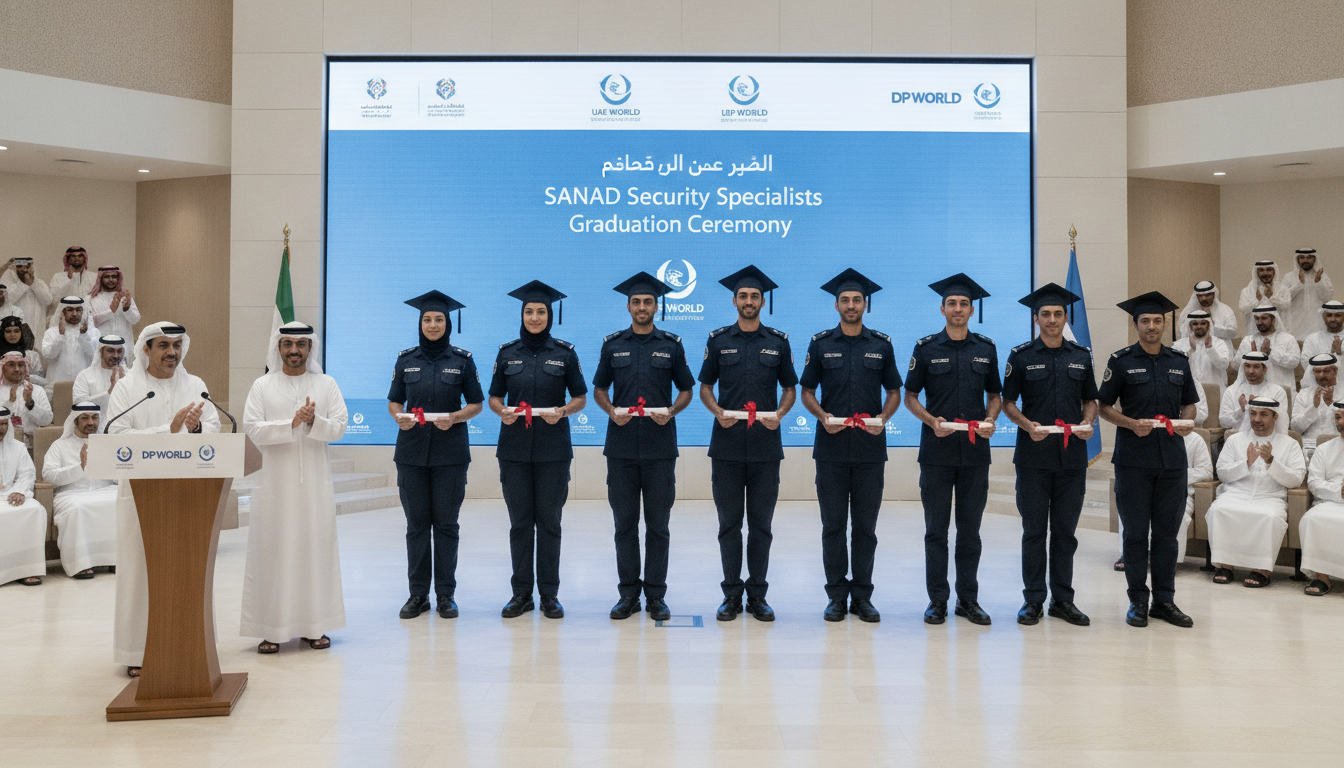
Sanad programme: 10 Emirati security specialists graduate in partnership with DP World
Ten Emiratis completed the Sanad programme, an 18-month maritime security training by the Ports, Customs and Free Zone Corporation and DP World, strengthening UAE port resilience and skills.
The Ports, Customs and Free Zone Corporation and DP World celebrated the graduation of 10 Emirati cadres from the Sanad programme, a specialised security and operational development initiative. The cohort, split evenly between the two organisations, completed an intensive 18-month curriculum designed to prepare Emirati professionals for roles in maritime and logistics security. Programme leaders said the graduates met all requirements, achieving a 100% completion rate across the training period.
Ten Emiratis complete specialised Sanad security training
The graduating class comprised five employees from the Ports, Customs and Free Zone Corporation and five from DP World. Participants completed technical, regulatory and operational modules aimed at enhancing capabilities in port security, customs oversight and critical infrastructure protection. Organisers highlighted the cohort’s discipline and adaptability throughout the sustained professional development timeline.
Partnership model between national authority and DP World
The Sanad programme is presented as a collaboration between a national regulatory body and a global ports operator to align public and private security priorities. Officials emphasised the importance of integrating academic, security and industry expertise to produce practitioners familiar with both regulatory frameworks and commercial port operations. The partnership is intended to create a pipeline of Emirati specialists who understand the full lifecycle of port, terminal and logistics security.
Structure and content of the 18-month programme
Sanad’s 18-month schedule combined classroom instruction, on-the-job training and scenario-based exercises tailored to maritime environments. Curriculum elements covered regulatory compliance, emergency response, cargo and supply chain security, and risk assessment methodologies. Programme managers said the design ensured participants attained practical competencies as well as strategic understanding of resilience and continuity planning.
Leadership comments underline strategic priorities
Abdullah bin Dumaithan, president of the Ports, Customs and Free Zone Corporation, described the training as a strategic investment in national capacity to protect critical infrastructure. He said preparing Emirati talent to secure ports, trade and logistics networks is a priority for sustaining economic continuity. Issa Kazim, chairman of DP World, noted the programme reflects the value of coordinated efforts across institutions and academia to develop a deep pool of local security expertise.
Immediate operational benefits for UAE ports and logistics
Graduates are expected to assume roles that strengthen on-the-ground security posture and oversight within terminals and logistics hubs. Organisers said the cohort’s mix of regulatory and operator backgrounds will facilitate smoother coordination during inspections, incident response and cross-agency operations. The programme also aims to reduce reliance on external expertise by embedding specialised knowledge within national teams.
Scaling workforce development and next steps
Officials indicated that Sanad is part of a broader push to institutionalise specialised training pathways for Emirati nationals across the logistics and maritime sectors. Plans include monitoring graduate performance in operational assignments and refining future curricula based on evolving threat landscapes and technological advances. The partnering organisations signalled intent to continue the programme, with potential expansion to include additional cohorts and modules focused on cyber-physical resilience and advanced risk analytics.
The Sanad programme’s first graduating cohort represents a measurable step toward bolstering UAE capacity in maritime and port security, marrying regulatory insight with operational know-how. As the graduates transition into roles across ports and free zones, stakeholders will assess outcomes to shape subsequent training cycles and to ensure the nation’s logistics infrastructure remains secure and resilient.
