
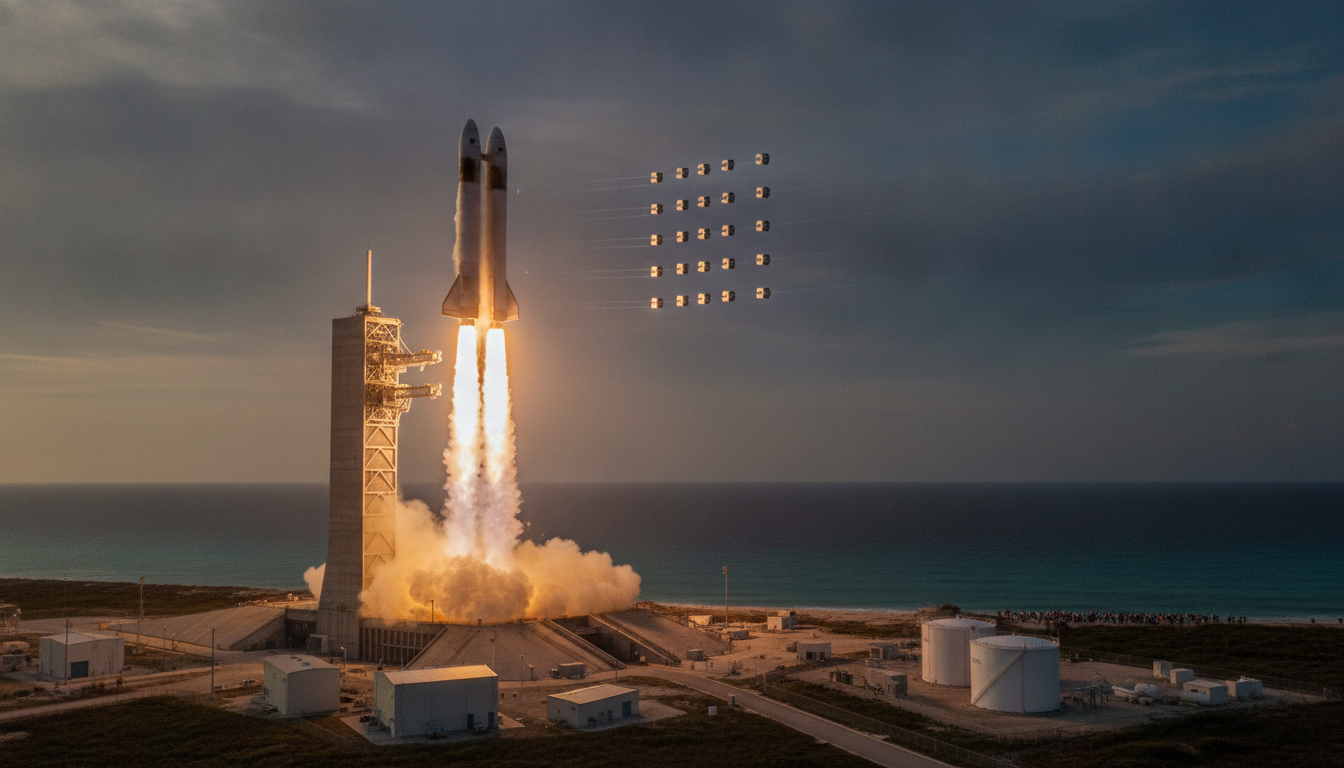
SpaceX Starship launch from Texas carries first 20 Starlink Gen3 satellites in 13th test flight
SpaceX Starship launch from Texas carried 20 Starlink Gen3 satellites in a key test, bringing the company closer to routine global internet service this year.
SpaceX’s mammoth Starship rocket lifted off from its Starbase facility in Texas on Sunday in the company’s thirteenth experimental flight, carrying the first 20 third‑generation Starlink satellites toward suborbital space. The SpaceX Starship launch, standing roughly 122 metres tall, marked a pivotal test for both the vehicle and the upgraded Starlink payloads. Company officials said the Gen3 satellites briefly linked with Starlink’s wider network, a constellation the firm has described as comprising roughly 10,000 satellites.
Thirteenth test flight from Texas
The rocket departed from SpaceX’s Starbase complex in the early hours, executing a flight profile designed to validate ascent, separation and early payload deployment procedures. Observers noted the vehicle’s scale and the precision of the launch sequence as engineers monitored telemetry from multiple ground stations. This mission was explicitly billed as an experimental step toward establishing routine operations before the end of the calendar year.
The flight carried no crew and focused on hardware and system checks rather than long‑duration orbital service. Engineers will analyze reentry and staging data intensively in the days following the launch to assess any anomalies and refine future test plans. SpaceX has emphasized iterative testing as central to Starship’s development pathway.
Payload and Starlink Gen3 capabilities
The primary payload consisted of 20 third‑generation Starlink satellites, which SpaceX describes as offering higher performance than earlier models. These Gen3 units are designed to deliver expanded bandwidth and wider frequency ranges, enabling faster download and upload speeds for end users. The satellites also incorporate updated communications hardware intended to increase throughput and resilience in congested orbital lanes.
SpaceX has been upgrading its Starlink designs to support growing demand for low‑latency broadband services globally. The Gen3 satellites represent a step toward denser, higher‑capacity constellations that the company says will underpin commercial and consumer service expansion. Engineers will monitor the health and signal quality of these satellites as they complete on‑orbit commissioning.
Flight profile and short network contact
According to the mission plan, the Starship deployed its Starlink payloads into a suborbital insertion rather than a sustained orbital trajectory for this test campaign. Following separation, the new satellites briefly established connections with the company’s operational network to demonstrate basic communications capability. That transient contact allowed engineers to confirm initial telemetry and payload function before the satellites’ planned decommissioning or transfer to later testing regimes.
The short‑lived linkup also provided a real‑world data point on how Gen3 hardware performs during the immediate post‑deployment phase. SpaceX will compare those telemetry sets to simulated models to validate antenna alignment, power profiles and signal acquisition times. These metrics are critical for scheduling future launches and scaling up Starlink service.
Starlink constellation context
SpaceX has built Starlink into one of the largest satellite constellations ever deployed, with the company citing plans and numbers that have been described publicly in various filings and statements. The firm’s broader ambitions include tens of thousands of satellites to achieve ubiquitous low‑latency coverage and to support a mix of consumer, enterprise and government customers. The introduction of Gen3 units is a part of that longer‑term upgrade path.
The company has been incrementally improving satellite design and launch cadence to boost capacity while managing orbital traffic and regulatory requirements. Each incremental generation is intended to increase per‑satellite throughput so the overall constellation can support more users and higher data rates without proportionally larger launch numbers.
Service timeline and company goals
SpaceX has signalled an aim to move from testing to routine Starship operations as soon as it can demonstrate repeatable performance. The company has publicly targeted the end of the current year as a timeframe for initiating more regular service launches, contingent on successful test outcomes and regulatory clearances. Achieving a reliable launch cadence with Starship is central to the company’s plan to reduce costs and increase payload mass to orbit.
For Starlink, routine deployment of Gen3 satellites would accelerate capacity improvements and enable faster rollouts of enhanced service plans. SpaceX’s commercial timetable remains tied to technical milestones, and company engineers must demonstrate consistent results across multiple test flights before scaling to frequent operational launches.
Regional and regulatory implications
Large test flights and expanding satellite fleets raise questions for regulators and regional operators who monitor frequency use, orbital debris risk and airspace coordination. Authorities in the United Arab Emirates and other countries have shown interest in how global broadband constellations might complement national connectivity goals. Satellite operators and national regulators continue to engage on spectrum management, licensing and coordination to avoid interference and ensure safe space operations.
SpaceX will need to continue working with international aviation and space agencies as Starship tests progress, especially where overflight or reentry corridors intersect populated regions. Clear communication and transparent data sharing on test outcomes will likely remain a priority for both the company and regulators.
The SpaceX Starship launch from Texas demonstrated progress on multiple fronts: a large launch vehicle executing complex flight tasks, the deployment of next‑generation Starlink hardware, and a paced move toward routine service ambitions. Engineers will spend the coming days poring over flight and communications data to shape the next steps in the Starship and Starlink programmes.
