
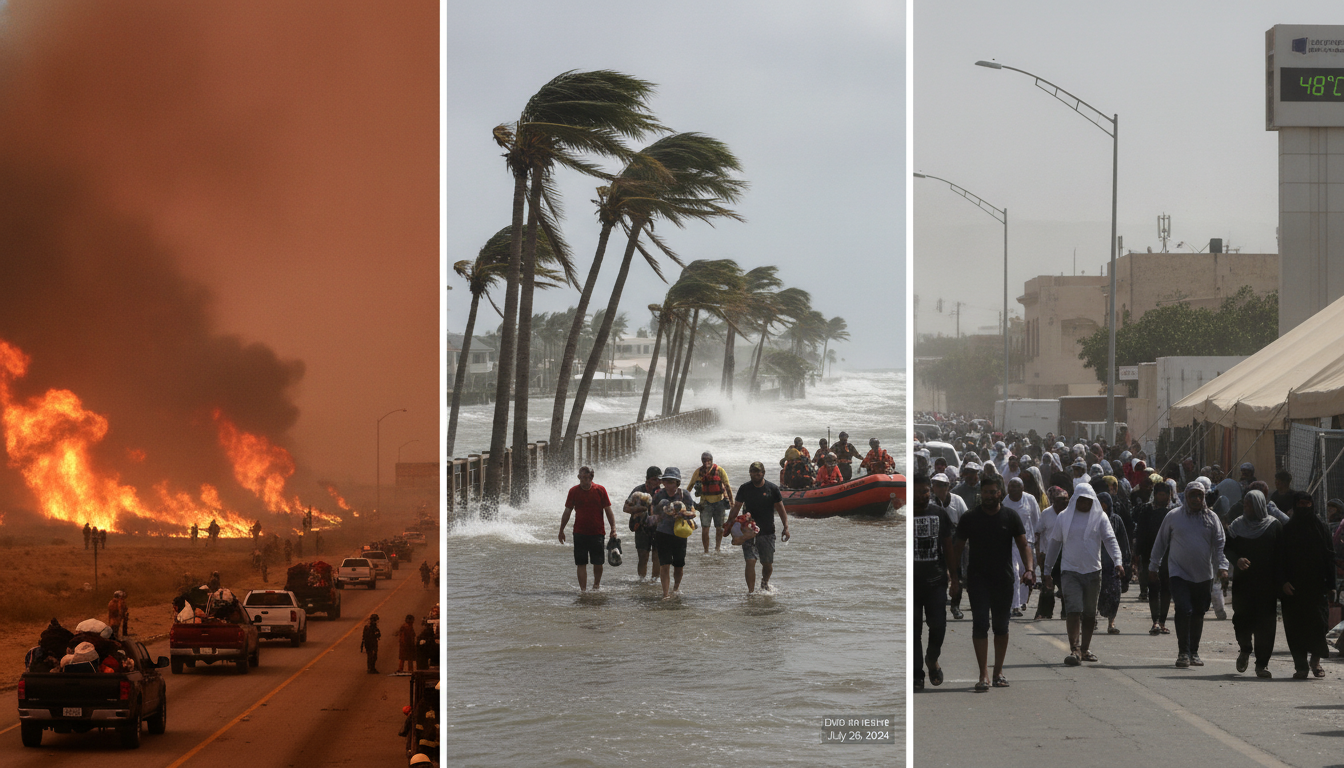
Global extreme weather: heatwaves, wildfires and storms trigger mass evacuations
Extreme weather strikes globally: record heat in Japan and South Korea, wildfires displace 260,000 in Spain and France, Typhoon Noul batters southern China.
Japan and parts of East Asia, southern Europe and the Pacific coast of North America faced synchronized extreme weather events, with heatwaves, fires and powerful tropical storms forcing large-scale evacuations and travel disruption. Meteorological agencies across the affected regions issued high-level warnings as authorities mobilised emergency responders, military assets and temporary shelters to protect residents and holidaymakers. The unfolding conditions underscore the wide geographic reach of this wave of extreme weather and the strain on local emergency systems.
Japan records fifth consecutive 40°C day
Japan’s Meteorological Agency reported sustained extreme heat across central regions, with temperatures exceeding 40°C for a fifth straight day. Six cities in central Japan, including all four Tokai prefectures—Shizuoka, Gifu, Mie and Aichi—recorded 40°C or above, marking the longest sequence of such highs since comparable records began in 2010.
The agency noted that Kofu in Yamanashi Prefecture reached 40°C, becoming the first area outside Tokai to log a “kokushobi” day under a heat classification introduced in April to warn the public of life-threatening heat. Authorities continued issuing advisories for vulnerable groups and urged workplaces and municipalities to implement heat-mitigation measures.
South Korea issues high-heat warnings in the southeast
South Korea’s weather service warned of intense heat in the southeast, with Daegu and surrounding areas under heightened alerts. Temperatures approached the upper 30s Celsius in cities such as Gyeongju, Daegu and Pohang, prompting officials to raise the level of public heat warnings where heat indices and sustained daytime highs met national thresholds.
Korean meteorologists said the highest heat alert is issued when daily maximum temperatures reach or exceed 39°C in areas that have already seen heat indices of 35°C or more for at least two consecutive days. Local authorities activated cooling centres and advised residents to limit outdoor exertion during peak hours.
Wildfires force 260,000 to evacuate in Spain and France
Wildfires in southwestern Europe triggered one of the largest civilian evacuations in recent French peacetime history and heavy displacement in Spain. French officials said roughly 200,000 people were ordered to leave homes or holiday sites near Bordeaux and other affected zones, while Spanish authorities reported about 60,000 people evacuated from areas to the west of Madrid.
Fire crews battled blazes that consumed tens of thousands of hectares west of the Spanish capital and spread rapidly amid dry conditions. France deployed some 1,500 soldiers to support firefighting operations and used an A400M military transport aircraft, adapted to drop water and fire-retardant loads, in an unprecedented effort to slow the blazes’ advance.
Typhoon Noul prompts mass evacuations in southern China and Hong Kong
Typhoon Noul made landfall along the Guangdong coast, prompting Chinese authorities to evacuate more than 340,000 residents and suspend rail services in several southern provinces. The National Meteorological Centre of China issued red warnings for heavy rains as the system moved ashore near Huizhou’s Huiyang district with strong winds and torrential precipitation.
Hong Kong elevated its storm signal to the third-highest level and opened dozens of shelters while airlines and airports adjusted schedules. Shenzhen’s airport and other regional transport hubs reported cancelled and delayed flights, and local governments warned of coastal flooding and landslides as wind gusts were expected to reach hazardous speeds when the system moved inland.
Hurricane Genevieve strengthens off Mexico’s Pacific coast
In the eastern Pacific, former Tropical Storm Genevieve intensified into Hurricane Genevieve as it tracked parallel to Mexico’s Pacific shoreline. The U.S. National Hurricane Center classified the system as a Category 1 hurricane, with sustained winds near 80 miles per hour, and cautioned that heavy surf and rain bands could affect coastal areas even if the storm remained primarily offshore.
Mexican authorities and coastal communities monitored the hurricane’s progress for potential impacts on maritime operations and regional ports. Forecasts indicated the system would remain over open waters for the near term, but forecasters warned of swells and localized heavy rainfall along the coast.
Transport disruption and emergency mobilisation across affected regions
Across the affected countries, transport networks experienced widespread disruption as officials prioritised safety and evacuation logistics. Airports in Hong Kong and Shenzhen reported dozens of cancellations and hundreds of delays, while rail services in southern China were halted as precautionary measures ahead of the typhoon’s landfall.
In Europe, road closures and evacuations around wildfire zones complicated relief efforts, and Spanish authorities reported large tracts of burned land and ongoing containment operations. Emergency services in France and Spain coordinated with military units to support evacuations and aerial firefighting, while hospitals and social services prepared to receive vulnerable evacuees.
Global authorities and local agencies are maintaining constant updates as situations evolve, and residents in the affected regions are urged to follow official guidance and avoid non-essential travel. Emergency shelters, cooling centres and temporary relief points remain active where large-scale displacement has occurred, with relief organisations focusing on immediate needs such as water, medical care and safe accommodation.
The convergence of heatwaves, wildfires and powerful tropical storms within a compressed timeframe has tested preparedness systems across multiple continents. Meteorological agencies continue to issue warnings and advisories, and officials emphasise the importance of heeding evacuation orders and staying informed through local channels as response operations proceed.
